RankRizz

Stoichiometry, limiting reagent and percentage yield — JEE Main Previous Year Questions

Stoichiometry, limiting reagent and percentage yield has been asked 71 times in JEE Main, in 15 different years between 2007 and 2026, and in all of the last five exam years (2022–2026), 41 questions in all. That is 28% of Some Basic Concepts of Chemistry, one of its three most-asked topics. Last asked in JEE Main 05 Apr 2026, Shift 2. 33 are multiple choice and 38 numerical-value; 44 easy and 23 medium by our difficulty labels. All of them are below, newest first, free to read.

Questions

71

Years asked

15

Since

2007

Of the chapter

28%

Every Stoichiometry, limiting reagent and percentage yield question

41–60 OF 71 · NEWEST FIRST

JEE MAIN 2022 · 24 JUN S2Stoichiometry, limiting reagent and percentage yield

120120 g of an organic compound which contains only carbon and hydrogen on complete combustion gives 330330 g of CO2CO_2 and 270270 g of water. The percentage of carbon and hydrogen in the organic compound are respectively

  1. A

    25 and 75

  2. B

    40 and 60

  3. C

    60 and 40

  4. D

    75 and 25

JEE MAIN 2021 · 27 AUG S2Stoichiometry, limiting reagent and percentage yield

100 g of propane is completely reacted with 1000 g of oxygen. The mole fraction of carbon dioxide in the resulting mixture is x×10−2x \times 10^{-2}. The value of xx is _________. (Nearest integer)

JEE MAIN 2021 · 27 JUL S2Stoichiometry, limiting reagent and percentage yield

2SO2(g)+O2(g)→2SO3(g)2SO_2(g) + O_2(g) \rightarrow 2SO_3(g)
The above reaction is carried out in a vessel starting with partial pressure PSO2=250P_{SO_2} = 250 m bar, PO2=750P_{O_2} = 750 m bar and PSO3=0P_{SO_3} = 0 bar. When the reaction is complete, the total pressure in the reaction vessel is _________ m bar. (Round off to the nearest integer).

JEE MAIN 2021 · 25 JUL S1Stoichiometry, limiting reagent and percentage yield

Consider the complete combustion of butane, the amount of butane utilized to produce 72.0 g of water is ___ ×10−1\times 10^{-1} g. (in nearest integer)

JEE MAIN 2021 · 22 JUL S1Stoichiometry, limiting reagent and percentage yield

Methylation of 10 g of benzene gave 9.2 g of toluene. Calculate the percentage yield of toluene (Nearest integer)

JEE MAIN 2021 · 20 JUL S1Stoichiometry, limiting reagent and percentage yield

250 mL of 0.5M NaOH was added to 500 mL of 1M HCl. The number of unreacted HCl molecules in the solution is p×1021\times 10^{21}. Find out p.
(Nearest integer) (NA_A = 6.022 ×10²³\times 10^{23})

JEE MAIN 2021 · 17 MAR S2Stoichiometry, limiting reagent and percentage yield

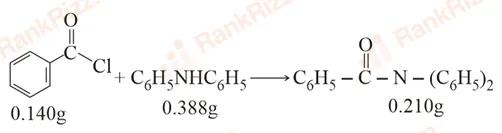
Consider the above reaction. The percentage yield of amide product is ________ (Round off to the Nearest Integer).
(Given: Atomic mass: C: 12.0u, H: 1.0u, N: 14.0u, O: 16.0u, Cl: 35.5u)

Figure for JEE Main 2021 Chemistry question on Stoichiometry, limiting reagent and percentage yield
JEE MAIN 2021 · 16 MAR S1Stoichiometry, limiting reagent and percentage yield

Complete combustion of 750 g of an organic compound provides 420 g of CO2CO_2 and 210 g of H2OH_2O. The percentage composition of carbon and hydrogen in organic compound is 15.3 and ________ respectively. (Round off to the Nearest Integer)

JEE MAIN 2021 · 16 MAR S2Stoichiometry, limiting reagent and percentage yield

When 35 mL of 0.15 M lead nitrate solution is mixed with 20 mL of 0.12 M chromic sulphate solution, ________ ×10−5\times 10^{-5} moles of lead sulphate precipitate out. (Round off to the Nearest Integer).

JEE MAIN 2021 · 25 FEB S1Stoichiometry, limiting reagent and percentage yield

Complete combustion of 1.80 g of an oxygen containing compound (CxHyOzC_xH_yO_z) gave 2.64 g of CO2CO_2 and 1.08 g of H2OH_2O. The percentage of oxygen in the organic compound is:

  1. A

    53.33

  2. B

    50.33

  3. C

    51.63

  4. D

    63.53

JEE MAIN 2021 · 24 FEB S2Stoichiometry, limiting reagent and percentage yield

The formula of a gaseous hydrocarbon which requires 6 times of its own volume of O2O_2 for complete oxidation and produces 4 times its own volume of CO2CO_2 is CxHyC_xH_y. The value of y is ______.

JEE MAIN 2021 · 24 FEB S2Stoichiometry, limiting reagent and percentage yield

1.86 g of aniline completely reacts to form acetanilide. 10% of the product is lost during purification. Amount of acetanilide obtained after purification (in g) is ______ ×10−2\times 10^{-2}.

JEE MAIN 2020 · 04 SEP S1Stoichiometry, limiting reagent and percentage yield

The mass of ammonia in grams produced when 2.8 kg of dinitrogen quantitatively reacts with 1 kg of dihydrogen is __________

JEE MAIN 2020 · 02 SEP S2Stoichiometry, limiting reagent and percentage yield

The ratio of the mass percentages of 'C & H' and 'C & O' of a saturated acyclic organic compound 'X' are 4 : 1 and 3 : 4 respectively. Then, the moles of oxygen gas required for complete combustion of two moles of organic compound 'X' is ___________.

JEE MAIN 2020 · 08 JAN S1Stoichiometry, limiting reagent and percentage yield

The volume (in mL) of 0.125 M AgNO3_3 required to quantitatively precipitate chloride ions in 0.3 g of [Co(NH3_3)6_6]Cl3_3 is __________.
M[Co(NH3_3)6_6]Cl3_3 = 267.46 g/mol
M AgNO3_3 = 169.87 g/mol
Report the nearest integer as the answer.

JEE MAIN 2020 · 08 JAN S2Stoichiometry, limiting reagent and percentage yield

NaClO3_3 is used, even in spacecrafts, to produce O2_2. The daily consumption of pure O2_2 by a person in 492 L at 1 atm, 300K. How much amount of NaClO3_3, in grams, is required to produce O2_2 for the daily consumption of a person at 1 atm, 300K?
NaClO3_3(s) + Fe(s) →\rightarrow O2_2(g) + NaCl(s) + FeO(s)
R = 0.082 L atm mol−1^{-1} K−1^{-1}

JEE MAIN 2020 · 07 JAN S2Stoichiometry, limiting reagent and percentage yield

The ammonia (NH3_3) released on quantitative reaction of 0.6 g urea (NH2_2CONH2_2) with sodium hydroxide (NaOH) can be neutralized by

  1. A

    200 ml of 0.4 N HCl

  2. B

    200 ml of 0.2 N HCl

  3. C

    100 ml of 0.2 N HCl

  4. D

    100 ml of 0.1 N HCl

JEE MAIN 2019 · 10 APR S1Stoichiometry, limiting reagent and percentage yield

At 300 K and 1 atmospheric pressure, 10 mL of a hydrocarbon required 55 mL of O2_2 for complete combustion, and 40 mL of CO2_2 is formed. The formula of the hydrocarbon is:

  1. A

    C4_4H8_8

  2. B

    C4_4H10_{10}

  3. C

    C4_4H6_6

  4. D

    C4_4H7_7Cl

JEE MAIN 2019 · 09 APR S1Stoichiometry, limiting reagent and percentage yield

For a reaction, N2_2(g) + 3H2_2(g) →\rightarrow 2NH3_3(g), identify di-hydrogen (H2_2) as a limiting reagent in the following reaction mixtures.

  1. A

    28 g of N2_2 + 6 g of H2_2

  2. B

    35 g of N2_2 + 8 g of H2_2

  3. C

    56 g of N2_2 + 10 g of H2_2

  4. D

    14 g of N2_2 + 4 g of H2_2

JEE MAIN 2019 · 08 APR S2Stoichiometry, limiting reagent and percentage yield

The percentage composition of carbon by mole in methane is:

  1. A

    75 %

  2. B

    20 %

  3. C

    80 %

  4. D

    25 %