JEE MAIN 2024 · 27 JAN S1Stoichiometry, limiting reagent and percentage yield
Mass of methane required to produce g of CO after complete combustion is _______ g. (Given Molar mass in g mol, )
Stoichiometry, limiting reagent and percentage yield has been asked 71 times in JEE Main, in 15 different years between 2007 and 2026, and in all of the last five exam years (2022–2026), 41 questions in all. That is 28% of Some Basic Concepts of Chemistry, one of its three most-asked topics. Last asked in JEE Main 05 Apr 2026, Shift 2. 33 are multiple choice and 38 numerical-value; 44 easy and 23 medium by our difficulty labels. All of them are below, newest first, free to read.
Questions
71
Years asked
15
Since
2007
Of the chapter
28%
21–40 OF 71 · NEWEST FIRST
Mass of methane required to produce g of CO after complete combustion is _______ g. (Given Molar mass in g mol, )
9.3 g of aniline is subjected to reaction with excess of acetic anhydride to prepare acetanilide. The mass of acetanilide produced if the reaction is 100% completed is _____ g.
(Given molar mass in g mol: N = 14, O = 16, C = 12, H = 1)
An organic compound gives g of CO and g of HO on complete combustion. If the % of carbon is then the % of hydrogen is _____ . (Nearest integer)
The volume of hydrogen liberated at STP by treating 2.4 g of magnesium with excess of hydrochloric acid is _______ L. Given Molar volume of gas is 22.4 L at STP. Molar mass of magnesium is 24 g mol
When a hydrocarbon A undergoes complete combustion it requires 11 equivalents of oxygen and produces 4 equivalents of water. What is the molecular formula of A?
CH
CH
CH
CH
Assume carbon burns according to following equation:
when 12 g carbon is burnt in 48 g of oxygen, the volume of carbon monoxide produced is ______ L at STP [nearest integer]
[Given: Assume CO as ideal gas, Mass of C is 12 g mol, mass of O is 16 g mol and molar volume of an ideal gas at STP is 22.7 L mol]
When a hydrocarbon A undergoes combustion in the presence of air, it requires equivalents of oxygen and produces equivalents of water. What is the molecular formula of A?
CH
CH
CH
CH
Consider the reaction: . If 20 g of dinitrogen reacts with 5 g of dihydrogen, then the limiting reagent of the reaction and number of moles of formed respectively are
, 1.42 moles
, 0.71 moles
, 1.42 moles
, 0.71 moles
In bromination of Propyne, with Bromine 1,1,2,2-tetrabromopropane is obtained in 27% yield. The amount of 1,1,2,2-tetrabromopropane obtained from 1 g of Bromine in this reaction is _____ g. (Molar Mass: Bromine = 80 g/mol)
In the given reaction, . If one mole of each of X and Y with 0.05 mol of Z gives compound . (Given: Atomic masses of X, Y and Z are 10, 20 and 30 amu, respectively). The yield of is _____ g.
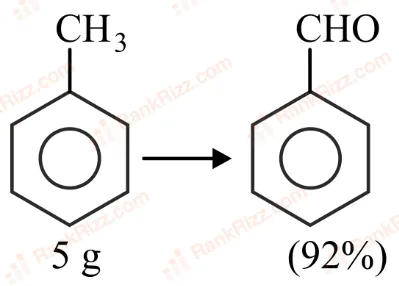
In the above reaction,5 g of toluene is converted into benzaldehyde with 92% yield. The amount of benzaldehyde produced is _____ g
Production of iron in blast furnace follows the following equation
FeO(s) + 4CO(g) 3Fe(l) + 4CO(g)
when 4.640 kg of FeO and 2.520 kg of CO are allowed to react then the amount of iron (in g) produced is:
[Given: Molar Atomic mass (g mol): Fe = 56, O = 16, C = 12]
1400
2200
3360
4200
Compound A contains 8.7% Hydrogen, 74% Carbon and 17.3% Nitrogen. The molecular formula of the compound is, Given: Atomic masses of C, H and N are 12, 1 and 14 amu respectively. The molar mass of the compound A is 162 g mol.
The complete combustion of 0.492 g of an organic compound containing 'C', 'H' and 'O' gives 0.793 g of CO and 0.442 g of HO. The percentage of oxygen composition in the organic compound is ______ (nearest integer)
g of a substance upon dissociation reaction, yields g of hydrogen, g of oxygen and g of carbon. Given that the atomic masses of H, O and C are 1, 16 and 12, respectively. The data agrees with how many formulae of the following?
A.
B. HCHO
C.
D.
On complete combustion g of an organic compound gave g of carbon dioxide and g of water. The percentage of carbon in the given organic compound is ______ (Nearest Integer)
CNG is an important transportation fuel. When g CNG is mixed with g oxygen in vehicles, it leads to the formation of and and produces large quantity of heat during this combustion, then the amount of carbon dioxide, produced in grams is ______ [nearest integer] [Assume CNG to be methane]
The number of N atoms in g of is . The value of is ______ (Nearest Integer)
mol
Number of grams of bromine that will completely react with g of pent-1-ene is ______ g. (Atomic mass of Br g/mol) [Nearest integer]
If a rocket runs on a fuel () and liquid oxygen, the weight of oxygen required and released for every litre of fuel respectively are :
(Given : density of the fuel is g/mL)
1188 g and 1296 g
2376 g and 2592 g
2592 g and 2376 g
3429 g and 3142 g