During " S " estimation, 160 mg of an organic compound gives 466 mg of barium sulphate. The percentage of Sulphur in the given compound is _______ %. (Given molar mass in of Ba : 137, S : 32, O : 16)
Quantitative estimation of elements has been asked 75 times in JEE Main, in 15 different years between 2004 and 2026, and in all of the last five exam years (2022–2026), 46 questions in all. That is 50% of Purification and Characterisation of Organic Compounds, its most-asked topic. Last asked in JEE Main 05 Apr 2026, Shift 1. 48 are multiple choice and 27 numerical-value; 42 easy, 29 medium and 1 hard by our difficulty labels. All of them are below, newest first, free to read.
Questions
75
Years asked
15
Since
2004
Of the chapter
50%
21–40 OF 75 · NEWEST FIRST
During " S " estimation, 160 mg of an organic compound gives 466 mg of barium sulphate. The percentage of Sulphur in the given compound is _______ %. (Given molar mass in of Ba : 137, S : 32, O : 16)
In Carius method for estimation of halogens, 180 mg of an organic compound produced 143.5 mg of AgCl . The percentage composition of chlorine in the compound is _______ %. (Given : molar mass in g )
Given below are two statements : Statement (I) : Nitrogen, sulphur, halogen and phosphorus present in an organic compound are detected by Lassaigne's Test. Statement (II) : The elements present in the compound are converted from covalent form into ionic form by fusing the compound with Magnesium in Lassaigne's test. In the light of the above statements, choose the correct anower from the options given below :
Statement I is false but Statement II is true
Both Statement I and Statement II are true
Both Statement I and Statement II are false
Statement I is true but Statement II is false
Given below are two statements : Statement (I) : Kjeldahl method is applicable to estimate nitrogen in pyridine. Statement (II) : The nitrogen present in pyridine can easily be converted into ammonium sulphate in Kjeldahl method. In the light of the above statements, choose the correct answer from the options given below :
Both Statement I and Statement II are true
Both Statement I and Statement II are false
Statement I is false but Statement II is true
Statement I is true but Statement II is false
In qualitative test for identification of presence of phosphorous, the compound is heated with an oxidising agent. Which is further treated with nitric acid and ammonium molybdate respectively. The yellow coloured precipitate obtained is :
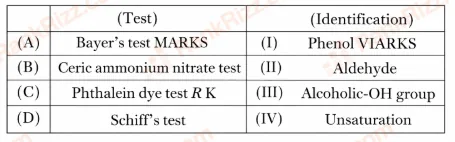
Match List - I with List - II.
Choose the correct answer from the options given below :
(A)-(IV), (B)-(III), (C)-(I), (D)-(II)
(A)-(II), (B)-(III), (C)-(IV), (D)-(I)
(A)-(IV), (B)-(I), (C)-(II), (D)-(III)
(A)-(III), (B)-(I), (C)-(IV), (D)-(II)
Which of the following nitrogen containing compound does not give Lassaigne's test?
Urea
Phenyl hydrazine
Glycine
Hydrazine
Lassaigne's test is used for detection of:
Nitrogen and Sulphur only
Nitrogen, Sulphur and Phosphorous Only
Phosphorous and halogens only
Nitrogen, Sulphur, and halogens
Following Kjeldahl's method, 1 g of organic compound released ammonia, that neutralised 10 mL of . The percentage of nitrogen in the compound is ______ %.
The Lassaigne's extract is boiled with dil before testing for halogens because,
is soluble in
Silver halides are soluble in
is soluble in
and are decomposed by
Appearance of blood red colour, on treatment of the sodium fusion extract of an organic compound with in presence of concentrated indicates the presence of element/s
Br
N
N and S
S
g of an organic compound (X) gave g of AgBr in Carius method for estimation of bromine. % of bromine in the compound (X) is (Given: Molar mass AgBr g mol, Br g mol)
In Carius tube, an organic compound 'X' is treated with sodium peroxide to form a mineral acid 'Y'. The solution of BaCl is added to 'Y' to form a precipitate 'Z'. 'Z' is used for the quantitative estimation of an extra element. 'X' could be
Cytosine
A nucleotide
Methionine
Chloroxylenol
Match List-I with List-II.
List-I (Element detected) List-II (Reagent used/Product formed)
A. Nitrogen I. NaFeCNNO
B. Sulphur II. AgNO
C. Phosphorus III. FeFeCN
D. Halogen IV. NHMoO
A III; B I; C IV; D II
A II; B IV; C I; D III
A IV; B II; C I; D III
A II; B I; C IV; D III
Given below are two statements:
Statement I: Sulphanilic acid gives esterification test for carboxyl group.
Statement II: Sulphanilic acid gives red colour in Lassigne's test for extra element detection.
In the light of the above statements, choose the most appropriate answer from the options given below:
Statement I is correct but Statement II is incorrect.
Both Statement I and Statement II are incorrect
Both Statement I and Statement II are correct
Statement I is incorrect but Statement II is correct.
In Dumas method for the estimation of N, the sample is heated with copper oxide and the gas evolved is passed over:
Copper gauze
Pd
Ni
Copper oxide
Compound that will give positive Lassaigne's test for both nitrogen and halogen is
NH HCl
CHNH. HCl
NHCl
NHOH. HCl
In sulphur estimation. 0.471 g of an organic compound gave 1.4439 g of barium sulphate. The percentage of sulphur in the compound is _____ (Nearest Integer)
(Given: Atomic mass Ba: 137u, S: 32u, O: 16u)
In Carius method of estimation of halogen, of an organic compound gave of . Find out the percentage of bromine in the compound. (Molar masses: )
While estimating the nitrogen present in an organic compound by Kjeldahl's method, the ammonia evolved from of the compound neutralized of . The percentage of nitrogen present in organic compound is ______.
RELATED PURIFICATION AND CHARACTERISATION OF ORGANIC COMPOUNDS TOPICS