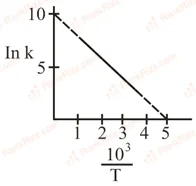
The rate constant of a reaction is measured at different temperature , and the data are plotted in the given figure. The activation energy of the reaction in is: (R is gas constant)
- A
- B
- C
- D
Arrhenius equation and activation energy has been asked 62 times in JEE Main, in 16 different years between 2005 and 2026, and in all of the last five exam years (2022–2026), 32 questions in all. That is 27% of Chemical Kinetics, one of its three most-asked topics. Last asked in JEE Main 08 Apr 2026, Shift 2. 30 are multiple choice and 32 numerical-value; 12 easy, 44 medium and 1 hard by our difficulty labels. All of them are below, newest first, free to read.
Questions
62
Years asked
16
Since
2005
Of the chapter
27%
41–60 OF 62 · NEWEST FIRST
The rate constant of a reaction is measured at different temperature , and the data are plotted in the given figure. The activation energy of the reaction in is: (R is gas constant)

The number of molecules with energy greater than the threshold energy for a reaction increases five fold by a rise of temperature from 27°C to 42°C. Its energy of activation in J/mol is __________ (Take ln 5 = 1.6094; R = 8.314 J mol)
For the following reactions:
It was found that the is decreased by 30 KJ/mol in the presence of catalyst. If the rate remains unchanged, the activation energy for catalysed reaction is (Assume pre-exponential factor is same):
75 KJ/mol
105 KJ/mol
135 KJ/mol
198 KJ/mol
A sample of milk splits after 60 min at 300K and after 40 min at 400K when the population of lactobacillus acidophilus in it doubles. The activation energy (in kJ/mol) for this process is closest to ___________.
(Given, J mol K, , )
The rate of a certain biochemical reaction at physiological temperature (T) occurs times faster with enzyme than without. The change in the activation energy upon adding enzyme is:
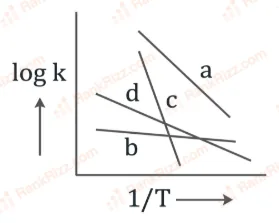
Consider the following plots of rate constant versus for four different reactions. Which of the following orders is correct for the activation energies of these reactions?

For the reaction of H with I, the rate constant is dm mol s at 327°C and 1.0 dm mol s at 527°C. The activation energy for the reaction, in kJ mol is:
R = 8.314 JK mol
166
59
72
150
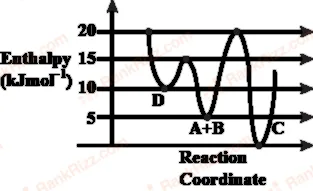
Consider the given plot of enthalpy of the following reaction between A and B.
A + B C + D. Identify the incorrect statement.

Formation of A and B from C has highest enthalpy of activation.
D is kinetically stable product.
C is the thermodynamically stable product.
Activation enthalpy to form C is 5 kJ mol less than that to form D.
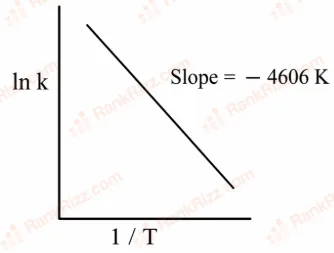
For a reaction, consider the plot of ln k versus 1/T given in the figure. If the rate constant of this reaction at 400 K is , then the rate constant at 500 K is:

If a reaction follows the Arrhenius equation, the plot vs gives straight line with a gradient unit. The energy required to activate the reactant is:
unit
unit
unit
unit
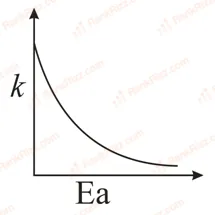
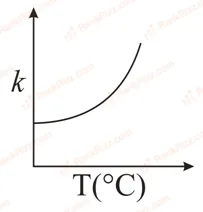
Consider the given plots for a reaction obeying Arrhenius equation (C < T < 300C): (K and are rate constant and activation energy, respectively)

I is wrong but II is right
Both I and II are wrong
I is right but II is wrong
Both I and II are correct
The rate of a reaction quadruples when the temperature changes from 300 to 310 K. The activation energy of this reaction is:
(Assume Activation energy and pre-exponential factor are independent of temperature;
ln(2) = 0.693; R = 8.314 J mol K)
53.6 kJ mol
214.4 kJ mol
107.2 kJ mol
53.7 kJ mol
The rate of a reaction A doubles on increasing the temperature from 300 to 310 K. By how much, the temperature of reaction B should be increased from 300 K so that rate doubles if activation energy of the reaction B is twice to that of reaction A.
4.92 K
9.84 K
19.67 K
2.45 K
Two reactions A and A have identical pre-exponential factors. The activation energy of A is more than A by 10 kJ mol. If k and k are the rate constants for reactions A and A, respectively at 300 K, then is equal to
(R = 8.314 J mol K)
12
6
4
8
For the equilibrium, , is kJ/mol. If the ratio of the activation energies of the forward and reverse reactions is then:
kJ/mol, kJ/mol
kJ/mol, kJ/mol
kJ/mol, kJ/mol
kJ/mol, kJ/mol
The rate coefficient (k) for a particular reactions is M s at 100°C, and M s at 150°C. What is the energy of activation (E) (in kJ) for this reaction? (R = molar gas constant = 8.314 JK mol)
16
60
99
132
The reaction X Y is an exothermic reaction. Activation energy of the reaction for X into Y is 150 kJ mol. Enthalpy of reaction is 135 kJ mol. The activation energy for the reverse reaction, Y X will be :
280 kJ mol
285 kJ mol
270 kJ mol
15 kJ mol
The rate of a reaction doubles when its temperature changes from 300K to 310K. Activation energy of such a reaction will be:
JK mol and log 2 = 0.301
58.5 kJ mol
60.5 kJ mol
53.6 kJ mol
48.6 kJ mol
The activation energy for a reaction which doubles the rate when the temperature is raised from 298 K to 308 K is
59.2 kJ mol
39.2 kJ mol
52.9 kJ mol
29.5 kJ mol
The rate of a chemical reaction doubles for every rise of temperature. If the temperature is raised by , the rate of the reaction increases by about:
times
times
times
times