JEE MAIN 2023 · 08 APR S2Arrhenius equation and activation energy
The correct reaction profile diagram for a positive catalyst reaction.
- A
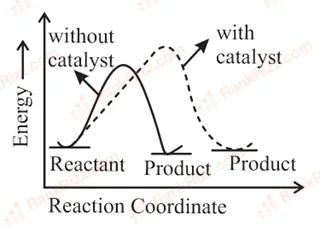
- B
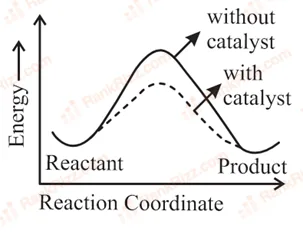
- C
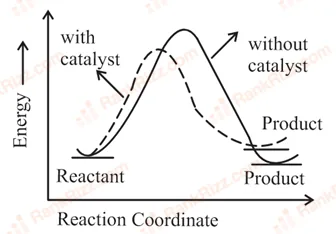
- D
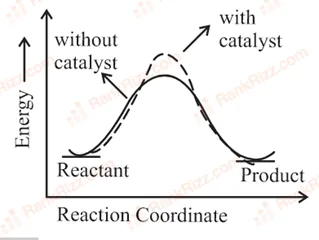
Arrhenius equation and activation energy has been asked 62 times in JEE Main, in 16 different years between 2005 and 2026, and in all of the last five exam years (2022–2026), 32 questions in all. That is 27% of Chemical Kinetics, one of its three most-asked topics. Last asked in JEE Main 08 Apr 2026, Shift 2. 30 are multiple choice and 32 numerical-value; 12 easy, 44 medium and 1 hard by our difficulty labels. All of them are below, newest first, free to read.
Questions
62
Years asked
16
Since
2005
Of the chapter
27%
21–40 OF 62 · NEWEST FIRST
The correct reaction profile diagram for a positive catalyst reaction.
For the adsorption of hydrogen on platinum, the activation energy is 30 kJ mol and for the adsorption of hydrogen on nickel, the activation energy is 41.4 kJ mol. The logarithm of the ratio of the rates of chemisorption on equal areas of the metals at 300 K is ______ (Nearest integer)
Given: ln10 = 2.3, R = 8.3 J K mol
The rate constants of the above reaction at 200 K and 300 K are 0.03 min and 0.05 min respectively. The activation energy for the reaction is J (Nearest integer)
(Given: ln 10 = 2.3, R = 8.3 J K mol, log 5 = 0.70, log 3 = 0.48, log 2 = 0.30)
The number of correct statement/s from the following is _____.
A. Larger the activation energy, smaller is the value of the rate constant.
B. The higher is the activation energy, higher is the value of the temperature coefficient.
C. At lower temperatures, increase in temperature causes more change in the value of k than at higher temperature.
D. A plot of vs is a straight line with slope equal to
The number of correct statement/s from the following is _____.
A. Larger the activation energy, smaller is the value of the rate constant.
B. The higher is the activation energy, higher is the value of the temperature coefficient.
C. At lower temperatures, increase in temperature causes more change in the value of k than at higher temperature.
D. A plot of ln k vs is a straight line with slope equal to
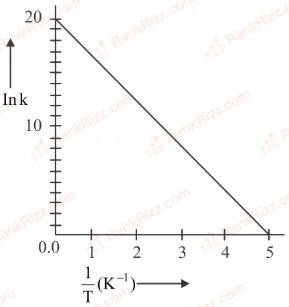
For a reaction, given below is the graph of vs . The activation energy for the reaction is equal to _____ cal mol. (Given: cal K mol)
The activation energy of one of the reactions in a biochemical process is 532611 J mol. When the temperature falls from 310 K to 300 K, the change in rate constant observed is k = x 10k. The value of x is ______.
[Given: ln 10 = 2.3 R = 8.3 J K mol]
The equation is followed for the decomposition of compound A. The activation energy for the reaction is ______ KJ mol. [nearest integer]
(Given: R = 8.314 J K mol)
The rate constant for a first order reaction is given by the following equation :
The Activation energy for the reaction is given by ______ kJ mol. (In Nearest integer) (Given : J K mol)
It has been found that for a chemical reaction with rise in temperature by K the rate constant gets doubled. Assuming a reaction to be occurring at K, the value of activation energy is found to be ______ kJ mol. [nearest integer] (Given J K mol, )
Catalyst A reduces the activation energy for a reaction by kJ mol at K. The ratio of rate constants, is . The value of is ______ [nearest integer] [Assume that the pre-exponential factor is same in both the cases. Given J K mol]
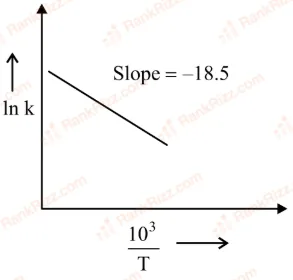
The rate constants for decomposition of acetaldehyde have been measured over the temperature range K. The data has been analysed by plotting vs graph. The value of activation energy for the reaction is ______ kJ mol. (Nearest integer) (Given : J K mol)
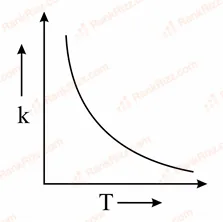
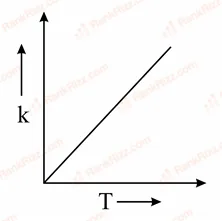
Which one of the following given graphs represents the variation of rate constant (k) with temperature (T) for an endothermic reaction?
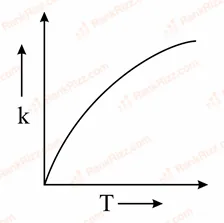
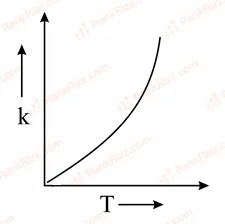
For the reaction A B, the rate constant k (in s) is given by
The energy of activation in kJ mol is _________. (Nearest integer)
[Given : R = 8.314 J K mol]
The first order rate constant for the decomposition of CaCO at 700 K is s and activation energy is 209 kJ mol. Its rate constant (in s) at 600 K is . The value of x is _________. (Nearest integer)
[Given R = 8.31 J K mol; log = -2.19, = ]
The decomposition of formic acid on gold surface follows first order kinetics. If the rate constant at 300 K is s and the activation energy kJ mol, the rate constant at 200 K is ________ s. (Round off to the Nearest Integer).
[Given J mol K]
If the activation energy of a reaction is 80.9 kJ mol, the fraction of molecules at 700 K, having enough energy to react to form products is . The value of is (Rounded off to the nearest integer) [Use R = 8.31 J K mol]
For the reaction, , the plot of log k v/s is given below:
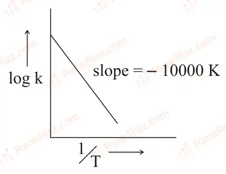
The temperature at which the rate constant of the reaction is s is ______ K.
(Rounded-off to the nearest integer) [Given: The rate constant of the reaction is s at 500 K.]
The rate constant of a reaction increases by five times on increase in temperature from 27°C to 52°C. The value of activation energy in kJ mol is ______. (Rounded-off to the nearest integer) [ J K mol]
The rate of a reaction decreased by 3.555 times when the temperature was changed from to . The activation energy (in ) of the reaction is______.