RankRizz

JEE Main 06 Sep 2020, Shift 1 Question Paper

All 75 questions of JEE Main 06 Sep 2020, Shift 1, in the order they were asked, one subject to a page. Pick an answer on any question to check it against the key. Free to read, nothing to download.

Questions

75

Physics · Chemistry · Maths

Answer key

74

questions with a checked key

Price

Free

no sign-up

Physics

Q1Kinematics of uniform circular motion

A clock has a continuously moving second's hand of 0.1 m0.1\,\text{m} length. The average acceleration of the tip of the hand (in units of ms−2\text{ms}^{-2}) is of the order of:

  1. A

    10−310^{-3}

  2. B

    10−410^{-4}

  3. C

    10−210^{-2}

  4. D

    10−110^{-1}

Q2Static and kinetic friction

An insect is at the bottom of a hemispherical ditch of radius 1 m1\,\text{m}. It crawls up the ditch but starts slipping after it is at height hh from the bottom. If the coefficient of friction between the ground and the insect is 0.750.75, then hh is: (g=10 m s−2)(g = 10\,\text{m s}^{-2})

  1. A

    0.20 m

  2. B

    0.45 m

  3. C

    0.60 m

  4. D

    0.80 m

Q3Conservation of mechanical energy

If the potential energy between two molecules is given by U=Ar6+Br12U = \frac{A}{r^6} + \frac{B}{r^{12}}, then at equilibrium, separation between molecules, and the potential energy are:

  1. A

    (B2A)1/6\left(\frac{B}{2A}\right)^{1/6}, −A22B-\frac{A^2}{2B}

  2. B

    (BA)1/6\left(\frac{B}{A}\right)^{1/6}, 0

  3. C

    (2BA)1/6\left(\frac{2B}{A}\right)^{1/6}, −A24B-\frac{A^2}{4B}

  4. D

    (B2A)16\left(\frac{B}{2A}\right)^{\frac{1}{6}}, A22B\frac{A^2}{2B}

Q4Moment of inertia of standard bodies and composite systems

Shown in the figure is a hollow ice-cream cone (it is open at top). If its mass is M, radius of its top is R and height, H, then its moment of inertia about its axis is:
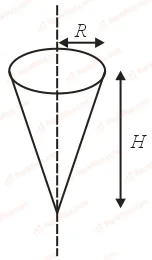
Figure for JEE Main 2020 Physics question on Moment of inertia of standard bodies and composite systems
  1. A

    MR22\frac{MR^2}{2}

  2. B

    M(R2+H2)4\frac{M(R^2+H^2)}{4}

  3. C

    MH23\frac{MH^2}{3}

  4. D

    MR23\frac{MR^2}{3}

Q5Angular momentum of particles and rigid bodies

Four point masses, each of mass mm, are fixed at the corners of a square of side ll. The square is rotating with angular frequency ω\omega, about an axis passing through one of the corners of the square and parallel to its diagonal, as shown in the figure. The angular momentum of the square about the axis is:
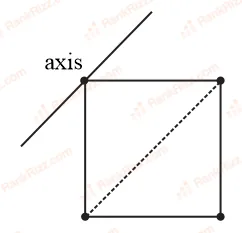
Figure for JEE Main 2020 Physics question on Angular momentum of particles and rigid bodies
  1. A

    ml2ωml^2\omega

  2. B

    4ml2ω4ml^2\omega

  3. C

    3ml2ω3ml^2\omega

  4. D

    2ml2ω2ml^2\omega

Q6Kepler's laws and planetary motion

A satellite is in an elliptical orbit around a planet PP. It is observed that the velocity of the satellite when it is farthest from the planet is 6 times less than that when it is closest to the planet. The ratio of distances between the satellite and the planet at closest and farthest points is:

  1. A

    1 : 6

  2. B

    1 : 3

  3. C

    1 : 2

  4. D

    3 : 4

Q7Molar specific heats of gases, Mayer's relation and gas mixtures

Molecules of an ideal gas are known to have three translational degrees of freedom. The gas is maintained at a temperature of T. The total internal energy, U of a mole of this gas, and the value of γ=(CpCv)\gamma = \left(\frac{C_p}{C_v}\right) are given, respectively, by:

  1. A

    U=52RTU = \frac{5}{2}RT and γ=65\gamma = \frac{6}{5}

  2. B

    U=5RTU = 5RT and γ=75\gamma = \frac{7}{5}

  3. C

    U=52RTU = \frac{5}{2}RT and γ=75\gamma = \frac{7}{5}

  4. D

    U=5RTU = 5RT and γ=65\gamma = \frac{6}{5}

Q8Stress, strain, Hooke's law and Young's modulus

An object of mass mm is suspended at the end of a massless wire of length LL and area of cross-section, A. Young modulus of the material of the wire is YY. If the mass is pulled down slightly its frequency of oscillation along the vertical direction is:

  1. A

    f=12πmLYAf = \frac{1}{2\pi}\sqrt{\frac{mL}{YA}}

  2. B

    f=12πYAmLf = \frac{1}{2\pi}\sqrt{\frac{YA}{mL}}

  3. C

    f=12πmAYLf = \frac{1}{2\pi}\sqrt{\frac{mA}{YL}}

  4. D

    f=12πYLmAf = \frac{1}{2\pi}\sqrt{\frac{YL}{mA}}

Q9Doppler effect in sound

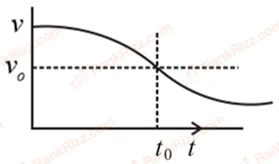
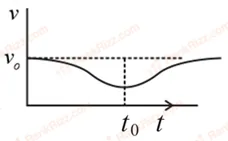
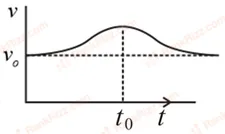
A sound source S is moving along a straight track with speed vv, and is emitting sound of frequency v0v_0. An observer is standing at a finite distance, at the point O, from the track. The time variation of frequency heard by the observer is best represented by: (t0t_0 represents the instant when the distance between the source and observer is minimum)
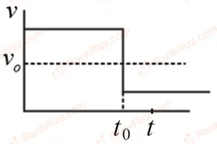
  1. A
    Figure for JEE Main 2020 Physics question on Doppler effect in sound
  2. B
    Figure for JEE Main 2020 Physics question on Doppler effect in sound
  3. C
    Figure for JEE Main 2020 Physics question on Doppler effect in sound
  4. D
    Figure for JEE Main 2020 Physics question on Doppler effect in sound
Q10Electric field due to point charges and superposition

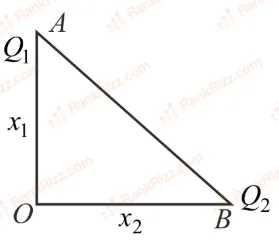
Charges Q1Q_1 and Q2Q_2 are at points A and B of a right-angled triangle OAB. The resultant electric field at point O is perpendicular to the hypotenuse, then Q1/Q2Q_1/Q_2 is proportional to:

Figure for JEE Main 2020 Physics question on Electric field due to point charges and superposition
  1. A

    x13x23\frac{x_1^3}{x_2^3}

  2. B

    x2x1\frac{x_2}{x_1}

  3. C

    x1x2\frac{x_1}{x_2}

  4. D

    x22x12\frac{x_2^2}{x_1^2}

Q11RC circuits: charging and discharging

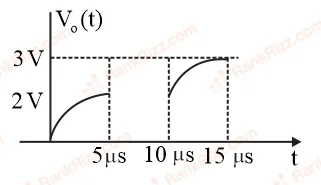
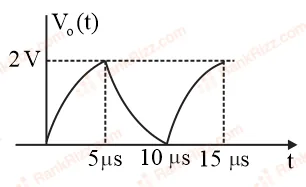
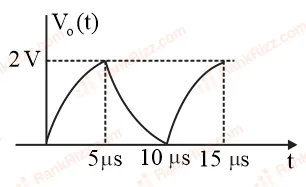
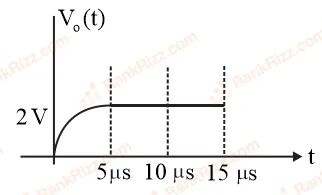
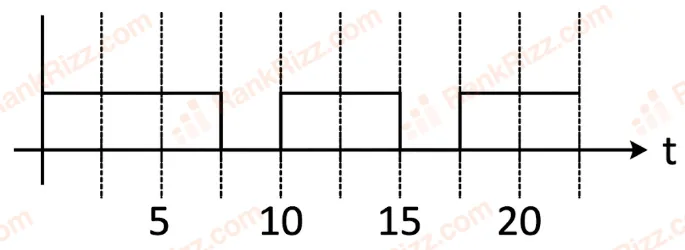
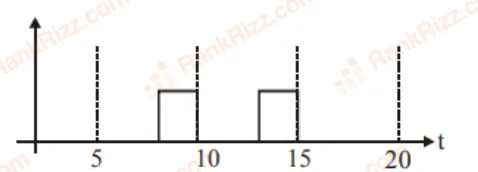
For the given input voltage waveform Vin(t)V_{in}(t), the output voltage waveform V0(t)V_0(t), across the capacitor is correctly depicted by:
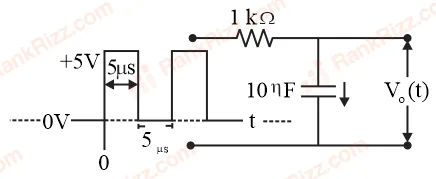
Figure for JEE Main 2020 Physics question on RC circuits: charging and discharging
  1. A
    Figure for JEE Main 2020 Physics question on RC circuits: charging and discharging
  2. B
    Figure for JEE Main 2020 Physics question on RC circuits: charging and discharging
  3. C
    Figure for JEE Main 2020 Physics question on RC circuits: charging and discharging
  4. D
    Figure for JEE Main 2020 Physics question on RC circuits: charging and discharging
Q12Motion of charged particles in a magnetic field

A particle of charge qq and mass mm is moving with a velocity −vi^-v\hat{i} (v≠0)(v \neq 0) towards a large screen placed in the Y−ZY-Z plane at distance dd. If there is a magnetic field B⃗=B0k^\vec{B} = B_0\hat{k}, the minimum value of vv for which the particle will not hit the screen is:

  1. A

    qdB03m\frac{qdB_0}{3m}

  2. B

    2qdB0m\frac{2qdB_0}{m}

  3. C

    qdB0m\frac{qdB_0}{m}

  4. D

    qdB02m\frac{qdB_0}{2m}

Q13Motion of charged particles in a magnetic field

An electron is moving along +x+x direction with a velocity of 6×10⁶ ms−16 \times 10^6\,\text{ms}^{-1}. It enters a region of uniform electric field of 300 V/cm300\,V/cm pointing along +y+y direction. The magnitude and direction of the magnetic field set up in this region such that the electron keeps moving along the xx direction will be:

  1. A

    3×10⁻⁴ T3 \times 10^{-4}\,\text{T}, along +z+z direction

  2. B

    5×10⁻³ T5 \times 10^{-3}\,\text{T}, along −z-z direction

  3. C

    5×10⁻³ T5 \times 10^{-3}\,\text{T}, along +z+z direction

  4. D

    3×10⁻⁴ T3 \times 10^{-4}\,\text{T}, along −z-z direction

Q14Resonance, bandwidth and quality factor

An AC circuit has R=100 ΩR = 100\,\Omega, C=2 μFC = 2\,\mu F and L=80 mHL = 80\,\text{mH}, connected in series. The quality factor of the circuit is:

  1. A

    2

  2. B

    0.5

  3. C

    20

  4. D

    400

Q15Thin lenses: lens formula, lens maker's formula and power

A point like object is placed at distance of 1 m1\,\text{m} in front of a convex lens of focal length 0.5 m0.5\,\text{m}. A plane mirror is placed at a distance of 2 m2\,\text{m} behind the lens. The position and nature of the image formed by the system is:

  1. A

    2.6 m2.6\,\text{m} from the mirror, real

  2. B

    1 m1\,\text{m} from the mirror, virtual

  3. C

    1 m1\,\text{m} from the mirror, real

  4. D

    2.6 m2.6\,\text{m} from the mirror, virtual

Q16Wavefronts and Huygens' principle

In the figure below, PP and QQ are two equally intense coherent sources emitting radiation of wavelength 20 m20\,\text{m}. The separation between P and Q is 5 m5\,\text{m} and the phase of P is ahead of that of Q by 90∘90^\circ. A, B and C are three distinct point of observation, each equidistant from the midpoint of PQ. The intensities of radiation at A, B, C will be in the ratio:
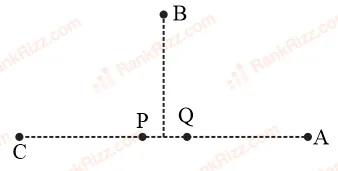
Figure for JEE Main 2020 Physics question on Wavefronts and Huygens' principle
  1. A

    0 : 1 : 4

  2. B

    2 : 1 : 0

  3. C

    0 : 1 : 2

  4. D

    4 : 1 : 0

Q17de Broglie wavelength of matter waves

An electron, a doubly ionized helium ion (He++)(He^{++}) and proton are having the same kinetic energy. The relation between their respective de-Broglie wavelength λe\lambda_e, λHe++\lambda_{He^{++}} and λp\lambda_p is:

  1. A

    λe>λHe++>λp\lambda_e > \lambda_{He^{++}} > \lambda_p

  2. B

    λe<λHe++=λp\lambda_e < \lambda_{He^{++}} = \lambda_p

  3. C

    λe>λp>λHe++\lambda_e > \lambda_p > \lambda_{He^{++}}

  4. D

    λe<λp<λHe++\lambda_e < \lambda_p < \lambda_{He^{++}}

Q18Nuclear size, mass defect and binding energy

You are given that 37Li=7.0160 u^7_3\text{Li} = 7.0160\,\text{u}, Mass of 24He=4.0026 u^4_2\text{He} = 4.0026\,\text{u} and Mass of 11He=1.0079 H^1_1\text{He} = 1.0079\,\text{H}. When 20 g20\,\text{g} of 37Li^7_3\text{Li} is converted into 24He^4_2\text{He} by proton capture, the energy liberated, (in kWh), is: [Mass of nucleon =1 GeV/c2= 1\,\text{GeV}/c^2]

  1. A

    4.5×1054.5 \times 10^5

  2. B

    8×1068 \times 10^6

  3. C

    6.82×1056.82 \times 10^5

  4. D

    1.33×1061.33 \times 10^6

Q19Logic gates and digital circuits

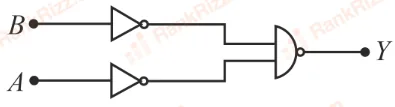
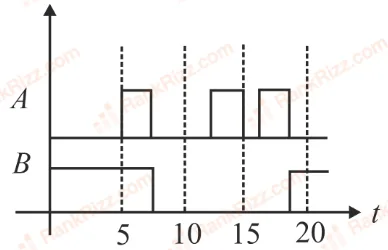
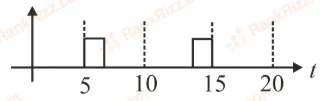
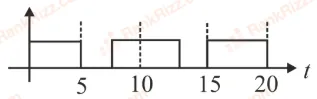
Identify the correct output signal YY in the given combination of gates (as shown nn) for the given inputs AA and BB:

Figure for JEE Main 2020 Physics question on Logic gates and digital circuitsFigure for JEE Main 2020 Physics question on Logic gates and digital circuits
  1. A
    Figure for JEE Main 2020 Physics question on Logic gates and digital circuits
  2. B
    Figure for JEE Main 2020 Physics question on Logic gates and digital circuits
  3. C
    Figure for JEE Main 2020 Physics question on Logic gates and digital circuits
  4. D
    Figure for JEE Main 2020 Physics question on Logic gates and digital circuits
Q20Screw gauge: pitch, least count and zero error

A screw gauge has 50 divisions on its circular scale. The circular scale is 4 units ahead of the pitch scale marking, prior to use. Upon one complete rotation of the circular scale, a displacement of 0.5 mm0.5\,\text{mm} is noticed on the pitch scale. The nature of zero error involved and the least count of the screw gauge, are respectively:

  1. A

    Negative, 2μm2\mu m

  2. B

    Positive 10μm10\mu m

  3. C

    Positive 0.1 mm0.1\,mm

  4. D

    Positive, 0.1μm0.1\mu m

Q21Errors in measurement and significant figures

The density of a solid metal sphere is diameter. The maximum error in the density of the sphere is (x100)%\left(\frac{x}{100}\right)\%. If the relative errors in measuring the mass and the diameter are 6.0%6.0\% and 1.5%1.5\% respectively, the value of xx is ___

Q22Motion of centre of mass, momentum conservation and explosions

Two bodies of the same mass are moving with the same speed, but in different directions in a plane. They have a completely inelastic collision and move together thereafter with a final speed which is half of their initial velocities of the two bodies (in degree) is ___

Q23Ideal gas equation and gas laws

Initially a gas of diatomic molecules is contained in a cylinder of volume V1V_1 at a pressure P1P_1 and temperature 250 K250\,\text{K}. Assuming that 25%25\% of the molecules get dissociated causing a change in number of moles. The pressure of the resulting gas at temperature 2000 K2000\,\text{K}, when contained in a volume 2V12V_1 is given by P2P_2. The ratio P2/P1P_2/P_1 is ___

Q24Properties of EM waves: fields, energy, intensity and momentum

Suppose that intensity of a laser is (315π) W m−2\left(\frac{315}{\pi}\right)\,\text{W m}^{-2}. The rms electric field, in units of V m−1\text{V m}^{-1} associated with this source is close to the nearest integer is ___ (ε0=8.86×10⁻¹² C2 N m−2\varepsilon_0 = 8.86 \times 10^{-12}\,\text{C}^2\,\text{N m}^{-2}; c=3×10⁸ m s−1c = 3 \times 10^8\,\text{m s}^{-1})

Q25Magnetic flux, Faraday's law and Lenz's law

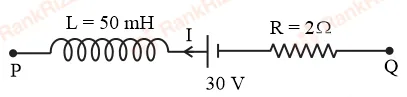
A part of a complete circuit is shown in the figure. At some instant, the value of current I is 1 A1\,\text{A} and it is decreasing at a rate of 102 As−110^2\,\text{As}^{-1}. The value of the potential difference VP−VQV_P - V_Q, (in volts) at that instant is___

Figure for JEE Main 2020 Physics question on Magnetic flux, Faraday's law and Lenz's law
NEXT IN THIS PAPER →Chemistry, Q26 onwards