RankRizz

JEE Main 05 Sep 2020, Shift 2 Question Paper

All 75 questions of JEE Main 05 Sep 2020, Shift 2, in the order they were asked, one subject to a page. Pick an answer on any question to check it against the key. Free to read, nothing to download.

Questions

75

Physics · Chemistry · Maths

Answer key

73

questions with a checked key

Price

Free

no sign-up

Physics

Q1Dimensional analysis: deriving and checking relations

The quantities x=1μ0ε0x = \frac{1}{\sqrt{\mu_0 \varepsilon_0}}, y=EBy = \frac{E}{B} and z=lCRz = \frac{l}{CR} are defined where C-capacitance, R-Resistance, ll-length, E-Electric field, B-magnetic field and ε0\varepsilon_0, μ0\mu_0 - free space permittivity and permeability respectively. Then:

  1. A

    x, y and z have the same dimension

  2. B

    Only x and z have the same dimension

  3. C

    Only x and y have the same dimension

  4. D

    Only y and z have the same dimension
Q2Motion graphs: x-t, v-t and a-t

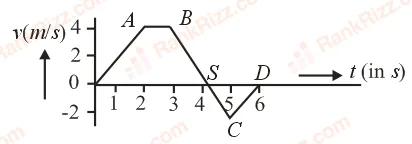
The velocity (v)(v) and time (t)(t) graph of a body in a straight line motion is shown in the figure. The point SS is at 4.3334.333 seconds. The total distance covered by the body in 66 s is:

Figure for JEE Main 2020 Physics question on Motion graphs: x-t, v-t and a-t
  1. A

    373\frac{37}{3} m

  2. B

    12 m

  3. C

    11 m

  4. D

    494\frac{49}{4} m

Q3Variable mass systems and rockets

A spaceship in space sweeps stationary interplanetary dust. As a result, its mass increases at a rate dM(t)dt=bv2(t)\frac{dM(t)}{dt} = bv^2(t), where v(t)v(t) is its instantaneous velocity. The instantaneous acceleration of the satellite is:

  1. A

    −bv3(t)-bv^3(t)

  2. B

    −bv3M(t)\frac{-bv^3}{M(t)}

  3. C

    −2bv3M(t)-\frac{2bv^3}{M(t)}

  4. D

    −bv32M(t)-\frac{bv^3}{2M(t)}

Q4Acceleration due to gravity and its variation

The acceleration due to gravity on the earth's surface at the poles is gg and angular velocity of the earth about the axis passing through the pole is ω\omega. An object is weighed at the equator and at a height hh above the poles by using a spring balance. If the weights are found to be same, then hh is: (h≪Rh \ll R, where RR is the radius of the earth)

  1. A

    R2ω22g\dfrac{R^2\omega^2}{2g}

  2. B

    R2ω2g\dfrac{R^2\omega^2}{g}

  3. C

    R2ω24g\dfrac{R^2\omega^2}{4g}

  4. D

    R2ω28g\dfrac{R^2\omega^2}{8g}

Q5Stokes' law and terminal velocity

In an experiment to verify Stokes law, a small spherical ball of radius rr and density ρ\rho falls under gravity through a distance hh in air before entering a tank of water. If the terminal velocity of the ball inside water is same as its velocity just before entering the water surface, then the value of hh is proportional to: (ignore viscosity of air)

  1. A

    r4r^4

  2. B

    rr

  3. C

    r3r^3

  4. D

    r2r^2

Q6Temperature scales and thermal expansion

Two different wires having lengths L1L_1 and L2L_2 and respective temperature coefficient of linear expansion α1\alpha_1 and α2\alpha_2, are joined end-to-end. Then the effective temperature coefficient of linear expansion is:

  1. A

    α1L1+α2L2L1+L2\frac{\alpha_1 L_1 + \alpha_2 L_2}{L_1 + L_2}

  2. B

    2α1α22\sqrt{\alpha_1 \alpha_2}

  3. C

    α1+α22\frac{\alpha_1 + \alpha_2}{2}

  4. D

    4α1α2α1+α2L2L1(L2+L1)24\frac{\alpha_1 \alpha_2}{\alpha_1 + \alpha_2}\frac{L_2 L_1}{(L_2 + L_1)^2}

Q7Isothermal and adiabatic processes

In an adiabatic process, the density of a diatomic gas becomes 32n32n times its initial value. The final pressure of the gas is found to be nn times the initial pressure. The value of nn is:

  1. A

    32

  2. B

    326

  3. C

    128

  4. D

    132\frac{1}{32}

Q8Simple, compound and torsional pendulums

A ring is hung on a nail. It can oscillate, without slipping or sliding (i) in its plane with a time period T1T_1 and (ii) back and forth in a direction perpendicular to its plane, with a period T2T_2. The ratio T1T2\frac{T_1}{T_2} will be:

  1. A

    23\frac{2}{\sqrt{3}}

  2. B

    23\frac{2}{3}

  3. C

    32\frac{3}{\sqrt{2}}

  4. D

    23\frac{\sqrt{2}}{3}

Q9Doppler effect in sound

A driver in a car, approaching a vertical wall notices that the frequency of his car horn has changed from 440440 Hz to 480480 Hz, when it gets reflected from the wall. If the speed of sound in air is 345 m s−1345\,\text{m s}^{-1}, then the speed of the car is:

  1. A

    54 km/hr54\,km/hr

  2. B

    36 km/hr36\,km/hr

  3. C

    18 km/hr18\,km/hr

  4. D

    24 km/hr24\,km/hr

Q10Electric potential and potential energy

Ten charges are placed on the circumference of a circle of radius R with constant angular separation between successive charges. Alternate charges 1, 3, 5, 7, 9 have charge (+q)(+q) each, while 2, 4, 6, 8, 10 have charge (−q)(-q) each. The potential V and the electric field E at the centre of the circle are respectively: (Take V=0V = 0 at infinity)

  1. A

    V=10q4πε0RV = \frac{10q}{4\pi\varepsilon_0 R}; E=0E = 0

  2. B

    V=0V = 0, E=10q4πε0R2E = \frac{10q}{4\pi\varepsilon_0 R^2}

  3. C

    V=0V = 0; E=0E = 0

  4. D

    V=10q4πε0RV = \frac{10q}{4\pi\varepsilon_0 R}; E=10q4πε0R2E = \frac{10q}{4\pi\varepsilon_0 R^2}

Q11Capacitors in DC circuits (steady state)

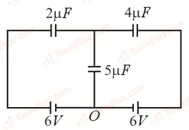
In the circuit shown, charge on the 5 μF5\,\mu\text{F} capacitor is:

Figure for JEE Main 2020 Physics question on Capacitors in DC circuits (steady state)
  1. A

    18.00 μC18.00\,\mu C

  2. B

    10.90 μC10.90\,\mu C

  3. C

    16.36 μC16.36\,\mu C

  4. D

    5.45 μC5.45\,\mu C

Q12Capacitors with dielectrics

A parallel plate capacitor has plate of length ll, width ww and separation of plates is dd. It is connected to a battery of emf VV. A dielectric slab of the same thickness dd and of dielectric constant K=4K = 4 is being inserted between the plates of the capacitor. At what length of the slab inside plates, will the energy stored in the capacitor be two times the initial energy stored?

  1. A

    2l3\frac{2l}{3}

  2. B

    l3\frac{l}{3}

  3. C

    l4\frac{l}{4}

  4. D

    l2\frac{l}{2}

Q13Galvanometer conversion to ammeter and voltmeter

A galvanometer is used in laboratory for detecting the null point in electrical experiments. If, on passing a current of 6 mA6\,mA it produces a deflection of 2∘2^\circ, its figure of merit is close to:

  1. A

    333∘ A/div333^\circ\,A/div

  2. B

    6×10⁻³ A/div6 \times 10^{-3}\,\text{A/div}

  3. C

    666∘ A/div666^\circ\,A/div

  4. D

    3×10⁻³ A/div3 \times 10^{-3}\,\text{A/div}

Q14Kirchhoff's laws and circuit analysis

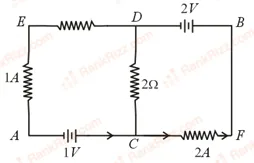
In the circuit, given in the figure currents in different branches and value of one resistor are shown. Then potential at point BB with respect to the point AA is:

Figure for JEE Main 2020 Physics question on Kirchhoff's laws and circuit analysis
  1. A

    +2V+2V

  2. B

    −2V-2V

  3. C

    −1V-1V

  4. D

    +1V+1V

Q15Magnetisation, magnetic intensity, susceptibility and permeability

An iron rod of volume 10−3 m310^{-3}\,\text{m}^3 and relative permeability 1000 is placed as core in a solenoid with 10 turns cm−1\text{cm}^{-1}. If a current of 0.5 A0.5\,\text{A} is passed through the solenoid, then the magnetic moment of the rod will be:

  1. A

    50×102 Am250 \times 10^2\,\text{Am}^2

  2. B

    5×10² Am25 \times 10^2\,\text{Am}^2

  3. C

    500×102 Am2500 \times 10^2\,\text{Am}^2

  4. D

    0.5×10² Am20.5 \times 10^2\,\text{Am}^2

Q16Motional emf in moving rods and loops

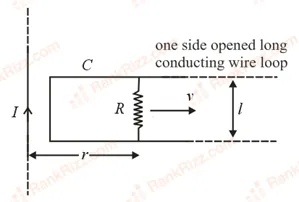
An infinitely long straight wire carrying current I, one side opened rectangular loop and a conductor C with a sliding connector are located in the same plane, as shown in the figure. The connector has length ll and resistance RR. It slides to the right with a velocity vv. The resistance of the conductor and the self inductance of the loop are negligible. The induced current in the loop, as a function of separation rr, between the connector and the straight wire is:

Figure for JEE Main 2020 Physics question on Motional emf in moving rods and loops
  1. A

    μ04πIvlRr\frac{\mu_0}{4\pi}\frac{Ivl}{Rr}

  2. B

    μ0πIvlRr\frac{\mu_0}{\pi}\frac{Ivl}{Rr}

  3. C

    2μ0πIvlRr\frac{2\mu_0}{\pi}\frac{Ivl}{Rr}

  4. D

    μ02πIvlRr\frac{\mu_0}{2\pi}\frac{Ivl}{Rr}

Q17Electromagnetic spectrum and uses

The correct match between the entries in column I and column II are:
I (Radiation)               II (Wavelength)
a. Microwave               i. 100 m
b. Gamma rays            ii. 10−1510^{-15} m
c. A.M. radio                iii. 10−1010^{-10} m
d. X-rays                       iv. 10−310^{-3} m

  1. A

    (a)-(ii), (b)-(i), (c)-(iv), (d)-(iii)

  2. B

    (a)-(i), (b)-(iii), (c)-(iv), (d)-(ii)

  3. C

    (a)-(iii), (b)-(ii), (c)-(i), (d)-(iv)

  4. D

    (a)-(iv), (b)-(ii), (c)-(i), (d)-(iii)

Q18Organ pipes and resonance columns

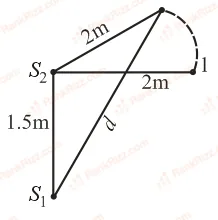
Two coherent sources of sound, S1S_1 and S2S_2, produce sound waves of the same wavelength λ=1 m\lambda = 1\,\text{m} are in phase. S1S_1 and S2S_2 are placed 1.5 m1.5\,\text{m} apart (see fig). A listener, located at L, directly in front of S2S_2, finds that the intensity is at a minimum when he is 2 m2\,\text{m} away from S2S_2. The listener moves away from S1S_1, keeping the distance from S2S_2 fixed. The adjacent maximum of intensity is observed when the listener is at a distance dd from S1S_1. Then dd is:

Figure for JEE Main 2020 Physics question on Organ pipes and resonance columns
  1. A

    12 m

  2. B

    5 m

  3. C

    2 m

  4. D

    3 m

Q19Radioactivity: decay law, half-life and decay modes

A radioactive nucleus decays by two different processes. The half-life for the first process is 10 s10\,\text{s} and that for the second is 100 s100\,\text{s}. The effective half-life of the nucleus is close to:

  1. A

    9 s

  2. B

    6 s

  3. C

    55 s

  4. D

    12 s

Q20Zener diode, LED, photodiode and solar cell

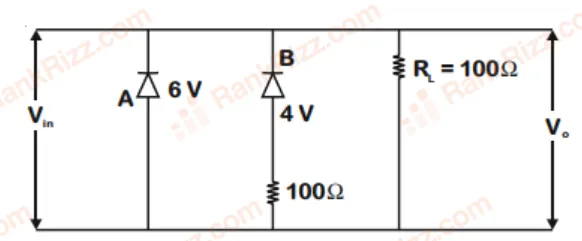
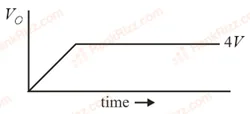
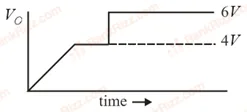
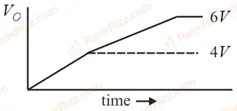
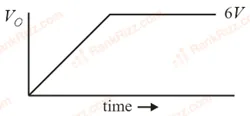
Two Zener diodes (AA and BB) having breakdown voltages of 6 V6\,\text{V} and 4 V4\,\text{V} respectively, are connected as shown in the circuit below. The output voltage V0V_0 variation with input voltage linearly increasing with time, is given by (Vinput=0VV_{input} = 0V at t=0t = 0):

Figure for JEE Main 2020 Physics question on Zener diode, LED, photodiode and solar cell
  1. A
    Figure for JEE Main 2020 Physics question on Zener diode, LED, photodiode and solar cell
  2. B
    Figure for JEE Main 2020 Physics question on Zener diode, LED, photodiode and solar cell
  3. C
    Figure for JEE Main 2020 Physics question on Zener diode, LED, photodiode and solar cell
  4. D
    Figure for JEE Main 2020 Physics question on Zener diode, LED, photodiode and solar cell
Q21Power

A body of mass 2 kg2\,\text{kg} is driven by an engine delivering a constant power of 1 J s−11\,\text{J s}^{-1}. The body starts from rest and moves in a straight line. After 9 s9\,\text{s}, the body has moved a distance (in m)....

Q22Angular momentum of particles and rigid bodies

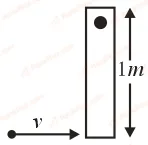
A thin rod of mass 0.9 kg0.9\,\text{kg} and length 1 m1\,\text{m} is suspended, at rest, from one end so that it can freely oscillate in the vertical plane. A particle of mass 0.1 kg0.1\,\text{kg} moving in a straight line with velocity 80 m s−180\,\text{m s}^{-1} hits the rod at its bottom most point and sticks to it (see figure). The angular speed (in rad s−1\text{rad s}^{-1}) of the rod immediately after the collision will be...........

Figure for JEE Main 2020 Physics question on Angular momentum of particles and rigid bodies
Q23RMS, average and most probable speeds of gas molecules

Nitrogen gas is at 300 ∘C300\,^\circ\text{C} temperature. The temperature (in K) at which the rms speed of a H2\text{H}_2 molecule would be equal to the rms speed of a nitrogen molecule, is........... (Molar mass of N2\text{N}_2 gas 28 g).

Q24Refraction at plane surfaces, Snell's law and apparent depth

A prism of angle A=1∘A = 1^\circ, μ=1.5\mu = 1.5. A good estimate for the minimum angle of deviation (in degrees) is close to N10\frac{N}{10}. Value of N is.........

Q25Photoelectric effect and Einstein's equation

The surface of a metal is illuminated alternately with photons of energies E1=4 eVE_1 = 4\,\text{eV} and E2=2.5 eVE_2 = 2.5\,\text{eV} respectively. The ratio of maximum speeds of the photoelectrons emitted in the two cases is 2. The work function of the metal in (eV) is..........

NEXT IN THIS PAPER →Chemistry, Q26 onwards