RankRizz

JEE Main 06 Sep 2020, Shift 2 Question Paper

All 75 questions of JEE Main 06 Sep 2020, Shift 2, in the order they were asked, one subject to a page. Pick an answer on any question to check it against the key. Free to read, nothing to download.

Questions

75

Physics · Chemistry · Maths

Answer key

75

questions with a checked key

Price

Free

no sign-up

Physics

Q1Newton's laws, free-body diagrams and equilibrium of a particle

A particle moving in the xy-plane experiences a velocity dependent force F⃗=k(vyi^+vxj^)\vec{F} = k(v_y\hat{i} + v_x\hat{j}), where vxv_x and vyv_y are the x and y components of its velocity v⃗\vec{v}. If a⃗\vec{a} is the acceleration of the particle, then which of the following statements is true for the particle?

  1. A

    quantity v⃗×a⃗\vec{v} \times \vec{a} is constant in time

  2. B

    F⃗\vec{F} arises due to a magnetic field

  3. C

    kinetic energy of particle is constant in time

  4. D

    quantity v⃗⋅a⃗\vec{v} \cdot \vec{a} is constant in time

Q2River-boat, rain-umbrella and wind problems

When a car is at rest, its driver sees rain drops falling on it vertically. When driving the car with speed vv, he sees that rain drops coming at an angle 60∘60^\circ from the horizontal. On further increasing the speed of the car to (1+β)v(1+\beta)v, this angle changes to 45∘45^\circ. The value of β\beta is close to:

  1. A

    0.50

  2. B

    0.41

  3. C

    0.37

  4. D

    0.73

Q3Head-on collisions and coefficient of restitution

Particle A of mass m1m_1 moving with velocity (3i^+j^) ms−1(\sqrt{3}\hat{i} + \hat{j})\,\text{ms}^{-1} collides with another particle B of mass m2m_2 which is at rest initially. Let v⃗1\vec{v}_1 and v⃗2\vec{v}_2 be the velocities of particles A and B after collision respectively. If m1=2m2m_1 = 2m_2 and after collision v⃗1−(i^+3j^) ms−1\vec{v}_1 - (\hat{i} + \sqrt{3}\hat{j})\,\text{ms}^{-1}, the angle between v⃗1\vec{v}_1 and v⃗2\vec{v}_2 is:

  1. A

    15∘15^\circ

  2. B

    60∘60^\circ

  3. C

    −45∘-45^\circ

  4. D

    105∘105^\circ

Q4Moment of inertia of standard bodies and composite systems

The linear mass density of a thin rod AB of length L varies from A to B as λ(x)=λ0(1+xL)\lambda(x) = \lambda_0\left(1 + \frac{x}{L}\right), where xx is the distance from A. If M is the mass of the rod then its moment of inertia about an axis passing through A and perpendicular to the rod is:

  1. A

    512ML2\frac{5}{12}ML^2

  2. B

    718ML2\frac{7}{18}ML^2

  3. C

    25ML2\frac{2}{5}ML^2

  4. D

    37ML2\frac{3}{7}ML^2

Q5Gravitational potential energy of systems

Two planets have masses M and 16M and their radii are aa and 2a2a, respectively. The separation between the centres of the planets is 10a10a. A body of mass mm is fired from the surface of the larger planet towards the smaller planet along the line joining their centres. For the body to be able to reach at the surface of smaller planet, the minimum firing speed needed is:

  1. A

    2GMa2\sqrt{\frac{GM}{a}}

  2. B

    4GMa4\sqrt{\frac{GM}{a}}

  3. C

    GM2ma\sqrt{\frac{GM^2}{ma}}

  4. D

    325GMa\frac{3}{2}\sqrt{\frac{5GM}{a}}

Q6Equation of continuity and Bernoulli's theorem

A fluid is flowing through a horizontal pipe of varying cross-section, with speed v ms−1v\,\text{ms}^{-1} at a point where the pressure is P Pascal. At another point where pressure is P2\frac{P}{2} Pascal its speed is V ms−1V\,\text{ms}^{-1}. If the density of the fluid is ρ kg m−3\rho\,\text{kg m}^{-3} and the flow is streamline, then VV is equal to:

  1. A

    Pρ+v\sqrt{\frac{P}{\rho} + v}

  2. B

    2Pρ+v2\sqrt{\frac{2P}{\rho} + v^2}

  3. C

    P2ρ+v2\sqrt{\frac{P}{2\rho} + v^2}

  4. D

    Pρ+v2\sqrt{\frac{P}{\rho} + v^2}

Q7Heat conduction and thermal resistance

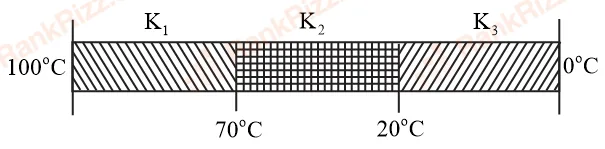
Three rods of identical cross-section and length are made of three different materials of thermal conductivity K1K_1, K2K_2 and K3K_3, respectively. They are joined together at their ends to make a long rod (see figure). One end of the long rod is maintained at 100∘C100^\circ\text{C} and the other at 0∘C0^\circ\text{C} (see figure). If the joints of the rod are at 70∘C70^\circ\text{C} and 20∘C20^\circ\text{C} in steady state and there is no loss of energy from the surface of the rod, the correct relationship between K1K_1, K2K_2 and K3K_3 is:

Figure for JEE Main 2020 Physics question on Heat conduction and thermal resistance
  1. A

    K1:K3=2:3K_1 : K_3 = 2 : 3; K2:K3=2:5K_2 : K_3 = 2 : 5

  2. B

    K1<K2<K3K_1 < K_2 < K_3

  3. C

    K1:K2=5:2K_1 : K_2 = 5 : 2; K1:K3=3:5K_1 : K_3 = 3 : 5

  4. D

    K1>K2>K3K_1 > K_2 > K_3

Q8Mean free path

In a dilute gas at pressure P and temperature T, the time between successive collision of a molecule varies with T as:

  1. A

    T

  2. B

    1T\frac{1}{\sqrt{T}}

  3. C

    1T\frac{1}{T}

  4. D

    T\sqrt{T}

Q9de Broglie wavelength of matter waves

Assuming the nitrogen molecule is moving with r.m.s. velocity at 400 K, the de-Broglie wave length of nitrogen molecule is close to: (Given: nitrogen molecule weight: 4.64×10⁻²⁶ kg4.64 \times 10^{-26}\,\text{kg}, Boltzman constant: 1.38×10⁻²³ J K−11.38 \times 10^{-23}\,\text{J K}^{-1}, Planck constant: 6.63×10⁻³⁴ J s6.63 \times 10^{-34}\,\text{J s})

  1. A

    0.24 A˚0.24\,\text{\AA}

  2. B

    0.20 A˚0.20\,\text{\AA}

  3. C

    0.34 A˚0.34\,\text{\AA}

  4. D

    0.44 A˚0.44\,\text{\AA}

Q10Spring-block oscillations

When a particle of mass mm is attached to a vertical spring of spring constant kk and released, its motion is described by y(t)=y0sin⁡2ωty(t) = y_0\sin^2\omega t, where 'y' is measured from the lower end of unstretched spring. Then ω\omega is:

  1. A

    12gy0\frac{1}{2}\sqrt{\frac{g}{y_0}}

  2. B

    gy0\sqrt{\frac{g}{y_0}}

  3. C

    g2y0\sqrt{\frac{g}{2y_0}}

  4. D

    2gy0\sqrt{\frac{2g}{y_0}}

Q11Electric dipole and dipole in external field

Two identical electric point dipoles have dipole moments p⃗1=pi^\vec{p}_1 = p\hat{i} and p⃗2=−pi^\vec{p}_2 = -p\hat{i} and are held on the x-axis at distance 'a' from each other. When released, they move along the x-axis with the direction of their dipole moments remaining unchanged. If the mass of each dipole is 'm', their speed when they are infinitely far apart is:

  1. A

    pa1πε0ma\frac{p}{a}\sqrt{\frac{1}{\pi\varepsilon_0 ma}}

  2. B

    pa12πε0ma\frac{p}{a}\sqrt{\frac{1}{2\pi\varepsilon_0 ma}}

  3. C

    pa2πε0ma\frac{p}{a}\sqrt{\frac{2}{\pi\varepsilon_0 ma}}

  4. D

    pa32πε0ma\frac{p}{a}\sqrt{\frac{3}{2\pi\varepsilon_0 ma}}

Q12Electric field due to point charges and superposition

Consider the force F on a charge 'q' due to a uniformly charged spherical shell of radius R carrying charge Q distributed uniformly over it. Which one of the following statements is true for F, if 'q' is placed at distance r from the centre of the shell?

  1. A

    F=14πε0QqR2F = \frac{1}{4\pi\varepsilon_0}\frac{Qq}{R^2} for r<Rr < R

  2. B

    14πε0qQR2>F>0\frac{1}{4\pi\varepsilon_0}\frac{qQ}{R^2} > F > 0 for r<Rr < R

  3. C

    F=14πε0Qqr2F = \frac{1}{4\pi\varepsilon_0}\frac{Qq}{r^2} for r>Rr > R

  4. D

    F=14πε0Qqr2F = \frac{1}{4\pi\varepsilon_0}\frac{Qq}{r^2} for all r

Q13Kirchhoff's laws and circuit analysis

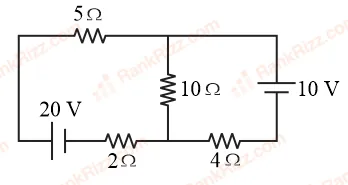
In the figure shown, the current in the 10 V10\,\text{V} battery is close to:

Figure for JEE Main 2020 Physics question on Kirchhoff's laws and circuit analysis
  1. A

    0.71 A from positive to negative terminal

  2. B

    0.42 A from positive to negative terminal

  3. C

    0.21 A from positive to negative terminal

  4. D

    0.36 A from negative to positive terminal

Q14Galvanometer conversion to ammeter and voltmeter

A circuit to verify Ohm's law uses ammeter and voltmeter in series or parallel connected correctly to the resistor. In the circuit:

  1. A

    ammeter is always used in parallel and voltmeter is series

  2. B

    Both ammeter and voltmeter must be connected in parallel

  3. C

    ammeter is always connected in series and voltmeter in parallel

  4. D

    Both ammeter and voltmeter must be connected in series

Q15Magnetic dipole moment of current loops and torque on loops

A charged particle going around in a circle can be considered to be a current loop. A particle of a mass mm carrying charge qq is moving in a plane with speed vv under the influence of magnetic field B⃗\vec{B}. The magnetic moment of this moving particle is:

  1. A

    mv2B⃗2B2\frac{mv^2\vec{B}}{2B^2}

  2. B

    −mv2B⃗2πB2-\frac{mv^2\vec{B}}{2\pi B^2}

  3. C

    −mv2B⃗B2-\frac{mv^2\vec{B}}{B^2}

  4. D

    −mv2B⃗2B2-\frac{mv^2\vec{B}}{2B^2}

Q16Magnetic dipole moment of current loops and torque on loops

A square loop of side 2a2a and carrying current I is kept in xz plane with its centre at origin. A long wire carrying the same current I is placed parallel to z-axis and passing through point (0,b,0)(0, b, 0), (b>>a)(b >> a). The magnitude of torque on the loop about z-axis will be:

  1. A

    2μ0I2a2πb\frac{2\mu_0 I^2 a^2}{\pi b}

  2. B

    2μ0I2a2bπ(a2+b2)\frac{2\mu_0 I^2 a^2 b}{\pi(a^2+b^2)}

  3. C

    μ0I2a2b2π(a2+b2)\frac{\mu_0 I^2 a^2 b}{2\pi(a^2+b^2)}

  4. D

    μ0I2a22πb\frac{\mu_0 I^2 a^2}{2\pi b}

Q17Properties of EM waves: fields, energy, intensity and momentum

For a plane electromagnetic wave, the magnetic field at a point x and time t is:
B⃗(x,t)=[1.2×10⁻⁷sin⁡(0.5×10³x+1.5×10¹¹t)k^] T\vec{B}(x, t) = [1.2 \times 10^{-7}\sin(0.5 \times 10^3 x + 1.5 \times 10^{11}t)\hat{k}]\,\text{T}.
The instantaneous electric field E⃗\vec{E} corresponding to B⃗\vec{B} is:

  1. A

    E⃗(x,t)=[−36sin⁡(0.5×10³x+1.5×10¹¹t)j^] Vm\vec{E}(x, t) = [-36\sin(0.5 \times 10^3 x + 1.5 \times 10^{11}t)\hat{j}]\,\frac{V}{m}

  2. B

    E⃗(x,t)=[36sin⁡(1×10³x+0.5×10¹¹t)j^] Vm\vec{E}(x, t) = [36\sin(1 \times 10^3 x + 0.5 \times 10^{11}t)\hat{j}]\,\frac{V}{m}

  3. C

    E⃗(x,t)=[36sin⁡(0.5×10³x+1.5×10¹¹t)k^] Vm\vec{E}(x, t) = [36\sin(0.5 \times 10^3 x + 1.5 \times 10^{11}t)\hat{k}]\,\frac{V}{m}

  4. D

    E⃗(x,t)=[36sin⁡(1×10³x+15×1011t)i^] Vm\vec{E}(x, t) = [36\sin(1 \times 10^3 x + 15 \times 10^{11}t)\hat{i}]\,\frac{V}{m}

Q18Thin lenses: lens formula, lens maker's formula and power

A double convex lens has power P and same radii of curvature R of both the surfaces. The radius of curvature of a surface of a plano-convex lens made of the same material with power 1.5 P1.5\,P is:

  1. A

    2R

  2. B

    R2\frac{R}{2}

  3. C

    3R2\frac{3R}{2}

  4. D

    R3\frac{R}{3}

Q19Radioactivity: decay law, half-life and decay modes

Given the masses of various atomic particles mP=1.0072 um_P = 1.0072\,\text{u}, mn=1.0087 um_n = 1.0087\,\text{u}, me=0.000548 um_e = 0.000548\,\text{u}, mvˉ=0m_{\bar{v}} = 0, md=2.0141 um_d = 2.0141\,\text{u}, where p = proton, n = neutron, e = electron, vˉ\bar{v} = antineutrino and d = deuteron. Which of the following process is allowed by momentum and energy conservation:

  1. A

    n+n→n + n \to deuterium atom (electron bound to the nucleus)

  2. B

    p→n+e++vˉp \to n + e^+ + \bar{v}

  3. C

    n+p→d+γn + p \to d + \gamma

  4. D

    e++e−→γe^+ + e^- \to \gamma

Q20Errors in measurement and significant figures

A student measuring the diameter of a pencil of circular cross-section with the help of a vernier scale records the following four readings 5.50 mm, 5.55 mm, 5.34 mm, 5.65 mm. The average of these four readings is 5.5375 mm and the standard deviation of the data is 0.07395 mm. The average diameter of the pencil should therefore be recorded as:

  1. A

    (5.5375±0.0739) mm(5.5375 \pm 0.0739)\,\text{mm}

  2. B

    (5.5375±0.0740) mm(5.5375 \pm 0.0740)\,\text{mm}

  3. C

    (5.538±0.074) mm(5.538 \pm 0.074)\,\text{mm}

  4. D

    (5.54±0.07) mm(5.54 \pm 0.07)\,\text{mm}

Q21Centre of mass of continuous bodies and cavities

The centre of mass of a solid hemisphere of radius 8 cm8\,\text{cm} is x cmx\,\text{cm} from the centre of the flat surface. Then value of xx is___

Q22Second law, heat engines, refrigerators and reversibility

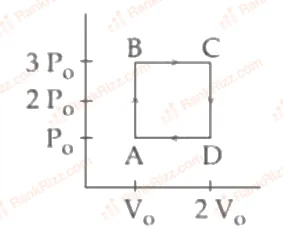
An engine operates by taking a monatomic ideal gas through the cycle shown in the figure. The percentage efficiency of the engine is close to___

Figure for JEE Main 2020 Physics question on Second law, heat engines, refrigerators and reversibility
Q23Series LCR circuits: impedance and phase

In a series LR circuit, power of 400 W400\,\text{W} is dissipated from a source of 250 V250\,\text{V}, 50 Hz50\,\text{Hz}. The power factor of the circuit is 0.80.8. In order to bring the power factor to unity, a capacitor of value C is added in series to the L and R. Taking the value of C as (n3π) μF\left(\frac{n}{3\pi}\right)\,\mu F, then value of n is___

Q24Wavefronts and Huygens' principle

A Young's double-slit experiment is performed using monochromatic light of wavelength λ\lambda. The intensity of light at a point on the screen, where the path difference is λ\lambda, is KK units. The intensity of light at a point where the path difference is λ6\dfrac{\lambda}{6} is given by nK12\dfrac{nK}{12}, where n is an integer. The value of n is___

Q25Transistors (older syllabus)

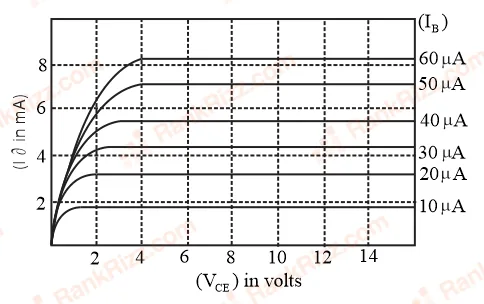
The output characteristics of a transistor is shown in the figure. When VCEV_{CE} is 10 V10\,\text{V} and IC=4.0 mAI_C = 4.0\,\text{mA}, then value of βac\beta_{ac} is___

Figure for JEE Main 2020 Physics question on Transistors (older syllabus)
NEXT IN THIS PAPER →Chemistry, Q26 onwards