RankRizz

JEE Main 05 Sep 2020, Shift 1 Question Paper

All 75 questions of JEE Main 05 Sep 2020, Shift 1, in the order they were asked, one subject to a page. Pick an answer on any question to check it against the key. Free to read, nothing to download.

Questions

75

Physics · Chemistry · Maths

Answer key

75

questions with a checked key

Price

Free

no sign-up

Physics

Q1Errors in measurement and significant figures

A physical quantity zz depends on four observables aa, bb, cc and dd, as z=a2b2/3cd3z = \frac{a^2 b^{2/3}}{\sqrt{cd^3}}. The percentage of error in the measurement of aa, bb, cc and dd are 2%2\%, 1.5%1.5\%, 4%4\% and 2.5%2.5\% respectively. The percentage of error in zz is:

  1. A

    12.25%

  2. B

    16.5%

  3. C

    13.5%

  4. D

    14.5%

Q2Kinematics in two dimensions using position vectors

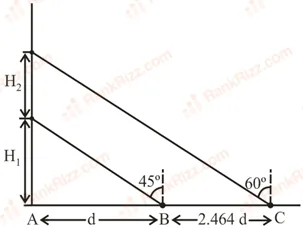
A balloon is moving up in air vertically above a point AA on the ground. When it is at a height h1h_1, a girl standing at a distance dd (point B) from AA (see figure) sees it at an angle 45∘45^\circ with respect to the vertical. When the balloon climbs up a further height h2h_2, it is seen at an angle 60∘60^\circ with respect to the vertical if the girl moves further by a distance 2.464 d2.464\,d (point C). Then the height h2h_2 is (given tan⁡30∘=0.5774\tan 30^\circ = 0.5774):

Figure for JEE Main 2020 Physics question on Kinematics in two dimensions using position vectors
  1. A

    1.464 dd

  2. B

    0.732 dd

  3. C

    0.464 dd

  4. D

    dd

Q3Vertical motion under gravity

A helicopter rises from rest on the ground vertically upwards with a constant acceleration gg. A food packet is dropped from the helicopter when it is at a height hh. The time taken by the packet to reach the ground is close to [gg is the acceleration due to gravity]:

  1. A

    23hg\frac{2}{3}\sqrt{\frac{h}{g}}

  2. B

    1.8hg1.8\sqrt{\frac{h}{g}}

  3. C

    3.4hg3.4\sqrt{\frac{h}{g}}

  4. D

    2h3g\sqrt{\frac{2h}{3g}}

Q4Angular momentum of particles and rigid bodies

A wheel is rotating freely with an angular speed ω\omega on a shaft. The moment of inertia of the wheel is II and the moment of inertia of the shaft is negligible. Another wheel of moment of inertia 3I3I initially at rest is suddenly coupled to the same shaft. The resultant fractional loss in the kinetic energy of the system is:

  1. A

    56\frac{5}{6}

  2. B

    14\frac{1}{4}

  3. C

    0

  4. D

    34\frac{3}{4}

Q5Acceleration due to gravity and its variation

The value of the acceleration due to gravity is g1g_1 at a height h=R2h = \frac{R}{2} (RR = radius of the earth) from the surface of the earth. It is again equal to g1g_1 at a depth dd below the surface the earth. The ratio (dR)\left(\frac{d}{R}\right) equals:

  1. A

    49\frac{4}{9}

  2. B

    59\frac{5}{9}

  3. C

    13\frac{1}{3}

  4. D

    79\frac{7}{9}

Q6Archimedes' principle and floatation

A hollow spherical shell at outer radius RR floats just submerged under the water surface. The inner radius of the shell is rr. If the specific gravity of the shell material is 278\frac{27}{8} with respect to water, the value of rr is:

  1. A

    89R\frac{8}{9}R

  2. B

    49R\frac{4}{9}R

  3. C

    23R\frac{2}{3}R

  4. D

    13R\frac{1}{3}R

Q7Work done in thermodynamic processes and P-V diagrams

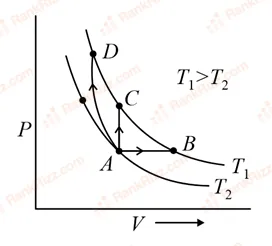
Three different processes that can occur in an ideal monoatomic gas are shown in the PP vs VV diagram. The paths are labelled as A→BA \to B, A→CA \to C and A→DA \to D. The change in internal energies during these processes are taken as EABE_{AB}, EACE_{AC} and EADE_{AD} and the work done as WABW_{AB}, WACW_{AC} and WADW_{AD}. The correct relation between these parameters are:

Figure for JEE Main 2020 Physics question on Work done in thermodynamic processes and P-V diagrams
  1. A

    EAB=EAC<EADE_{AB} = E_{AC} < E_{AD}, WAB>0W_{AB} > 0, WAC=0W_{AC} = 0, WAD<0W_{AD} < 0

  2. B

    EAB=EAC=EADE_{AB} = E_{AC} = E_{AD}, WAB>0W_{AB} > 0, WAC=0W_{AC} = 0, WAD<0W_{AD} < 0

  3. C

    EAB<EAC<EADE_{AB} < E_{AC} < E_{AD}, WAB>0W_{AB} > 0, WAC>WADW_{AC} > W_{AD}

  4. D

    EAB>EAC>EADE_{AB} > E_{AC} > E_{AD}, WAB<WAC<WADW_{AB} < W_{AC} < W_{AD}

Q8Kinetic interpretation of pressure and temperature

Number of molecules in a volume of 4 cm34\,\text{cm}^3 of a perfect monoatomic gas at some temperature T and at a pressure of 2 cm2\,\text{cm} of mercury is close to? (Given, mean kinetic energy of a molecule (at T) is 4×10⁻¹⁴ erg4 \times 10^{-14}\,\text{erg}, g=980 cm s−2g = 980\,\text{cm s}^{-2}, density of mercury =13.6 g cm−3= 13.6\,\text{g cm}^{-3})

  1. A

    4.8×10184.8 \times 10^{18}

  2. B

    4.0×10184.0 \times 10^{18}

  3. C

    5.8×10165.8 \times 10^{16}

  4. D

    5.8×10185.8 \times 10^{18}

Q9Calorimetry and specific heat capacity

A bullet of mass 5 gram5\,\text{gram}, travelling with a speed of 210 m s−1210\,\text{m s}^{-1}, strikes a fixed wooden target. One half of its kinetic energy is converted into heat in the wood. The rise of temperature of the bullet if the specific heat of its material is 0.030 (gram ∘C)−10.030\,(\text{gram}\,^\circ\text{C})^{-1} (1 calorie=4.2×10⁷ ergs1\,\text{calorie} = 4.2 \times 10^7\,\text{ergs}) close to:

  1. A

    87.5∘C87.5^\circ\text{C}

  2. B

    83.3∘C83.3^\circ\text{C}

  3. C

    119.2∘C119.2^\circ\text{C}

  4. D

    38.4∘C38.4^\circ\text{C}

Q10Progressive waves: wave equation, phase and intensity

Assume that the displacement (s) of air is proportional to the pressure difference (Δp)(\Delta p) created by a sound wave. Displacement (s) further depends on the speed of sound (v), density of air (ρ\rho) and the frequency (f). If Δp∼10 Pa\Delta p \sim 10\,\text{Pa}, v∼300 m/sv \sim 300\,\text{m/s}, ρ∼1 kg/m3\rho \sim 1\,\text{kg/m}^3, f∼1000 Hzf \sim 1000\,\text{Hz}, then ss will be of the order of (take the multiplicative constant to be 1):

  1. A

    3100 mm\frac{3}{100}\,\text{mm}

  2. B

    10 mm10\,\text{mm}

  3. C

    110 mm\frac{1}{10}\,\text{mm}

  4. D

    1 mm1\,\text{mm}

Q11Superposition, interference and beats

In a resonance tube experiment when the tube is filled with water up to a height of 17.0 cm17.0\,\text{cm}, from bottom, it resonates with a given tuning fork. When the water level is raised the next resonance with the same tuning fork occurs at a height of 24.5 cm24.5\,\text{cm}. If the velocity of sound in air is 330 m s−1330\,\text{m s}^{-1}, the tuning fork frequency is:

  1. A

    2200 Hz2200\,\text{Hz}

  2. B

    550 Hz550\,\text{Hz}

  3. C

    1100 Hz1100\,\text{Hz}

  4. D

    3300 Hz3300\,\text{Hz}

Q12Electric potential and potential energy

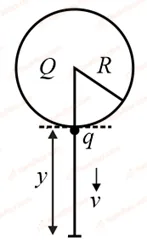
A solid sphere of radius RR carries a charge Q+qQ + q distributed uniformly over its volume. A very small point like piece of it of mass mm gets detached from the bottom of the sphere and falls down vertically under gravity. This piece carries charge qq. If it acquires a speed vv when it has fallen through a vertical height yy (see figure), then (assume the remaining portion to be spherical)

Figure for JEE Main 2020 Physics question on Electric potential and potential energy
  1. A

    v2=y[qQ4πε0R2ym+g]v^2 = y\left[\frac{qQ}{4\pi\varepsilon_0 R^2 ym} + g\right]

  2. B

    v2=y[qQ4πε0R(R+y)m+g]v^2 = y\left[\frac{qQ}{4\pi\varepsilon_0 R(R+y)m} + g\right]

  3. C

    v2=2y[QqR4πε0(R+y)3m+g]v^2 = 2y\left[\frac{QqR}{4\pi\varepsilon_0(R+y)^3 m} + g\right]

  4. D

    v2=2y[qQ4πε0R(R+y)m+g]v^2 = 2y\left[\frac{qQ}{4\pi\varepsilon_0 R(R+y)m} + g\right]

Q13Series and parallel combinations of capacitors

Two capacitors of capacitances CC and 2C2C are charged to potential differences VV and 2V2V, respectively. These are then connected in parallel in such a manner that the positive terminal of one is connected to the negative terminal of the other. The final energy of this configuration is:

  1. A

    256CV2\frac{25}{6}CV^2

  2. B

    32CV2\frac{3}{2}CV^2

  3. C

    zero

  4. D

    92CV2\frac{9}{2}CV^2

Q14Galvanometer conversion to ammeter and voltmeter

A galvanometer of resistance GG is converted into a voltmeter of range 0−1 V0 - 1\,\text{V} by connecting a resistance RR in series with it. The additional resistance that should be connected in series with R1R_1 to increase the range of the voltmeter to 0−2 V0 - 2\,\text{V} will be:

  1. A

    GG

  2. B

    R1R_1

  3. C

    R1−GR_1 - G

  4. D

    R1+GR_1 + G

Q15Electric power and heating effect of current

An electrical power line, having a total resistance of 2 Ω2\,\Omega, delivers 1 kW1\,\text{kW} at 220 V220\,\text{V}. The efficiency of the transmission line is approximately:

  1. A

    72%

  2. B

    91%

  3. C

    85%

  4. D

    96%

Q16Properties of EM waves: fields, energy, intensity and momentum

An electron is constrained to move along the yy-axis with a speed of 0.1 c0.1\,c (cc is the speed of light) in the presence of electromagnetic wave, whose electric field is E⃗=30j^sin⁡(1.5×10⁷t−5×10⁻²x) V m−1\vec{E} = 30\hat{j}\sin(1.5 \times 10^7 t - 5 \times 10^{-2}x)\,\text{V m}^{-1}, where tt in in seconds and xx is in meters. The maximum magnetic force experienced by the electron will be: (given c=3×10⁸ m s−1c = 3 \times 10^8\,\text{m s}^{-1} and electron charge =1.6×10⁻¹⁹ Coulombs= 1.6 \times 10^{-19}\,\text{Coulombs})

  1. A

    3.2×10⁻¹⁸ N3.2 \times 10^{-18}\,\text{N}

  2. B

    2.4×10⁻¹⁸ N2.4 \times 10^{-18}\,\text{N}

  3. C

    4.8×10⁻¹⁹ N4.8 \times 10^{-19}\,\text{N}

  4. D

    1.6×10⁻¹⁹ N1.6 \times 10^{-19}\,\text{N}

Q17Magnetic dipole moment of current loops and torque on loops

A square loop of side 2a2a, and carrying current II, is kept in XZXZ plane with its centre at origin. A long wire carrying the same current II is placed parallel to the zz-axis and passing through the point (0,b,0)(0, b, 0), (b>>a)(b >> a). The magnitude of the torque on the loop about zz-axis is given by:

  1. A

    μ0I2a22πb\frac{\mu_0 I^2 a^2}{2\pi b}

  2. B

    μ0I2a22πb2\frac{\mu_0 I^2 a^2}{2\pi b^2}

  3. C

    2μ0I2a2πb\frac{2\mu_0 I^2 a^2}{\pi b}

  4. D

    2μ0I2a3πb2\frac{2\mu_0 I^2 a^3}{\pi b^2}

Q18Thin lenses: lens formula, lens maker's formula and power

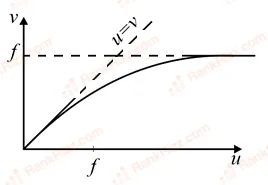
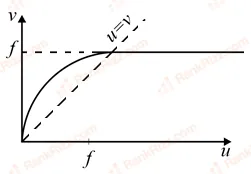
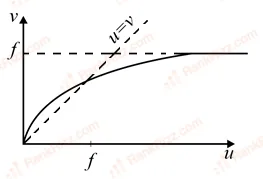
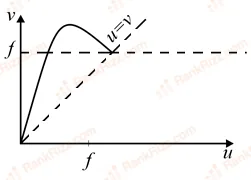
For a concave lens of focal length ff, the relation between object and image distance uu and vv, respectively, from its pole can best be represented by (u=vu = v is the reference line):

  1. A
    Figure for JEE Main 2020 Physics question on Thin lenses: lens formula, lens maker's formula and power
  2. B
    Figure for JEE Main 2020 Physics question on Thin lenses: lens formula, lens maker's formula and power
  3. C
    Figure for JEE Main 2020 Physics question on Thin lenses: lens formula, lens maker's formula and power
  4. D
    Figure for JEE Main 2020 Physics question on Thin lenses: lens formula, lens maker's formula and power
Q19Radioactivity: decay law, half-life and decay modes

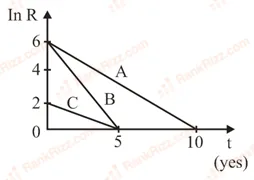
Activities of three radioactive substances AA, BB and CC are represented by the curves AA, BB and CC, in the figure. Then their half-lives T1/2(A):T1/2(B):T1/2(C)T_{1/2}(A) : T_{1/2}(B) : T_{1/2}(C) are in the ratio:

Figure for JEE Main 2020 Physics question on Radioactivity: decay law, half-life and decay modes
  1. A

    2:1:12 : 1 : 1

  2. B

    3:2:13 : 2 : 1

  3. C

    2:1:32 : 1 : 3

  4. D

    4:3:14 : 3 : 1

Q20Zener diode, LED, photodiode and solar cell

With increasing biasing voltage of a photo diode, the photocurrent magnitude:

  1. A

    remains constant

  2. B

    increases initially and after attaining certain value, it decreases

  3. C

    increases linearly

  4. D

    increases initially and saturates finally

Q21Hydrogen spectrum and spectral series

A particle of mass 200 MeV c−2200\,\text{MeV c}^{-2} collides with a hydrogen atom at rest. Soon after the collision, the particle comes to rest, and the atom recoils and goes to its first excited state. The initial kinetic energy of the particle (in eV) is N4\frac{N}{4}. The value of NN is: (Given the mass of the hydrogen atom to be 1 GeV c−21\,\text{GeV c}^{-2})........

Q22Torque and the rotational form of Newton's second law

A force F⃗=(i^+2j^+3k^) N\vec{F} = \left(\hat{i} + 2\hat{j} + 3\hat{k}\right)\,\text{N} acts at a point (4i^+3j^−k^) m\left(4\hat{i} + 3\hat{j} - \hat{k}\right)\,\text{m}. Then the magnitude of torque about the point (i^+2j^+k^) m\left(\hat{i} + 2\hat{j} + \hat{k}\right)\,\text{m} will be x N-m\sqrt{x}\,\text{N-m}. The value of xx is..........

Q23Self inductance and energy stored in inductors

Two concentric circular coils, C1C_1 and C2C_2, are placed in the XYXY plane. C1C_1 has 500 turns, and a radius of 1 cm1\,\text{cm}. C2C_2 has 200 turns and radius of 20 cm20\,\text{cm}. C2C_2 carries a time dependent current I(t)=(5t2−2t+3) AI(t) = (5t^2 - 2t + 3)\,\text{A} where tt is in s. The emf induced in C1C_1 (in mV) at the instant t=1 st = 1\,\text{s} is 4x\frac{4}{x}. The value of xx is..........

Q24Optical instruments: microscopes and telescopes

A compound microscope consists of an objective lens of focal length 1 cm1\,\text{cm} and an eye piece of focal length 5 cm5\,\text{cm} with a separation of 10 cm10\,\text{cm}. The distance between an object and the objective lens, at which the strain on the eye is minimum is n40 cm\frac{n}{40}\,\text{cm}. The value of nn is.......

Q25Davisson-Germer experiment

A beam of electrons of energy EE scatters from a target having atomic spacing of 1 A˚1\,\text{\AA}. The first maximum intensity occurs at θ=60∘\theta = 60^\circ. Then EE (in eV) is......... (Planck's constant h=6.64×10⁻³⁴ Jsh = 6.64 \times 10^{-34}\,\text{Js}, 1 eV=1.6×10⁻¹⁹ J1\,\text{eV} = 1.6 \times 10^{-19}\,\text{J}, electron mass m=9.1×10⁻³¹ kgm = 9.1 \times 10^{-31}\,\text{kg})

NEXT IN THIS PAPER →Chemistry, Q26 onwards