RankRizz

JEE Main 04 Sep 2020, Shift 2 Question Paper

All 75 questions of JEE Main 04 Sep 2020, Shift 2, in the order they were asked, one subject to a page. Pick an answer on any question to check it against the key. Free to read, nothing to download.

Questions

75

Physics · Chemistry · Maths

Answer key

75

questions with a checked key

Price

Free

no sign-up

Physics

Q1Dimensional analysis: deriving and checking relations

A quantity xx is given by (1Fv2/WL4)(1Fv^2/WL^4) in terms of moment of inertia II, force FF, velocity vv, work WW and length LL. The dimensional formula for xx is same as that of:

  1. A

    planck's constant

  2. B

    force constant

  3. C

    energy density

  4. D

    coefficient of viscosity

Q2Motion and equilibrium of charged bodies in electric fields

A particle of charge qq and mass mm is subjected to an electric field E=E0(1−ax2)E = E_0(1 - ax^2) in the xx-direction, where aa and E0E_0 are constants. Initially the particle was at rest at x=0x = 0. Other than the initial position the kinetic energy of the particle becomes zero when the distance of the particle from the origin is:

  1. A

    aa

  2. B

    2a\sqrt{\frac{2}{a}}

  3. C

    3a\sqrt{\frac{3}{a}}

  4. D

    1a\sqrt{\frac{1}{a}}

Q3Newton's laws, free-body diagrams and equilibrium of a particle

A small ball of mass mm is thrown upward with velocity uu from the ground. The ball experiences a resistive force mkv2mkv^2 where vv is its speed. The maximum height attained by the ball is:

  1. A

    12ktan⁡−1ku2g\frac{1}{2k}\tan^{-1}\frac{ku^2}{g}

  2. B

    1kln⁡(1+ku22g)\frac{1}{k}\ln\left(1 + \frac{ku^2}{2g}\right)

  3. C

    1ktan⁡−1ku22g\frac{1}{k}\tan^{-1}\frac{ku^2}{2g}

  4. D

    12kln⁡(1+ku2g)\frac{1}{2k}\ln\left(1 + \frac{ku^2}{g}\right)

Q4Work done by constant and variable forces

A person pushes a box on a rough horizontal platform surface. He applies a force of 200 N over a distance of 15 m. Thereafter, he gets progressively tired and his applied force reduces linearly with distance to 100 N. The total distance through which the box has been moved is 30 m. What is the work done by the person during the total movement of the box?

  1. A

    3280 J

  2. B

    2780 J

  3. C

    5690 J

  4. D

    5250 J

Q5Moment of inertia of standard bodies and composite systems

Consider two uniform discs of the same thickness and different radii R1=RR_1 = R and R2=αRR_2 = \alpha R made of the same material. If the ratio of their moments of inertia I1I_1 and I2I_2, respectively, about their axes is I1:I2=1:16I_1 : I_2 = 1 : 16 then the value of α\alpha is:

  1. A

    222\sqrt{2}

  2. B

    2\sqrt{2}

  3. C

    22

  4. D

    44

Q6Moment of inertia of standard bodies and composite systems

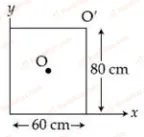
For a uniform rectangular sheet shown in the figure, the ratio of moments of inertia about the axes perpendicular to the sheet and passing through O (the centre of mass) and O' (corner point) is:

Figure for JEE Main 2020 Physics question on Moment of inertia of standard bodies and composite systems
  1. A

    2/3

  2. B

    1/4

  3. C

    1/8

  4. D

    1/2

Q7Satellites: orbital speed, period, energy and geostationary orbits

A body is moving in a low circular orbit about a planet of mass M and radius R. The radius of the orbit can be taken to be R itself. Then the ratio of the speed of this body in the orbit to the escape velocity from the planet is:

  1. A

    12\frac{1}{\sqrt{2}}

  2. B

    22

  3. C

    11

  4. D

    2\sqrt{2}

Q8Bulk modulus and compressibility

A cube of metal is subjected to a hydrostatic pressure 4 GPa. The percentage change in the length of the side of the cube is close to: (Given bulk modulus of metal, B=8×10¹⁰B = 8 \times 10^{10} Pa)

  1. A

    5

  2. B

    0.6

  3. C

    20

  4. D

    1.67

Q9Fluid pressure, Pascal's law and accelerated/rotating liquids

Two identical cylindrical vessels are kept on the ground and each contain the same liquid of density dd. The area of the base of both vessels is SS but the height of liquid in one vessel is x1x_1 and in the other x2x_2. When both cylinders are connected through a pipe of negligible volume very close to the bottom, the liquid flows from one vessel to the other until it comes to equilibrium at a new height. The change in energy of the system in the process is:

  1. A

    gdS(x22+x12)gdS(x_2^2 + x_1^2)

  2. B

    gdS(x2+x1)2gdS(x_2 + x_1)^2

  3. C

    34gdS(x2−x1)2\frac{3}{4}gdS(x_2 - x_1)^2

  4. D

    14gdS(x2−x1)2\frac{1}{4}gdS(x_2 - x_1)^2

Q10Zeroth and first law of thermodynamics

Match the thermodynamics processes taking place in a system with the correct conditions. In the table: ΔQ\Delta Q is the heat supplied, ΔW\Delta W is the work done and ΔU\Delta U is change in internal energy of the system.
Process    Condition
(I) Adiabatic    (A) ΔW=0\Delta W = 0
(II) Isothermal    (B) ΔQ=0\Delta Q = 0
(III) Isochoric    (C) ΔU≠0,ΔW≠0,ΔQ≠0\Delta U \neq 0, \Delta W \neq 0, \Delta Q \neq 0
(IV) Isobaric    (D) ΔU=0\Delta U = 0

  1. A

    (I)-(A), (II)-(B), (III)-(D), (IV)-(D)

  2. B

    (I)-(B), (II)-(A), (III)-(D), (IV)-(C)

  3. C

    (I)-(A), (II)-(A), (III)-(B), (IV)-(C)

  4. D

    (I)-(B), (II)-(D), (III)-(A), (IV)-(C)

Q11Doppler effect in sound

The driver of bus approaching a big wall notices that the frequency of his bus's horn changes from 420 Hz to 490 Hz when he hears it after it gets reflected from the wall. Find the speed of the bus if speed of the sound is 330 ms−1^{-1}:

  1. A

    91 kmh−1^{-1}

  2. B

    81 kmh−1^{-1}

  3. C

    61 kmh−1^{-1}

  4. D

    71 kmh−1^{-1}

Q12Energy stored, force between plates and charge sharing

A capacitor C is fully charged with voltage V0V_0. After disconnecting the voltage source, it is connected in parallel with another uncharged capacitor of capacitance C2\frac{C}{2}. The energy loss in the process after the charge is distributed between the two capacitors is:

  1. A

    12CV02\frac{1}{2}CV_0^2

  2. B

    13CV02\frac{1}{3}CV_0^2

  3. C

    14CV02\frac{1}{4}CV_0^2

  4. D

    16CV02\frac{1}{6}CV_0^2

Q13Wheatstone bridge

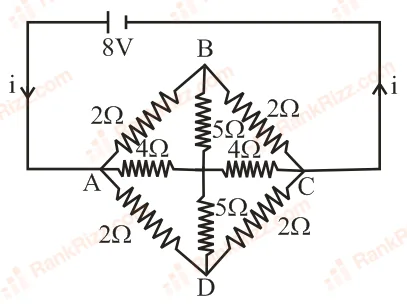
The value of current i1i_1 flowing from A to C in the circuit diagram is:

Figure for JEE Main 2020 Physics question on Wheatstone bridge
  1. A

    5 A

  2. B

    2.25 A

  3. C

    0.75 A

  4. D

    1 A

Q14Magnetisation, magnetic intensity, susceptibility and permeability

A paramagnetic sample shows a net magnetisation of 6 A/m when it is placed in an external magnetic field of 0.4 T at a temperature of 4 K. When the sample is placed in an external magnetic field of 0.3 T at a temperature of 24 K, then the magnetisation will be:

  1. A

    1 A/m

  2. B

    4 A/m

  3. C

    2.25 A/m

  4. D

    0.75 A/m

Q15Magnetic dipole moment of current loops and torque on loops

A circular coil has moment of inertia 0.8 kg m2^2 around any diameter and is carrying current to produce a magnetic moment of 20 Am2^2. The coil is kept initially in a vertical position and it can rotate freely around a horizontal diameter. When a uniform magnetic field of 4 T is applied along the vertical, it starts rotating around its horizontal diameter. The angular speed the coil acquires after rotating by 60° will be:

  1. A

    10 rad s−1^{-1}

  2. B

    10π10\pi rad s−1^{-1}

  3. C

    20π20\pi rad s−1^{-1}

  4. D

    20 rad s−1^{-1}

Q16LR circuits: growth and decay of current

A series L−RL - R circuit is connected to a battery of emf VV. If the circuit is switched on at t=0t = 0, then the time at which the energy stored in the inductor reaches (1n)\left(\frac{1}{n}\right) times of its maximum value, is:

  1. A

    LRln⁡(nn−1)\frac{L}{R}\ln\left(\frac{\sqrt{n}}{\sqrt{n}-1}\right)

  2. B

    LRln⁡(n+1n−1)\frac{L}{R}\ln\left(\frac{\sqrt{n}+1}{\sqrt{n-1}}\right)

  3. C

    LRln⁡(nn+1)\frac{L}{R}\ln\left(\frac{\sqrt{n}}{\sqrt{n+1}}\right)

  4. D

    LRln⁡(n−1n)\frac{L}{R}\ln\left(\frac{\sqrt{n}-1}{\sqrt{n}}\right)

Q17Properties of EM waves: fields, energy, intensity and momentum

The electric field of a plane electromagnetic wave is given by E⃗=E0(x^+y^)sin⁡(kz−ωt)\vec{E} = E_0(\hat{x} + \hat{y})\sin(kz - \omega t). Its magnetic field will be given by

  1. A

    E0c(−x^+y^)sin⁡(kz−ωt)\frac{E_0}{c}(-\hat{x} + \hat{y})\sin(kz - \omega t)

  2. B

    E0c(x^+y^)sin⁡(kz−ωt)\frac{E_0}{c}(\hat{x} + \hat{y})\sin(kz - \omega t)

  3. C

    E0c(x^−y^)sin⁡(kz−ωt)\frac{E_0}{c}(\hat{x} - \hat{y})\sin(kz - \omega t)

  4. D

    E0c(x^−y^)cos⁡(kz−ωt)\frac{E_0}{c}(\hat{x} - \hat{y})\cos(kz - \omega t)

Q18Photoelectric effect and Einstein's equation

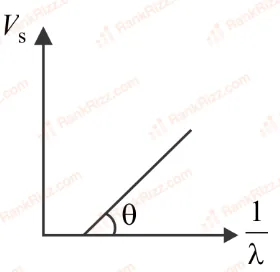
In a photoelectric effect experiment, the graph of stopping potential VV versus reciprocal of wavelength obtained is shown in the figure. As the intensity of incident radiation is increased:

Figure for JEE Main 2020 Physics question on Photoelectric effect and Einstein's equation
  1. A

    Straight line shifts to right

  2. B

    Slope of the straight line get more steep

  3. C

    Straight line shifts to left

  4. D

    Graph does not change

Q19Nuclear size, mass defect and binding energy

Find the Binding energy per nucleon for 50120Sn^{120}_{50}Sn. Mass of proton mp=1.00783m_p = 1.00783 U, mass of neutron mn=1.00867m_n = 1.00867 U and mass of tin nucleus msn=119.902199m_{sn} = 119.902199 U. (take 1U = 931 MeV)

  1. A

    7.5 MeV

  2. B

    9.0 MeV

  3. C

    8.0 MeV

  4. D

    8.5 MeV

Q20Logic gates and digital circuits

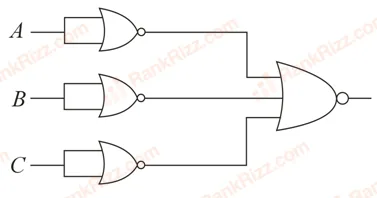
Identify the operation performed by the circuit given below:

Figure for JEE Main 2020 Physics question on Logic gates and digital circuits
  1. A

    NAND

  2. B

    OR

  3. C

    AND

  4. D

    NOT

Q21Motion graphs: x-t, v-t and a-t

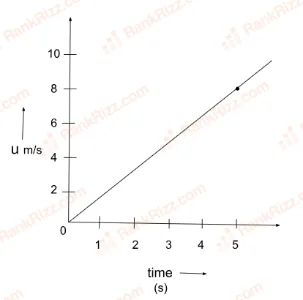
The speed versus time graph for a particle is shown in the figure. The distance travelled (in m) by the particle during the time interval t = 0 to t = 5 s will be __________

Screenshot 2026-03-30 11
Q22Ideal gas equation and gas laws

The change in the magnitude of the volume of an ideal gas when a small additional pressure ΔP\Delta P is applied at a constant temperature, is the same as the change when the temperature is reduced by a small quantity ΔT\Delta T at constant pressure. The initial temperature and pressure of the gas were 300 K and 2 atm respectively. If ∣ΔT∣=C∣ΔP∣|\Delta T| = C|\Delta P| then value of C in (K/atm) is __________

Q23Kirchhoff's laws and circuit analysis

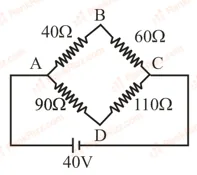
Four resistances 40 Ω\Omega, 60 Ω\Omega, 90 Ω\Omega, 110 Ω\Omega and make the arms of a quadrilateral ABCD. Across AC is a battery of emf 40 V and internal resistance negligible. The potential difference across BD in V is __________

Figure for JEE Main 2020 Physics question on Kirchhoff's laws and circuit analysis
Q24Thin lenses: lens formula, lens maker's formula and power

The distance between an object and a screen is 100 cm. A lens can produce real image of the object on the screen for two different positions between the screen and the object. The distance between these two positions is 40 cm. If the power of the lens is close to (N100)\left(\frac{N}{100}\right)D where N is an integer, the value of N is __________

Q25Single slit diffraction

Orange light of wavelength 6000×10−106000 \times 10^{-10} m illuminates a single slit of width 0.6×10−40.6 \times 10^{-4} m. The maximum possible number of diffraction minima produced on both sides of the central maximum is __________

NEXT IN THIS PAPER →Chemistry, Q26 onwards