Q1Dimensional analysis: deriving and checking relations
Dimensional formula for thermal conductivity is (here K denotes the temperature):
- A
- B
- C
- D
All 75 questions of JEE Main 04 Sep 2020, Shift 1, in the order they were asked, one subject to a page. Pick an answer on any question to check it against the key. Free to read, nothing to download.
Questions
75
Physics · Chemistry · Maths
Answer key
74
questions with a checked key
Price
Free
no sign-up
Dimensional formula for thermal conductivity is (here K denotes the temperature):
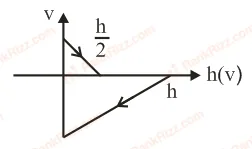
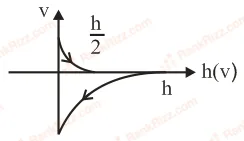
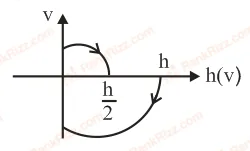
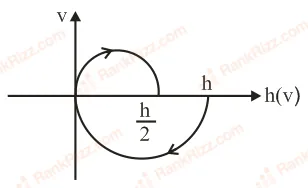
A tennis ball is released from a height h and after freely falling on a wooden floor it rebounds and reaches height h/2. The velocity versus height of the ball during its motion may be represented graphically by: (graphs are drawn schematically and on not to scale)
Starting from the origin at time t = 0, with initial velocity ms, a particle moves in the - plane with a constant acceleration of ms. At time t, its coordinates are (20 m, m). The values of t and are, respectively:
2 s and 18 m
4 s and 52 m
2 s and 24 m
5 s and 25 m
Blocks of masses m, 2m, 4m and 8m are arranged in a line of a frictionless floor. Another block of mass m, moving with speed v along the same line (see figure) collides with mass m in perfectly inelastic manner. All the subsequent collisions are also perfectly inelastic. By the time the last block of mass 8m starts moving the total energy loss is p% of the original energy. Value of 'p' is close to:

77
94
37
87
On the -axis and at a distance from the origin, the gravitational field due to a mass distribution is given by in the -direction. The magnitude of the gravitational potential on the -axis at a distance , taking its value to be zero at infinity is:
An air bubble of radius 1 cm in water has an upward acceleration of 9.8 cms. The density of water is 1 gm cm and water offers negligible drag force on the bubble. The mass of the bubble is cm/s.
4.51 gm
3.15 gm
4.15 gm
1.52 gm
The specific heat of water = 4200 J kg K and the latent heat of ice = J kg. 100 grams of ice at 0°C is placed in 200 g of water at 25°C. The amount of ice that will melt as the temperature of water reaches 0°C is close to (in grams)
61.7
63.8
69.3
64.6
Match the ratio for ideal gases with different type of molecules:
Molecule Type
(A) Monoatomic (I) 7/5
(B) Diatomic rigid molecules (II) 9/7
(C) Diatomic non-rigid molecules (III) 4/3
(D) Triatomic rigid molecules (IV) 5/3
(A) - (IV), (B) - (II), (C) - (I), (D) - (III)
(A) - (III), (B) - (IV), (C) - (II), (D) - (I)
(A) - (IV), (B) - (I), (C) - (II), (D) - (III)
(A) - (II), (B) - (III), (C) - (I), (D) - (IV)
For a transverse wave travelling along a straight line, the distance between two peaks (crests) is 5 m, while the distance between one crest and one trough is 1.5 m. The possible wavelengths (in m) of the waves are:
1, 3, 5
1, 2, 3, ....
Two charged thin infinite plane sheets of uniform charge density and , where , intersect at the right angle. Which of the following best represents the electric field lines for the system:
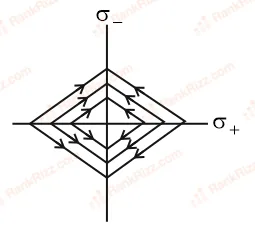
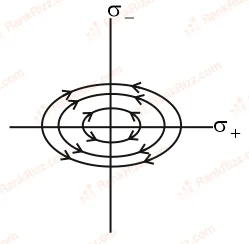
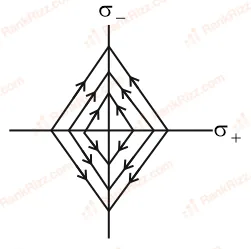
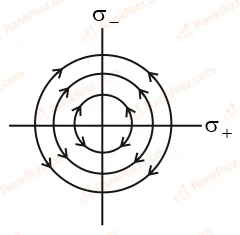
A two point charges and are fixed on the -axis at and , respectively. If the third point charge 'q' is taken from the origin to along the semicircle as shown in the figure, the energy of the charge will:
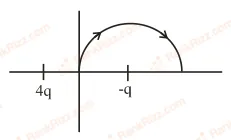
Increase by
Increase by
decrease by
decrease by
A battery of 3.0 V is connected to a resistor dissipating 0.5 W of power. If the terminal voltage of the battery is 2.5 V, the power dissipated within the internal resistance is:
0.50 W
0.072 W
0.10 W
0.125 W
A small bar magnet is placed with its axis at 30° with an external magnetic field of 0.06 T experiences a torque of 0.018 Nm. The minimum work required to rotate it from its stable to unstable equilibrium position is:
J
J
J
J
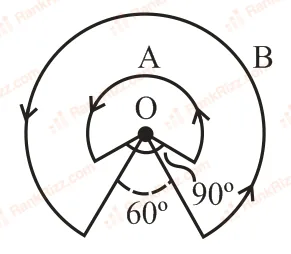
A wire A, bent in the shape of an arc of a circle, carrying a current of 2 A and having radius 2 cm and another wire B, also bent in the shape of an arc of a circle, carrying a current of 3 A and having radius of 4 cm, are placed as shown in the figure. The ratio of the magnetic fields due to the wires A and B at the common centre O is:
4 : 6
6 : 4
2 : 5
6 : 5
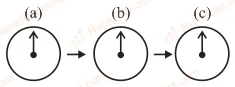
A small bar magnet is moved through a coil at constant speed from one end to the other. Which of the following series of observations will be seen on the galvanometer G attached across the coil?
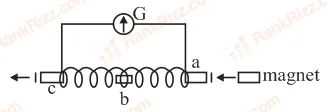
Three positions shown describe: (a) the magnet's entry (b) magnet is completely inside and (c) magnet's exit.
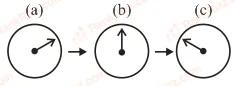
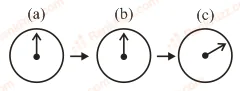
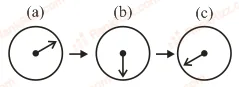
Choose the correct option relating wavelengths of different parts of electromagnetic wave spectrum:
A beam of plane polarized light of large cross-sectional area and uniform intensity of 3.3 W m falls normally on a polarizer (cross-sectional area m), which rotates about its axis with an angular speed of 31.4 rad s. The energy of light passing through the polarizer per revolution, is close to:
J
J
J
J
Particle A of mass moving along the x-axis with velocity collides elastically with another particle B at rest having mass . If both particles move along the x-axis after the collision, the change in the wavelength of particle A, in terms of its de-Broglie wavelength before the collision is:
Given figure shows few data points in a photo-electric effect experiment for a certain metal. The minimum energy for ejection of electrons from its surface is: (Planck's constant h = 6.62 10 J.s)
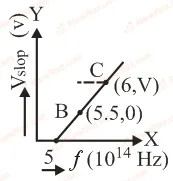
2.27 eV
2.59 eV
1.93 eV
2.10 eV
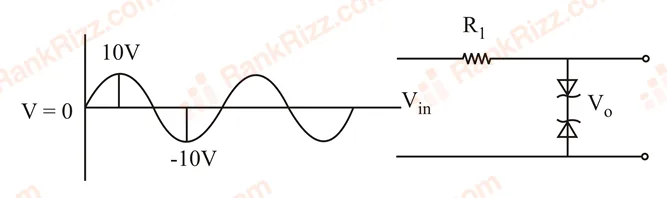
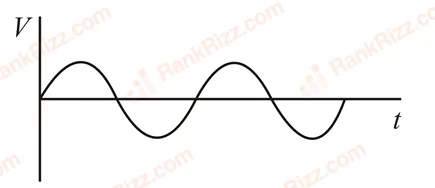
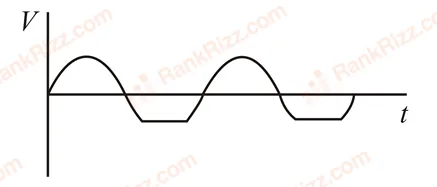
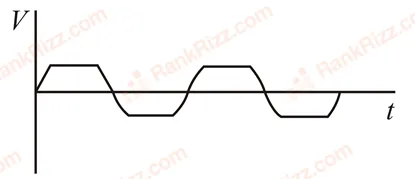
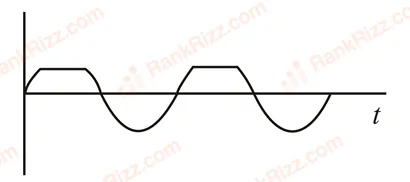
Take the breakdown voltage of the zener diode used in the given circuit as 6V. For the input voltage shown in the figure below, the time variation of the output voltage is: (Graphs drawn are schematic and not to the scale)
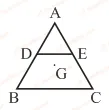
ABC is a plane lamina of the shape of an equilateral triangle. D, E are mid-points of AB, AC and G is the centroid of the lamina. Moment of inertia of the lamina about an axis passing through G and perpendicular to the plane ABC is . If part ADE is removed, the moment of inertia of the remaining part about the same axis is where N is an integer. Value of N is:
A circular disc of mass M and radius R is rotating about its axis with angular speed . If another stationary disc having radius and same mass M is dropped co-axially on to the rotating disc. Gradually both discs attain constant angular speed . The energy lost in the process is p% of the initial energy. Value of p is
A closed vessel contains 0.1 mole of a monoatomic ideal gas at 200 K. If 0.05 mole of the same gas at 400 K is added to it, the final equilibrium temperature (in K) of the gas in the vessel will be close to __________
In a compound microscope, the magnified virtual image is formed at a distance of 25 cm from the eye-piece. The focal length of its objective lens is 1 cm. If the magnification is 100 and the tube length of the microscope is 20 cm, then the focal length of the eye-piece lens (in cm) is __________
In the line spectra of hydrogen atom, difference between the largest and the shortest wavelengths of the Lyman series is 305 . The corresponding difference for the Paschan series in is __________ (nearest integer)