Q1Dimensional analysis: deriving and checking relations
Amount of solar energy received on the earth's surface per unit area per unit time is defined a solar constant. Dimension of solar constant is:
- A
- B
- C
- D
All 75 questions of JEE Main 03 Sep 2020, Shift 2, in the order they were asked, one subject to a page. Pick an answer on any question to check it against the key. Free to read, nothing to download.
Questions
75
Physics · Chemistry · Maths
Answer key
74
questions with a checked key
Price
Free
no sign-up
Amount of solar energy received on the earth's surface per unit area per unit time is defined a solar constant. Dimension of solar constant is:
A particle is moving unidirectional on a horizontal plane under the action of a constant power supplying energy source. The displacement (s) - time (t) graph that describes the motion of the particle is (graphs are drawn schematically and are not to scale):
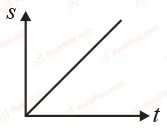
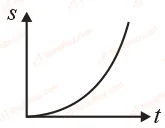
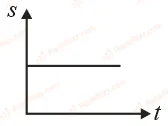
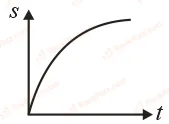
Hydrogen ion and singly ionized helium atom are accelerated, from rest, through the same potential difference. The ratio of final speeds of hydrogen and helium ions is close to:
A block of mass 1.9 kg is at rest at the edge of a table, of height 1 m. A bullet of mass 0.1 kg collides with the block and sticks to it. If the velocity of the bullet is 20 m s in the horizontal direction just before the collision then the kinetic energy just before the combined system strikes the floor, is [Take g = 10 m s. Assume there is no rotational motion and loss of energy after the collision is negligible.]
21 J
20 J
19 J
23 J
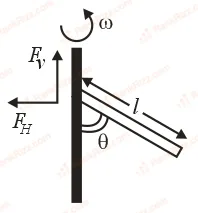
A uniform rod of length '' is pivoted at one of its ends on a vertical shaft of negligible radius. When the shaft rotates at angular speed the rod makes an angle with it (see figure). To find equate the rate of change of angular momentum (direction going into the paper) about the centre of mass (CM) to the torque provided by the horizontal and vertical forces and about the CM. The value of is then such that:
The mass density of a planet of radius R varies with the distance r from its centre as . Then the gravitational field is maximum at:
A metallic sphere cools from 50°C to 40°C in 300 s. If atmospheric temperature around is 20°C, then the sphere's temperature after the next 5 minutes will be close to:
31°C
33°C
28°C
35°C
A calorimeter of water equivalent 20 g contains 180 g of water at 25°C. 'm' grams of steam at 100°C is mixed in it till the temperature of the mixture is 31°C. The value of 'm' is close to (Latent heat of water = 540 cal g, specific heat of water = 1 cal g°C)
2
4
3.2
2.6
To raise the temperature of a certain mass of gas by 50°C at a constant pressure, 160 calories of heat is required. When the same mass of gas is cooled by 100°C at constant volume, 240 calories of heat is released. How many degrees of freedom does each molecule of this gas have (assume gas to be ideal)?
5
6
3
7
A block of mass m attached to a massless spring is performing oscillatory motion of amplitude 'A' on a frictionless horizontal plane. If half of the mass of the block breaks off when it is passing through its equilibrium point, the amplitude of oscillation for the remaining system become . The value of is:
Concentric metallic hollow spheres of radii R and 4R hold charges and respectively. Given that surface charge densities of the concentric spheres are equal, the potential difference V(R) - V(4R) is:
Two resistors 400 and 800 are connected in series across a 6V battery. The potential difference measured by a voltmeter of 10 k across 400 resistor is close to:
2 V
1.8 V
2.05 V
1.95 V
Which of the following will NOT be observed when a multimeter (operating in resistance measuring mode) probes connected across a component, are just reversed?
Multimeter shows an equal deflection in both cases i.e., before and after reversing the probes if the chosen component is resistor
Multimeter shows NO deflection in both cases i.e. before and after reversing the probes if the chosen component is capacitor
Multimeter shows a deflection, accompanied by a splash of light out of connected component in one direction and NO deflection on reversing the probes if the chosen component is LED
Multimeter shows NO deflection in both cases i.e. before and after reversing the probes is the chosen component is metal wire.
A perfectly diamagnetic sphere has a small spherical cavity at its centre, which is filled with a paramagnetic substance. The whole system is placed in a uniform magnetic field . Then the field inside the paramagnetic substance is:

Zero
much larger than and parallel to
much larger than but opposite to
A uniform magnetic field B exists in a direction perpendicular to the plane of a square loop made of a metal wire. The wire has a diameter of 4 mm and a total length of 30 cm. The magnetic field changes with time at a steady rate dB/dt = 0.032 Ts. The induced current in the loop is close to (Resistivity of the metal wire is 1.23 10 m)
0.43 A
0.61 A
0.34 A
0.53 A
The electric field of a plane electromagnetic wave propagating along the x direction in vacuum is . The magnetic field , at the moment t = 0 is:
Two sources of light emit X-rays of wavelength 1 nm and visible light of wavelength 500 nm, respectively. Both the sources emit light of the same power 200 W. The ratio of the number density of photons of X-rays to the number density of photons of the visible light of the given wavelengths is:
250
500
Two light waves having the same wavelength in vacuum are in phase initially. Then the first wave travels a path through a medium of refractive index while the second wave travels a path of length through a medium of refractive index . After this the phase difference between the two waves is:
The radius R of a nucleus of mass number A can be estimated by the formula m. It follows that the mass density of n nucleus is of the order of: kg)
kg m
kg m
kg m
kg m
If a semiconductor photo diode can detect a photon with a maximum wavelength of 400 nm, then its band gap energy is: Planck's constant h = 6.63 10 J.s, Speed of light c = 3 10 m s
1.1 eV
2.0 eV
1.5 eV
3.1 eV
A block starts moving up an inclined plane of inclination 30° with an initial velocity of . It comes back to its initial position with velocity . The value of the coefficient of kinetic friction between the block and the inclined plane is close to . The nearest integer to I is:
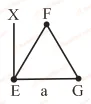
An massless equilateral triangle EFG of side 'a' (As shown in figure) has three particles of mass m situated at its vertices. The moment of inertia of the system about the line EX perpendicular to EG in the plane of EFG is where N is an integer. The value of N is __________.
If minimum possible work is done by a refrigerator in converting 100 grams of water at 0°C to ice, how much heat (in calories) is released to the surroundings at temperature 27°C (Latent heat of ice = 80 Cal/gram) to the nearest integer?
A galvanometer coil has 500 turns and each turn has an average area of m. If a torque of 1.5 Nm is required to keep this coil parallel to a magnetic field when a current of 0.5A is flowing through it, the strength of the field (in T) is __________.
When an object is kept at a distance of 30 cm from a concave mirror, the image is formed at a distance of 10 cm from the mirror. If the object is moved with a speed of 9 cm s, the speed (in cm s) with which image moves at that instant is