RankRizz

JEE Main 03 Sep 2020, Shift 1 Question Paper

All 75 questions of JEE Main 03 Sep 2020, Shift 1, in the order they were asked, one subject to a page. Pick an answer on any question to check it against the key. Free to read, nothing to download.

Questions

75

Physics · Chemistry · Maths

Answer key

75

questions with a checked key

Price

Free

no sign-up

Physics

Q1Moment of inertia of standard bodies and composite systems

Moment of inertia of a cylinder of mass mm, length LL and radius RR about an axis passing through its centre and perpendicular to the axis of the cylinder is I=M(R24+L212)I = M\left(\frac{R^2}{4} + \frac{L^2}{12}\right). If such a cylinder is to be made for a given mass of a material, the ratio LR\frac{L}{R} for it to have minimum possible II is:

  1. A

    23\frac{2}{3}

  2. B

    32\frac{3}{2}

  3. C

    32\sqrt{\frac{3}{2}}

  4. D

    23\sqrt{\frac{2}{3}}

Q2Collisions involving rigid bodies

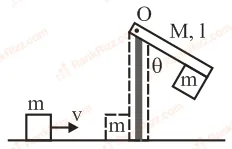
A block of mass m=1m = 1 kg slides with velocity v=6v = 6 m s−1^{-1} on a frictionless horizontal surface and collides with a uniform vertical rod and sticks to it as shown. The rod is pivoted about O and swings as a result of the collision making angle θ\theta before momentarily coming to rest. If the rod has mass M=2M = 2 kg, and length ℓ=1\ell = 1 m, the value of θ\theta is approximately (take g=10g = 10 m s−2^{-2})

Figure for JEE Main 2020 Physics question on Collisions involving rigid bodies
  1. A

    63°63°

  2. B

    55°55°

  3. C

    69°69°

  4. D

    49°49°

Q3Satellites: orbital speed, period, energy and geostationary orbits

A satellite is moving in a low nearly circular orbit around the earth. Its radius is roughly equal to that of the earth's radius ReR_e. By firing rockets attached to it, its speed is instantaneously increased in the direction of its motion so that it becomes 32\sqrt{\frac{3}{2}} times larger. Due to this the farthest distance from the centre of the earth that the satellite reaches is RR. Value of RR is:

  1. A

    4Re4R_e

  2. B

    2.5Re2.5R_e

  3. C

    3Re3R_e

  4. D

    2Re2R_e

Q4Excess pressure in drops and bubbles

Pressure inside two soap bubbles are 1.01 and 1.02 atmosphere, respectively. The ratio of their volumes is:

  1. A

    4:14 : 1

  2. B

    0.8:10.8 : 1

  3. C

    8:18 : 1

  4. D

    2:12 : 1

Q5Isothermal and adiabatic processes

A balloon filled with helium (32°C and 1.7 atm) bursts. Immediately afterwards the expansion of helium can be considered as:

  1. A

    irreversible isothermal

  2. B

    irreversible adiabatic

  3. C

    reversible adiabatic

  4. D

    reversible isothermal

Q6Degrees of freedom, equipartition of energy and internal energy

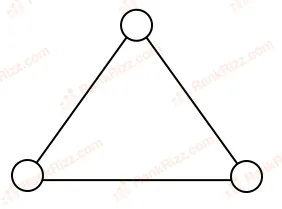
Consider a gas of triatomic molecules. The molecules are assumed to be triangular and made of massless rigid rods whose vertices are occupied by atoms. The internal energy of a mole of the gas at temperature T is:

Figure for JEE Main 2020 Physics question on Degrees of freedom, equipartition of energy and internal energy
  1. A

    52RT\frac{5}{2}RT

  2. B

    32RT\frac{3}{2}RT

  3. C

    92RT\frac{9}{2}RT

  4. D

    3RT3RT

Q7Progressive waves: wave equation, phase and intensity

A uniform thin rope of length 12 m and mass 6 kg hangs vertically from a rigid support and a block of mass 2 kg is attached to its free end. A transverse short wave train of wavelength 6 cm is produced at the lower end of the rope. What is the wavelength of the wave train (in cm) when it reaches the top of the rope?

  1. A

    3

  2. B

    6

  3. C

    12

  4. D

    9

Q8Electric potential and potential energy

Two isolated conducting spheres S1S_1 and S2S_2 of radius 23R\frac{2}{3}R and 13R\frac{1}{3}R have 12 μC\mu C and −3-3 μC\mu C charges, respectively, and are at a large distance from each other. They are now connected by a conducting wire. A long time after this is done the charges on S1S_1 and S2S_2 are respectively:

  1. A

    4.54.5 μC\mu C of both

  2. B

    +4.5+4.5 μC\mu C and −4.5-4.5 μC\mu C

  3. C

    33 μC\mu C and 66 μC\mu C

  4. D

    66 μC\mu C and 33 μC\mu C

Q9Capacitors in DC circuits (steady state)

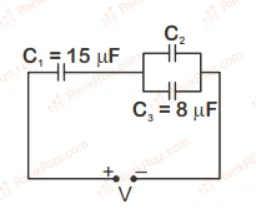
In the circuit shown in the figure, the total charge is 750 μC\mu C and the voltage across capacitor C2C_2 is 20 V. Then the charge on capacitor C2C_2 is:

Figure for JEE Main 2020 Physics question on Capacitors in DC circuits (steady state)
  1. A

    450450 μC\mu C

  2. B

    590590 μC\mu C

  3. C

    160160 μC\mu C

  4. D

    650650 μC\mu C

Q10Magnetic flux, Faraday's law and Lenz's law

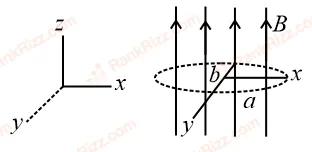
An elliptical loop having resistance RR, of semi major axis aa, and semi minor axis bb is placed in a magnetic field as shown in the figure. If the loop is rotated about the xx-axis with angular frequency ω\omega, the average power loss in the loop due to Joule heating is:

Figure for JEE Main 2020 Physics question on Magnetic flux, Faraday's law and Lenz's law
  1. A

    π2a2b2B2ω22R\frac{\pi^2 a^2 b^2 B^2 \omega^2}{2R}

  2. B

    zero

  3. C

    πbBωR\frac{\pi bB\omega}{R}

  4. D

    π2a2b2B2ω2R\frac{\pi^2 a^2 b^2 B^2 \omega^2}{R}

Q11Electric power and heating effect of current

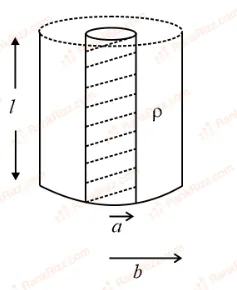
Model a torch battery of length ll to be made up of a thin cylindrical bar of radius aa and a concentric thin cylindrical shell of radius bb filled in between with an electrolyte of resistivity ρ\rho (see figure). If the battery is connected to a resistance of value RR, the maximum Joule heating in RR will take place for:

Figure for JEE Main 2020 Physics question on Electric power and heating effect of current
  1. A

    R=ρ2πl(ba)R = \frac{\rho}{2\pi l}\left(\frac{b}{a}\right)

  2. B

    R=ρ2πlln⁡(ba)R = \frac{\rho}{2\pi l}\ln\left(\frac{b}{a}\right)

  3. C

    R=ρπlIn(ba)R = \frac{\rho}{\pi l}In\left(\frac{b}{a}\right)

  4. D

    R=2ρπlln⁡(ba)R = \frac{2\rho}{\pi l}\ln\left(\frac{b}{a}\right)

Q12Biot-Savart law: straight wires and moving charges

Magnitude of magnetic field (in SI units) at the centre of a hexagonal shape coil of side 10 cm, 50 turns and carrying current II (Ampere) in units of μ0Iπ\frac{\mu_0 I}{\pi} is:

  1. A

    2503250\sqrt{3}

  2. B

    50350\sqrt{3}

  3. C

    5003500\sqrt{3}

  4. D

    535\sqrt{3}

Q13Motion of charged particles in a magnetic field

A charged particle carrying charge 1 μC\mu C is moving with velocity (2i^+3j^+4k^)\left(2\hat{i} + 3\hat{j} + 4\hat{k}\right) m s−1^{-1}. If an external magnetic field of (5i^+3j^−6k^)×10−3\left(5\hat{i} + 3\hat{j} - 6\hat{k}\right) \times 10^{-3} T exists in the region where the particle is moving then the force on the particle is F⃗×10−9\vec{F} \times 10^{-9} N. The vector F⃗\vec{F} is:

  1. A

    −0.30i^+0.32j^−0.09k^-0.30\hat{i} + 0.32\hat{j} - 0.09\hat{k}

  2. B

    −30i^+32j^−9k^-30\hat{i} + 32\hat{j} - 9\hat{k}

  3. C

    −300i^+320j^−90k^-300\hat{i} + 320\hat{j} - 90\hat{k}

  4. D

    −3.0i^+32j^−0.9k^-3.0\hat{i} + 32\hat{j} - 0.9\hat{k}

Q14Series LCR circuits: impedance and phase

A 750 Hz, 20 V(rms) source is connected to a resistance of 100 Ω\Omega, an inductance of 0.1803 H and a capacitance of 10 μ\muF all in series. The time in which the resistance (heat capacity 2 J/°C) will get heated by 10°C (assume no loss of heat to the surroundings) is close to:

  1. A

    418 s

  2. B

    245 s

  3. C

    365 s

  4. D

    348 s

Q15Properties of EM waves: fields, energy, intensity and momentum

The magnetic field of a plane electromagnetic wave is B⃗=3×10⁻⁸sin⁡[200π(y+ct)]i^\vec{B} = 3 \times 10^{-8} \sin\left[200\pi(y + ct)\right]\hat{i} T. Where, c=3×10⁸c = 3 \times 10^8 m s−1^{-1} is the speed of light. The corresponding electric field is:

  1. A

    E⃗=9sin⁡[200π(y+ct)]k^\vec{E} = 9 \sin\left[200\pi\left(y + ct\right)\right]\hat{k} V/m

  2. B

    E⃗=−10−6sin⁡[200π(y+ct)]k^\vec{E} = -10^{-6} \sin\left[200\pi\left(y + ct\right)\right]\hat{k} V/m

  3. C

    E⃗=3×10⁻⁸sin⁡[200π(y+ct)]k^\vec{E} = 3 \times 10^{-8} \sin\left[200\pi\left(y + ct\right)\right]\hat{k} V/m

  4. D

    E⃗=−9sin⁡[200π(y+ct)]k^\vec{E} = -9 \sin\left[200\pi\left(y + ct\right)\right]\hat{k} V/m

Q16Wavefronts and Huygens' principle

In a Young's double slit experiment, light of 500 nm is used to produce and interference pattern. When the distance between the slits is 0.05 mm, the angular width (in degree) of the fringes formed on the distance screen is close to:

  1. A

    0.17°

  2. B

    0.57°

  3. C

    1.7°

  4. D

    0.07°

Q17Photoelectric effect and Einstein's equation

When the wavelength of radiation falling on a metal is changed from 500 nm to 200 nm, the maximum kinetic energy of the photoelectrons becomes three times larger. The work function of the metal is close to:

  1. A

    0.81 eV

  2. B

    1.02 eV

  3. C

    0.52 eV

  4. D

    0.61 eV

Q18Radioactivity: decay law, half-life and decay modes

In a radioactive material, a fraction of active material remaining after the time tt is 916\frac{9}{16}. The fraction that was remaining after the time t2\frac{t}{2} is:

  1. A

    45\frac{4}{5}

  2. B

    35\frac{3}{5}

  3. C

    34\frac{3}{4}

  4. D

    78\frac{7}{8}

Q19p-n junction diode and its characteristics

When a diode is forward biased, it has a voltage drop of 0.5 V. The safe limit of current through the diode is 10 mA. If a battery of emf 1.5 V is used in the circuit, the value of minimum resistance to be connected in series with the diode so that the current does not exceed the safe limit is:

  1. A

    300 Ω\Omega

  2. B

    50 Ω\Omega

  3. C

    100 Ω\Omega

  4. D

    200 Ω\Omega

Q20Screw gauge: pitch, least count and zero error

Using screw gauge of pitch 0.1 cm and 50 divisions on its circular scale, the thickness of an object is measured. It should correctly be recorded as:

  1. A

    2.121 cm

  2. B

    2.124 cm

  3. C

    2.125 cm

  4. D

    2.123 cm

Q21Conservation of mechanical energy

A cricket ball of mass 0.15 kg is thrown vertically up by a bowling machine so that it rises to a maximum height of 20 m after leaving the machine. If the part pushing the ball applies a constant force FF on the ball and moves horizontally a distance of 0.2 m while launching the ball, the value of FF (in N) is (g=10(g = 10 m s−2)^{-2})

Q22Angular momentum of particles and rigid bodies

A person of 80 kg mass is standing on the rim of a circular platform of mass 200 kg rotating about its axis at 5 revolutions per minute (rpm). The person now starts moving towards the centre of the platform. What will be the rotational speed (in rpm) of the platform when the person reaches its centre....

Q23Angle of contact and capillary rise

When a long glass capillary tube of radius 0.015 cm is dipped in a liquid, the liquid rises to a height of 15 cm within it. If the contact angle between the liquid and glass is close to 0°, the surface tension of the liquid, in milliNewton m−1^{-1}, is [ρ(liquid)=900 kg m−3,  g=10 m s−2]\left[\rho_{\text{(liquid)}} = 900 \text{ kg m}^{-3},\; g = 10 \text{ m s}^{-2}\right] (Given answer in closed integer)

Q24Temperature scales and thermal expansion

A bakelite beaker has volume capacity of 500 cc at 30°C. When it is partially filled with VmV_m volume (at 30°C) of mercury, it is found that the unfilled volume of the beaker remains constant as temperature is varied. If γbeaker=6×10⁻⁶\gamma_{beaker} = 6 \times 10^{-6} °C−1^{-1}, where γ\gamma is the coefficient of volume expansion, then VmV_m (in cc) is close to...

Q25Refraction at plane surfaces, Snell's law and apparent depth

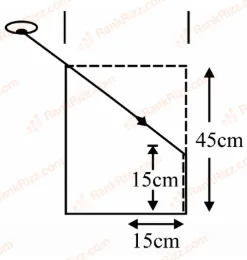
An observer can see through a small hole on the side of a jar (radius 15 cm) at a point at height of 15 cm from the bottom (see figure). The hole is at a height of 45 cm. When the jar is filled with a liquid up to a height of 30 cm the same observer can see the edge at the bottom of the jar. If the refractive index of the liquid is N100\frac{N}{100}, where N is an integer, the value of N i

Figure for JEE Main 2020 Physics question on Refraction at plane surfaces, Snell's law and apparent depth
NEXT IN THIS PAPER →Chemistry, Q26 onwards