Q1Kinematics in two dimensions using position vectors
The position co-ordinates of a particle moving in a 3D coordinate system is given by
and
The speed of the particle is:
- A
- B
- C
- D
All 90 questions of JEE Main 09 Jan 2019, Shift 2, in the order they were asked, one subject to a page. Pick an answer on any question to check it against the key. Free to read, nothing to download.
Questions
90
Physics · Chemistry · Maths
Answer key
90
questions with a checked key
Price
Free
no sign-up
The position co-ordinates of a particle moving in a 3D coordinate system is given by
and
The speed of the particle is:
Expression for time in terms of (universal gravitational constant), (Planck constant) and (speed of light) is proportional to:
In a car race on straight road, car A takes a time less than car at the finish and passes finishing point with a speed more than that of car . Both the cars start from rest and travel with constant acceleration and respectively. Then is equal to:
A mass of 10 kg is suspended vertically by a rope from the roof. When a horizontal force is applied on the rope at some point, the rope deviated at an angle of 45 at the roof point. If the suspended mass is at equilibrium, the magnitude of the force applied is ( m s)
100 N
200 N
140 N
70 N
A force acts on a 2 kg object so that its position is given as a function of time as . What is the work done by this force in first 5 seconds?
875 J
850 J
950 J
900 J
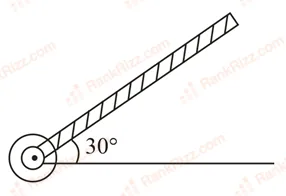
A rod of length 50 cm is pivoted at one end. It is raised such that it makes an angle of 30 from the horizontal as shown and released from rest. Its angular speed when it passes through the horizontal (in rad s) will be: ( ms)
The energy required to take a satellite to a height above the Earth surface (radius of Earth km) is , and the kinetic energy required for the satellite to be in a circular orbit at this height is . The value of for which and are equal, is:
km
km
km
km
The top of a water tank is open to air and its water level is maintained. It is giving out 0.74 m water per minute through a circular opening of 2 cm radius in its wall. The depth of the centre of the opening from the level of water in the tank is close to:
2.9 m
4.8 m
6.0 m
9.6 m
Two carnot engines and are operated in series. The first one, , receives heat at and rejects to a reservoir at temperature . The second engine receives heat rejected by the first engine and, in turn, rejects to a heat reservoir at . Calculate the temperature if the work outputs of the two engines are equal:
500 K
400 K
300 K
600 K
A 15 g mass of nitrogen gas is enclosed in a vessel at a temperature, 27C. The amount of heat transferred to the gas, so that R.M.S. velocity of molecules is doubled, is about. [ J (K mole)]
14 kJ
10 kJ
6 kJ
0.9 kJ
A particle is executing simple harmonic motion (SHM) of amplitude , along the -axis, about . When its potential Energy (PE) equal kinetic energy (KE), the position of the particle will be:
A rod of mass and length is suspended at its middle by a wire. It exhibits torsional oscillations. If two masses, each of mass , are attached at a distance from its centre on both sides, it reduces the oscillation frequency by 20%. The value of ratio is close to:
0.17
0.77
0.57
0.37
A musician using an open flute of length 50 cm produces second harmonic sound waves. A person runs towards the musician from another end of a hall at a speed of 10 km h. If the wave speed is 330 m s, the frequency heard by the running person shall be close to:
333 Hz
500 Hz
666 Hz
753 Hz
Charge is distributed within a sphere of radius with a volume charge density , where and are constants. If is the total charge of this charge distribution, the radius is:
Two point charges C) and C) are placed on the -axis at m and m respectively. The electric field (in V/m) at a point m on -axis is, [Take N mC]
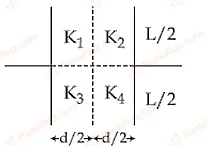
A parallel plate capacitor with square plates is filled with four dielectrics of dielectric constants , , , arranged as shown in the figure. The effective dielectric constant will be:
A carbon resistance has a following colour code. What is the value of the resistance?
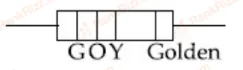
GOY Golden
6.4 M 5%
64 k 10%
530 k 5%
5.3 M 5%
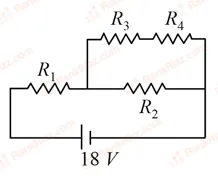
In the given circuit the internal resistance of the 18V cell is negligible. If , and and the reading of an ideal voltmeter across is 5 V, then the value of will be:
550
300
450
230
A particle having the same charge as of electron moves in a circular path of radius 0.5 cm under the influence of a magnetic field of 0.5 T. If an electric field of 100 V/m makes it to move in a straight path, then the mass of the particle is (Given charge of electron C)
kg
kg
kg
kg
One of the two identical conducting wires of length is bent in the form of a circular loop and the other one into a circular coil of identical turns. If the same current is passed in both, the ratio of the magnetic field at the centre of the loop to that at the centre of the coil , i.e. will be:
A power transmission line feeds input power at 2300 V to a step down transformer with its primary windings having 4000 turns. The output power is delivered at 230 V by the transformer. If the current in the primary of the transformer is 5 A and its efficiency is 90%, the output current would be:
35 A
25 A
50 A
45 A
A series AC circuit containing an inductor (20 mH), a capacitor (120 F) and a resistor (60 ) is driven by an AC source of 24 V/50 Hz. The energy dissipated in the circuit in 60 s is:
J
J
J
J
The energy associated with electric field is and with magnetic field is for an electromagnetic wave in free space. Then:
Two plane mirrors are inclined to each other such that a ray of light incident on the first mirror and parallel to the second mirror is finally reflected from the second mirror and parallel to the first mirror . The angle between the two mirrors will be:
60
45
90
75
In a young's double slit experiment, the slits are placed 0.320 mm apart. Light of wavelength nm is incident on the slits. The total number of bright fringes that are observed in the angular range is:
321
641
320
640
The magnetic field associated with a light wave is given, at the origin, by . If this light falls on a silver plate having a work function of 4.7 eV, what will be the maximum kinetic energy of the photoelectrons? ( m s, J s)
6.82 eV
7.72 eV
12.5 eV
8.52 eV
At a given instant, say , two radioactive substance A and B have equal activities. The ratio of their activities after time itself decays with time as . If the half-life of A is , the half-life of B is:
Ge and Si diodes start conducting at 0.3 V and 0.7 V respectively. In the following figure if Ge diode connection are reversed, the value of changes by: (assume that the Ge diode has large breakdown voltage)
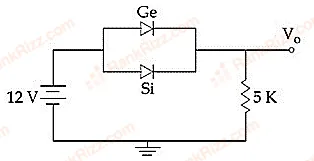
0.8 V
0.4 V
0.2 V
0.6 V
In a communication system operating at wavelength 800 nm, only one percent of source frequency is available as signal bandwidth. The number of channels accommodated for transmitting TV signals of band width 6 MHz are (Take velocity of light m/s, J-s)
The pitch and the number of divisions, on the circular scale, for a given screw gauge are 0.5 mm and 100 respectively. When the screw gauge is fully tightened without any object, the zero of its circular scale lies 3 divisions below the mean line. The readings of the main scale and the circular scale, for a thin sheet, are 5.5 mm and 48 respectively, the thickness of this sheet is:
5.755 mm
5.740 mm
5.725 mm
5.950 mm