Q1Kinematics in two dimensions using position vectors
A particle is moving with a velocity , where is a constant. The general equation for its path is:
- A
+ constant
- B
= constant
- C
+ constant
- D
+ constant
All 90 questions of JEE Main 09 Jan 2019, Shift 1, in the order they were asked, one subject to a page. Pick an answer on any question to check it against the key. Free to read, nothing to download.
Questions
90
Physics · Chemistry · Maths
Answer key
90
questions with a checked key
Price
Free
no sign-up
A particle is moving with a velocity , where is a constant. The general equation for its path is:
+ constant
= constant
+ constant
+ constant
A copper wire is stretched to make it 0.5% longer. The percentage change in its electrical resistance if its volume remains unchanged is:
2.5%
1.0%
2.0%
0.5%
A block of mass 10 kg is kept on a rough inclined plane as shown in the figure. A force of 3 N is applied on the block. The coefficient of static friction between the plane and the block is 0.6. What should be the minimum value of force P, such that the block does not move downward? (take )
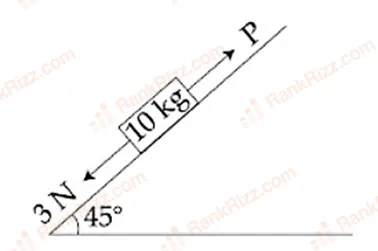
23 N
25 N
18 N
32 N
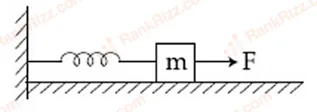
A block of mass , lying on a smooth horizontal surface, is attached to a spring (of negligible mass) of spring constant . The other end of the spring is fixed, as shown in the figure. The block is initially at rest in its equilibrium position. If now the block is pulled with a constant force , the maximum speed of the block is:
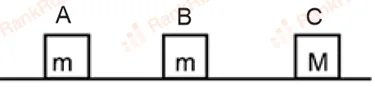
Three blocks A, B and C are lying on a smooth horizontal surface, as shown in the figure. A and B have equal masses, while C has mass . Block A is given an initial speed towards B due to which it collides with B perfectly inelastically. The combined mass collides with C, also perfectly inelastically. th of the initial kinetic energy is lost in the whole process. What is the value of ?
3
4
5
2
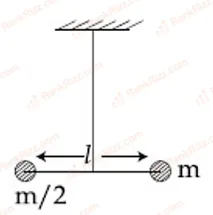
Two masses and are connected at the two ends of a massless rigid rod of length . The rod is suspended by a thin wire of torsional constant at the centre of mass of the rod-mass system (see figure). Because of torsional constant , the restoring torque is for angular displacement . If the rod is rotated by and released, the tension in it when it passes through its mean position will be:
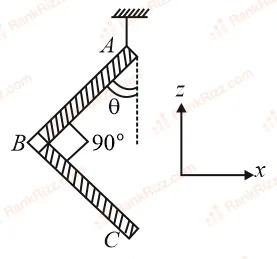
An -shaped object, made of thin rods of uniform mass density, is suspended with a string as shown in figure. If , and the angle made by with downward vertical is , then:
If the angular momentum of a planet of mass , moving around the Sun in a circular orbit is , about the center of the Sun, its areal velocity is:
A heavy ball of mass is suspended from the ceiling of a car by a light string of mass (). When the car is at rest, the speed of transverse waves in the string is 60 ms. When the car has acceleration , the wave-speed increases to 60.5 ms. The value of , in terms of gravitational acceleration , is closest to:
A rod, of length at room temperature and uniform area of cross section , is made of a metal having coefficient of linear expansion /C. It is observed that an external compressive force is applied on each of its ends, prevents any change in the length of the rod when its temperature rises by K. Young's modulus, for this metal is:
Temperature difference of 120C is maintained between two ends of a uniform rod of length . Another bent rod , of same cross-section as and length , is connected across (See figure). In steady state, temperature difference between and will be close to:
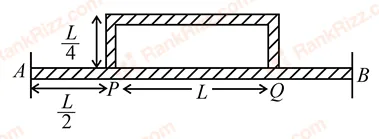
45C
35C
60C
75C
A gas can be taken from A to B via two different processes ACB and ADB.
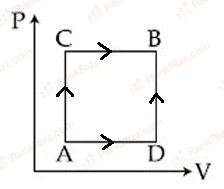
When path ACB is used 60 J of heat flows into the system and 30 J of work is done by the system. If the path ADB is used then work done by the system is 10 J, the heat flows into the system in the path ADB is:
100 J
20 J
40 J
80 J
A mixture of 2 moles of helium gas (atomic mass = 4u), and 1 mole of argon gas (atomic mass = 40 u) is kept at 300 K in a container. The ratio of their rms speeds , is close to:
0.45
2.24
0.32
3.16
Three charges , , are placed respectively, at distance, , and from the origin, on the -axis. If the net force experienced by , placed at , is zero, then value of is:
For a uniformly charged ring of radius , the electric field on its axis has the largest magnitude at a distance from its centre. Then value of is:
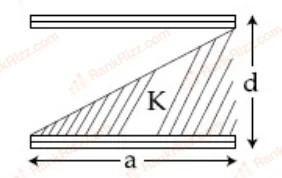
A parallel plate capacitor is made of two square plates of side , separated by a distance (). The lower triangular portion filled with a dielectric of dielectric constant , as shown in the figure. Capacitance of this capacitor is:
When the switch , in the circuit shown, is closed, then the value of current will be:
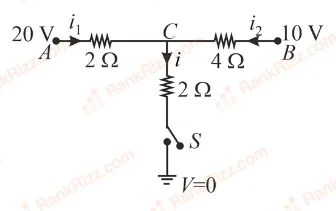
2 A
5 A
3 A
4 A
Drift speed of electrons, when 1.5 A current flows in a copper wire of cross section 5 mm is . If the electron density in copper is m, the value of in mm s is close to (Take charge of an electron to be C)
0.2
3
2
0.02
Mobility of electrons in a semiconductor is defined as the ratio of their drift velocity to the applied electric field. If, for an N-type semiconductor, the density of electrons is m and their mobility is 1.6 m V s, then the resistivity of the semiconductor (since it is an N-type semiconductor contribution of holes is ignored) is close to:
0.2 m
4 m
2 m
0.4 m
A resistance is shown in the figure. Its value and tolerance are given respectively by:
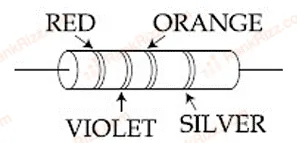
27 k, 10%
270 , 5%
270 , 10%
27 k, 20%
A bar magnet is demagnetized by inserting it inside a solenoid of length 0.2 m, 100 turns, and carrying a current of 5.2 A. The coercivity of the bar magnet is:
285 A/m
2600 A/m
520 A/m
1200 A/m
A current loop, having two circular arcs joined by two radial lines is shown in the figure. It carries a current of 10 A. The magnetic field at point O will be close to:
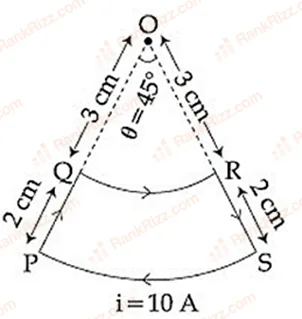
T
T
T
T
An infinitely long current carrying wire and a small current carrying loop are in the plane of the paper as shown. The radius of the loop is and distance of its centre from the wire is (). If the loop applies a force on the wire then:
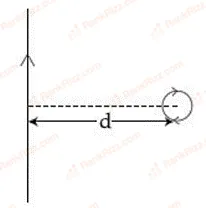
A conducting circular loop made of a thin wire has area m and resistance 10 . It is placed perpendicular to a time-dependent magnetic field . The field is uniform in space. Then the net charge flowing through the loop during s and ms is close to:
1.4 mC
7 mC
21 mC
6 mC
A plane electromagnetic wave of frequency 50 MHz travels in free space along the positive -direction. At a particular point in space and time, V/m. The corresponding magnetic field , at that point will be:
T
T
T
T
A convex lens is put 10 cm from a light source and it makes a sharp image on a screen, kept 10 cm from the lens. Now a glass block (refractive index 1.5) of 1.5 cm thickness is placed in between the light source and the lens. To get the sharp image again, the screen is shifted by a distance . Then is:
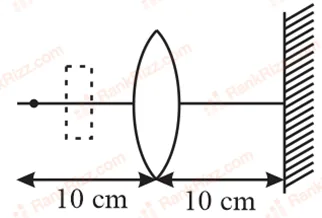
0
0.55 cm away from the lens
0.55 cm towards the lens
1.1 cm away from the lens
Two coherent sources produce waves of different intensities which interfere. After interference, the ratio of the maximum intensity to the minimum intensity is 16. The intensity of the waves are in the ratio:
25 : 9
16 : 9
5 : 3
4 : 1
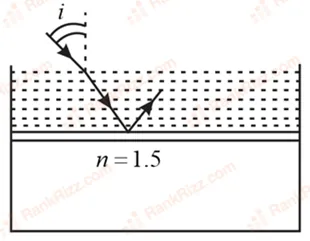
Consider a tank made of glass (refractive index 1.5) with a thick bottom. It is filled with a liquid of refractive index . A student finds that, irrespective of what the incident angle (see figure) is for a beam of light entering the liquid, the light reflected from the liquid glass interface is never completely polarized. For this to happen, the minimum value of is:
The surface of certain metal is first illuminated with light of wavelength nm and then, by a light of wavelength nm. It is found that the maximum speed of the photoelectrons in the two cases differ by a factor of 2. The work function of the metal (in eV) is close to (Energy of photon eV)
2.5
1.8
5.6
1.4
A Sample of radioactive material A, that has an activity of 10 mCi (1 Ci decays s), has twice the number of nuclei as another sample of a different radioactive material B which has an activity of 20 mCi. The correct choices for half-lives of A and B would then be, respectively:
5 days and 10 days
10 days and 40 days
20 days and 10 days
20 days and 5 days