Q1Vectors: addition, subtraction, resolution and unit vectors
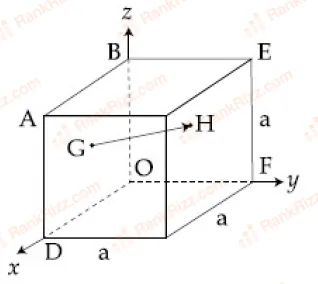
In the cube of side 'a' shown in the figure, the vector from the central point of the face ABOD to the central point of the face BEFO will be:
- A
- B
- C
- D
All 90 questions of JEE Main 10 Jan 2019, Shift 1, in the order they were asked, one subject to a page. Pick an answer on any question to check it against the key. Free to read, nothing to download.
Questions
90
Physics · Chemistry · Maths
Answer key
89
questions with a checked key
Price
Free
no sign-up
In the cube of side 'a' shown in the figure, the vector from the central point of the face ABOD to the central point of the face BEFO will be:
The density of a material in SI units is 128 kg m. In certain units in which the unit of length is 25 cm and the unit of mass is 50g, the numerical value of density of the material is:
410
16
40
640
Two guns A and B can fire bullets at speeds 1 km/s and 2 km/s respectively. From a point on a horizontal ground, they are fired in all possible directions. The ratio of maximum areas covered by the bullets fired by the two guns, on the ground is:
1 : 16
1 : 2
1 : 4
1 : 8
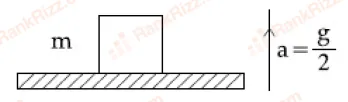
A block of mass is kept on a platform which starts from rest with a constant acceleration upwards, as shown in the figure. Work done by normal reaction on block in time is:
0
A piece of wood of mass 0.03 kg is dropped from the top of a 100 m height building. At the same time, a bullet of mass 0.02 kg is fired vertically upward, with a velocity 100 ms, from the ground. The bullet gets embedded in the wood. Then the maximum height to which the combined system reaches above the top of the building before falling below is: ( ms)
40 m
20 m
10 m
30 m
To mop-clean a floor, a cleaning machine presses a circular mop of radius vertically down with a total force and rotates it with a constant angular speed about its axis. If the force is distributed uniformly over the mop and if coefficient of friction between the mop and the floor is , the torque, applied by the machine on the mop is:
A homogeneous solid cylindrical roller of radius and mass is pulled on a cricket pitch by a horizontal force. Assuming rolling without slipping, angular acceleration of the cylinder is:
A satellite is moving with a constant speed in circular orbit around the earth. An object of mass '' is ejected from the satellite such that it just escapes from the gravitational pull of the earth. At the time of ejection, the kinetic energy of the object is:
Water flows into a large tank with flat bottom at the rate of ms. Water is also leaking out of a hole of area 1 cm at its bottom. If the height of the water in the tank remains steady then this height is:
5.1 cm
1.7 cm
2.9 cm
4 cm
A heat source at K is connected to another heat reservoir at K by a copper slab which is 1 m thick. Given that the thermal conductivity of copper is 0.1 W K m, the energy flux through it in the steady-state is:
65 W m
120 W m
90 W m
200 W m
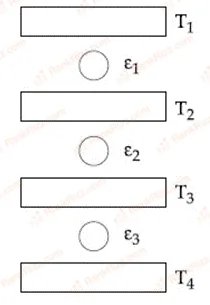
Three Carnot engines operate in series between a heat source at a temperature and a heat sink at temperature (see figure). There are two other reservoirs at temperature and , as shown, with . The three engines are equally efficient if:
A train moves towards a stationary observer with speed 34 m/s. The train sounds a whistle and its frequency registered by the observer is . If the speed of the train is reduced to 17 m/s, the frequency registered is . If speed of sound is 340 m/s, then the ratio is:
21/20
20/19
19/18
18/17
A string of length 1 m and mass 5 g is fixed at both ends. The tension in the string is 8.0 N. The string is set into vibration using an external vibrator of frequency 100 Hz. The separation between successive nodes on the string is close to:
20.0 cm
10.0 cm
16.6 cm
33.3 cm
Two electric dipoles, A, B with respective dipole moments and are placed on the -axis with a separation , as shown in the figure.
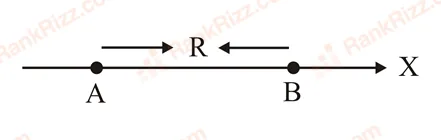
The distance from A at which both of them produce the same potential is:
A charge is distributed over three concentric spherical shells of radii , , () such that their surface charge densities are equal to one another. The total potential at a point at distance from their common centre, where , would be:
A parallel plate capacitor is of area 6 cm and a separation 3 mm. The gap is filled with three dielectric materials of equal thickness (see figure) with dielectric constant , and . The dielectric constant of a material which when fully inserted in above capacitor, gives same capacitance would be:
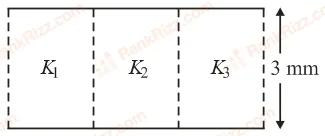
4
36
14
12
In the given circuit the cells have zero internal resistance. The currents (in amperes) passing through resistance and respectively, are:
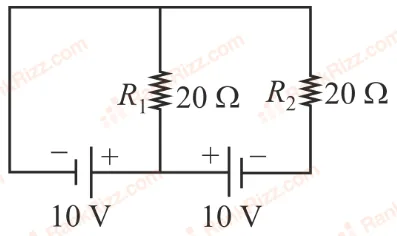
0, 1
2, 2
0.5, 0
1, 2
A uniform metallic wire has a resistance of 18 and is bent into an equilateral triangle. Then, the resistance between any two vertices of the triangle is:
2
12
8
4
A 2 W carbon resistor is color coded with green, black, red and silver respectively. The maximum current which can be passed through this resistor is:
100 mA
0.4 mA
20 mA
63 mA
A magnet of total magnetic moment A m is placed in a time varying magnetic field, where Tesla and rad s. The work done for reversing the direction of the magnetic moment at second, is:
0.007 J
0.02 J
0.014 J
0.01 J
An insulating thin rod of length has a linear charge density on it. The rod is rotated about an axis passing through the origin () and perpendicular to the rod. If the rod makes rotations per second, then the time averaged magnetic moment of the rod is:
A solid metal cube of edge length 2 cm is moving in the positive y-direction, at a constant speed of 6 m s. There is a uniform magnetic field of 0.1 T in the positive z-direction. The potential difference between the two faces of the cube, perpendicular to the x-axis, is:
12 mV
1 mV
2 mV
6 mV
If the magnetic field of a plane electromagnetic wave is given by (The speed of light m/s) then the maximum electric field associated with it is:
N C
N C
N C
N C
A plano-convex lens of refractive index and focal length is kept in contact with another plano-concave lens of refractive index and focal length . If the radius of curvature of their spherical faces is each and , the and are related as:
In a Young's double slit experiment slit separation 0.1 mm, one observes a bright fringe at angle rad by using light of wavelength . When the light of wavelength is used a bright fringe is seen at the same angle in the same set up. Given that and are in visible range (380 nm to 740 nm), their values are:
400 nm, 500 nm
380 nm, 525 nm
625 nm, 500 nm
380 nm, 500 nm
In an electron microscope, the resolution that can be achieved is of the order of the wavelength of electrons used. To resolve a width of m, the minimum electron energy required is close to:
100 keV
25 keV
1 keV
500 keV
Using a nuclear counter the count rate of emitted particles from a radioactive source is measured. At it was 1600 counts per second and seconds it was 100 counts per second. The count rate observed, as counts per second, at seconds is close to:
400
200
150
360
To get output '1' at R, for the given logic gate circuit the input values must be:
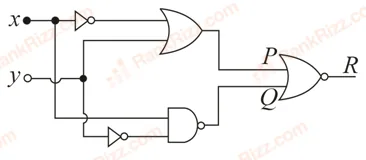
A TV transmission tower has a height of 140 m and the height of the receiving antenna is 40 m. What is the maximum distance upto which signals can be broadcasted from this tower in LOS (Line of Sight) mode? (Given: radius of earth m).
48 km
40 km
80 km
65 km
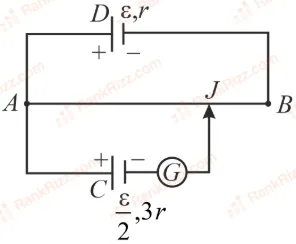
A potentiometer wire AB having length and resistance is joined to a cell D of emf and internal resistance . A cell C having EMF and internal resistance is connected. The length AJ, at which the galvanometer, as shown in the figure, shows no deflection is: