Q1Errors in measurement and significant figures
The area of a square is 5.29 cm. The area of 7 such squares taking into account the significant figures is:
- A
37.03 cm
- B
37.030 cm
- C
37.0 cm
- D
37 cm
All 90 questions of JEE Main 09 Apr 2019, Shift 2, in the order they were asked, one subject to a page. Pick an answer on any question to check it against the key. Free to read, nothing to download.
Questions
90
Physics · Chemistry · Maths
Answer key
90
questions with a checked key
Price
Free
no sign-up
The area of a square is 5.29 cm. The area of 7 such squares taking into account the significant figures is:
37.03 cm
37.030 cm
37.0 cm
37 cm
The position of a particle as a function of time t, is given by where a, b and c are constants. When the particles zero acceleration, then its velocity will be:
The position vector of a particle changes with time according to the relation . What is the magnitude of the acceleration at ?
40
25
100
50
A wedge of mass lies on a frictionless plane. A particle of mass approaches the wedge with speed . There is no friction between the particle and the plane or between the particle and the wedge. The maximum height climbed by the particle on the wedge is given by:
A particle of mass is moving with speed and collides with a mass moving with speed in the same direction. After the collision, the first mass is stopped completely while the second one splits into two particles each of mass , which move at an angle 45° with respect to the original direction. The speed of each of the moving particle will be:
A thin smooth rod of length L and mass M is rotating freely with angular speed about an axis perpendicular to the rod and passing through center. Two beads of mass m and negligible size are at the center of the rod initially.The beads of mass and negligible size are at the center of the rod initially. The beads are free to slide along the rod. The angular speed of the system, when the beads reach the opposite ends of the rod, will be:
Moment of inertia of a body about a given axis is 1.5 kg m. Initially the body is at rest. In order to produce a rotational kinetic energy of 1200 J, the angular acceleration of 20 rad/s must be applied about the axis for a duration of:
3 s
2 s
2.5 s
5 s
A test particle is moving in a circular orbit in the gravitational field produced by a mass density . Identify the current relation between the radius R of the particle's orbit and its period T:
TR is a constant
is a constant
T/R is a constant
is a constant
A wooden block floating in a bucket of water has of its volume submerged. When certain amount of an oil is poured into the bucket, it is found that the block is just under the oil surface with half of its volume under water and half in oil. The density of oil relative to that of water is:
0.8
0.7
0.5
0.6
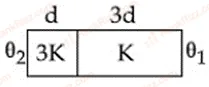
Two materials having coefficients of thermal conductivity 3K and K and thickness d and 3d respectively, are joined to form a slab as shown in the figure. The temperatures of the outer surfaces are and respectively, . The temperature at the interface is:
The specific heats, C and C of a gas of diatomic molecules, A, are given (in units of J mol K) by 29 and 22, respectively. Another gas of diatomic molecules, B, has the corresponding values 30 and 21. If they are treated as ideal gases, then:
A has one vibrational mode and B has two
A has a vibrational mode but B has none.
Both A and B have a vibrational mode each.
A is rigid but B has a vibrational mode.
A massless spring (k = 800 N/m), attached with a mass (500 g) is completely immersed in 1 kg of water. The spring is stretched by 2 cm and released so that it starts vibrating. What would be the order of magnitude of the change in the temperature of water when the vibrations stop completely? (Assume that the water container and spring receive negligible heat and specific heat of mass = 400 J/kg K, water = 4184 J/kg K)
K
K
K
K
Two cars A and B are moving away from each other in opposite directions. Both the cars are moving with speed of 20 m s with respect to the ground. If an observer in car A detects a frequency 2000 Hz of the sound coming from car B, what is the natural frequency of the sound source in car B? (speed of sound in air = 340 m s)
2150 Hz
2300 Hz
2250 Hz
2060 Hz
A string 2.0 m long and fixed at its ends is driven by a 240 Hz vibrator. The string vibrates in its third harmonic mode. The speed of the wave and its fundamental frequency is:
320 m s, 120 Hz
320 m s, 80 Hz
180 m s, 80 Hz
180 m s, 120 Hz
Four point charges -q, +q, +q and -q are placed on y-axis at y = -2d, y = -d, and y = +2d, respectively. The magnitude of the electric field E at a point on the x-axis at x = D, with D >> d, will behave as:
The parallel combination of two air filled parallel plate capacitors of capacitance C and nC is connected to a battery of voltage, V. When the capacitors are fully charged, the battery is removed and after that a dielectric material of dielectric constant K is placed between the two plates of the first capacitor. The new potential difference of the combined system is:
V
A metal wire of resistance 3 is elongated to make a uniform wire of double its previous length. This new wire is now bent and the ends joined to make a circle. If two points on this circle make an angle 60° at the center, the equivalent resistance between these two points will be:
The resistance of a galvanometer is 50 ohm and the maximum current which can be passed through it is 0.002 A. What resistance must be connected to it in order to convert it into an ammeter of range 0 - 0.5 A?
0.2 ohm
0.5 ohm
0.002 ohm
0.02 ohm
In a conductor, if the number of conduction electrons per unit volume is m and mean free time is 25 fs (femto second), it's approximate resistivity is: ( kg)
m
m
m
m
Two coils 'P' and 'Q' are separated by some distance. When a current of 3 A flows through coil 'P', a magnetic flux of Wb passes through 'Q'. No current is passed through 'Q'. When no current passes through 'P' and a current of 2 A passes through 'Q', the flux through 'P' is:
Wb
Wb
Wb
Wb
A moving coil galvanometer has a coil with 175 turns and area 1 cm. It uses a torsion band of torsion constant N m/rad. The coil is placed in a magnetic field B parallel to its plane. The coil deflects by 1° for a current of 1 mA. The value of B (in tesla) is approximately:
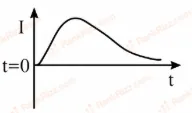
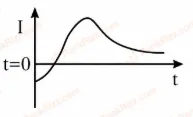
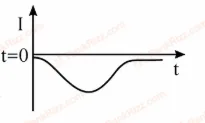
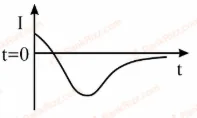
A very long solenoid of radius R is carrying current (k > 0), as a function of time (t 0). Counterclockwise current is taken to be positive. A circular conducting coil of radius 2R is placed in the equatorial plane of the solenoid and concentric with the solenoid. The current induced in the outer coil is correctly depicted, as a function of time, by:
Sunlight of intensity 50 W m is incident normally on the surface of a solar panel. Some part of incident energy (25%) is reflected from the surface and the rest is absorbed. The force exerted on 1 m surface area will be close to ( m s):
N
N
N
N
A convex lens of focal length 20 cm produces images of the same magnification 2 when an object is kept at two distances and () from the lens. The ratio of and is:
2 : 1
5 : 3
4 : 3
3 : 1
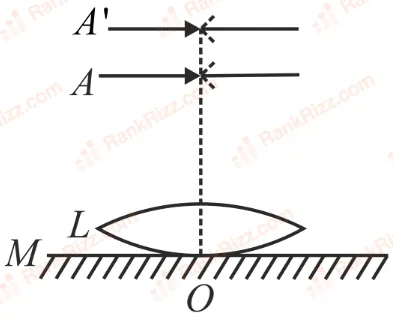
A thin convex lens L (refractive index = 1.5) is placed on a plane mirror M. When a pin is placed at A, such that OA = 18 cm, its real inverted image is formed at A itself, as shown in figure. When liquid of refractive index is put between the lens and the mirror, the pin has to be moved to A', such that OA' = 27 cm, to get its inverted real image at A' itself. The value of will be:
Diameter of the objective lens of a telescope is 250 cm. For light of wavelength 600 nm coming from a distant object, the limit of resolution of the telescope is close to:
rad
rad
rad
rad
A particle 'P' is formed due to a completely inelastic collision of particles 'x' and 'y' having de-Broglie wavelengths '' and '' respectively. If x and y were moving in opposite directions, then the de-Broglie wavelength of 'P' is:
A He ion is in its first excited state. Its ionization energy is:
13.60 eV
48.36 eV
54.40 eV
6.04 eV
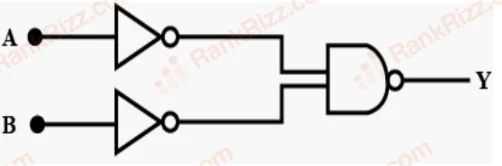
The logic gate equivalent to the given logic circuit is:
NAND
AND
NOR
OR
The physical sizes of the transmitter and receiver antenna in a communication system are:
proportional to carrier frequency
independent of both carrier and modulation frequency
inversely proportional to modulation frequency
inversely proportional to carrier frequency