Q1Errors in measurement and significant figures
In the density measurement of a cube, the mass and edge length are measured as kg and m, respectively. The error in the measurement of density is:
- A
0.31
- B
0.10
- C
0.07
- D
0.01
All 90 questions of JEE Main 09 Apr 2019, Shift 1, in the order they were asked, one subject to a page. Pick an answer on any question to check it against the key. Free to read, nothing to download.
Questions
90
Physics · Chemistry · Maths
Answer key
90
questions with a checked key
Price
Free
no sign-up
In the density measurement of a cube, the mass and edge length are measured as kg and m, respectively. The error in the measurement of density is:
0.31
0.10
0.07
0.01
A ball is thrown vertically up (taken as +z-axis) from the ground. The correct momentum-height (p-h) diagram is:
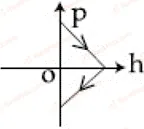
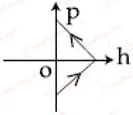
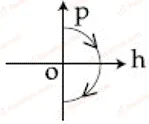
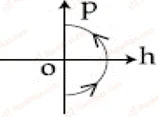
The stream of a river is flowing with a speed of 2 km h. A swimmer can swim at a speed of 4 km h. The direction of the swimmer with respect to the flow of the river, to cross the river straight, is:
150°
90°
120°
60°
A uniform cable of mass and length is placed on a horizontal surface such that its part is hanging below the edge of the surface. To lift the hanging part of the cable upto the surface, the work done should be:
A body of mass 2 kg makes an elastic collision with a second body at rest and continues to move in the original direction but with one fourth of its original speed. What is the mass of the second body?
1.8 kg
1.2 kg
1.0 kg
1.5 kg
A stationary horizontal disc is free to rotate about its axis. When a torque is applied on it, its kinetic energy as a function of , where is the angle by which it has rotated, is given as . If its moment of inertia is I then the angular acceleration of the disc is:
The following bodies are made to roll up (without slipping) the same inclined plane from a horizontal plane: (i) a ring of radius R, (ii) a solid cylinder of radius and (iii) a solid sphere of radius . If, in each case, the speed of the center of mass at the bottom of the incline is same, the ratio of the maximum heights they climb is:
2 : 3 : 4
20 : 15 : 14
4 : 3 : 2
14 : 15 : 20
A solid sphere of mass M and radius a is surrounded by a uniform concentric spherical shell of thickness 2a and mass 2M. The gravitational field at distance 3a from the centre will be:
If 'M' is the mass of water that rises in a capillary tube of radius 'r', then mass of water which will rise in a capillary tube of radius '2r' is:
4 M
2 M
M
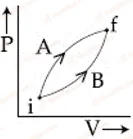
Following figure shows two processes A and B for a gas. If and are the amount of heat absorbed by the system in two cases, and and are changes in internal energies, respectively, then:
For given gas at 1 atm pressure, rms speed of the molecules is 200 m/s at 127°C. At 2 atm pressure and at 227°C, the rms speed of the molecules will be:
100 m/s
80 m/s
m/s
m/s
An HCl molecule has rotational, translational and vibrational motions. If the rms velocity of HCl molecules in its gaseous phase is , m is its mass and k is Boltzmann's constant, then its temperature will be:
A simple pendulum oscillating in air has period T. The bob of the pendulum is completely immersed in a non-viscous liquid. The density of the liquid is th of the material of the bob. If the bob is inside liquid all the time, its period of oscillation in this liquid is:
A string is clamped at both the ends and it is vibrating in its 4th harmonic. The equation of the stationary wave is . The length of the string is: (All quantities are in SI units.)
20 m
60 m
40 m
80 m
The pressure wave, N m, corresponds to the sound produced by a vibrating blade on a day when atmospheric temperature is 0°C. On some other day when temperature is T, the speed of sound produced by the same blade and at the same frequency is found to be 336 m s. Approximate value of T is:
12°C
15°C
4°C
11°C
A system of three charges are placed as shown in the figure:
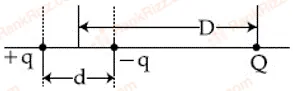
If , the potential energy of the system is best given by:
A capacitor with capacitance 5 F is charged to 5 C. If the plates are pulled apart to reduce the capacitance to 2 F, how much work is done?
J
J
J
J
A wire of resistance R is bent to form a square ABCD as shown in the figure. The effective resistance between E and C is: (E is mid-point of arm CD)
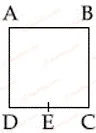
R
Determine the charge on the capacitor in the following circuit:
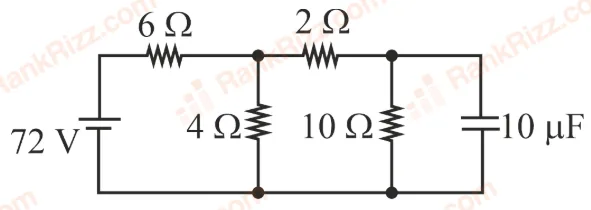
2 C
60 C
10 C
200 C
A moving coil galvanometer has resistance 50 and it indicates full deflection at 4 mA current. A voltmeter is made using this galvanometer and a 5 k resistance. The maximum voltage, that can be measured using this voltmeter, will be close to:
40 V
15 V
20 V
10 V
A rigid square loop of side 'a' and carrying current is lying on a horizontal surface near a long current carrying wire in the same plane as shown in figure. The net force on the loop due to the wire will be:
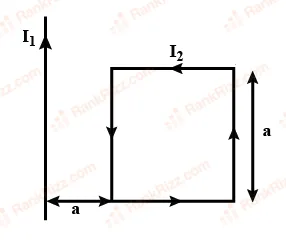
Attractive and equal to
Repulsive and equal to
Repulsive and equal to
Zero
A rectangular coil (Dimension 5 cm 2.5 cm) with 100 turns, carrying a current of 3 A in the clock-wise direction, is kept centered at the origin and in the X-Z plane. A magnetic field of 1 T is applied along X-axis. If the coil is tilted through 45° about Z-axis, then the torque on the coil is:
0.42 N m
0.55 N m
0.38 N m
0.27 N m
The total number of turns and cross-section area in a solenoid is fixed. However, its length L is varied by adjusting the separation between windings. The inductance of solenoid will be proportional to:
L
The magnetic field of a plane electromagnetic wave is given by , where T and T. The RMS value of the force experienced by a stationary charge C at z = 0 is closest to:
0.1 N
0.9 N
N
0.6 N
A concave mirror for face viewing has a focal length of 0.4 m. The distance at which you hold the mirror from your face in order to see your image upright with a magnification of 5 is:
1.60 m
0.16 m
0.32 m
0.24 m
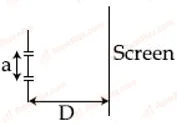
The figure shows a Young's double slit experimental setup. It is observed that when a thin transparent sheet of thickness t and refractive index is put in front of one of the slits, the central maximum gets shifted by a distance equal to n fringe width. If the wavelength of light used is then t will be:
The electric field of light wave is given as . This light falls on a metal plate of work function 2 eV. The stopping potential of the photo-electrons is: Given, E (in eV) =
0.72 V
2.0 V
2.48 V
0.48 V
Taking the wavelength of first Balmer line in hydrogen spectrum (n = 3 to n = 2) as 660 nm, the wavelength of the 2nd Balmer line (n = 4 to n = 2) will be:
889.2 nm
488.9 nm
388.9 nm
642.7 nm
An NPN transistor is used in common emitter configuration as an amplifier with 1 k load resistance. Signal voltage of 10 mV is applied across the base-emitter. This produces a 3 mA change in the collector current and 15 A change in the base current of the amplifier. The input resistance and voltage gain are:
0.33 k, 1.5
0.67 k, 300
0.67 k, 200
0.33 k, 300
A signal A cost is transmitted using as carrier wave. The correct amplitude modulated (AM) signal is: