Q1Torque and the rotational form of Newton's second law
A particle of mass m is moving along a trajectory given by
The torque, acting on the particle about the origin, at t = 0 is:
- A
- B
- C
Zero
- D
All 90 questions of JEE Main 10 Apr 2019, Shift 1, in the order they were asked, one subject to a page. Pick an answer on any question to check it against the key. Free to read, nothing to download.
Questions
90
Physics · Chemistry · Maths
Answer key
90
questions with a checked key
Price
Free
no sign-up
A particle of mass m is moving along a trajectory given by
The torque, acting on the particle about the origin, at t = 0 is:
Zero
A ball is thrown upward with an initial velocity from the surface of the earth. The motion of the ball is affected by a drag force equal to (where m is the mass of the ball, is its instantaneous velocity and is a constant). Time taken by the ball to rise to its zenith is:
Two particles, of masses and , moving, as shown, with speeds of and , collide elastically at the origin. After the collision, they move along the indicated directions with speeds and , respectively. The values of and are nearly :
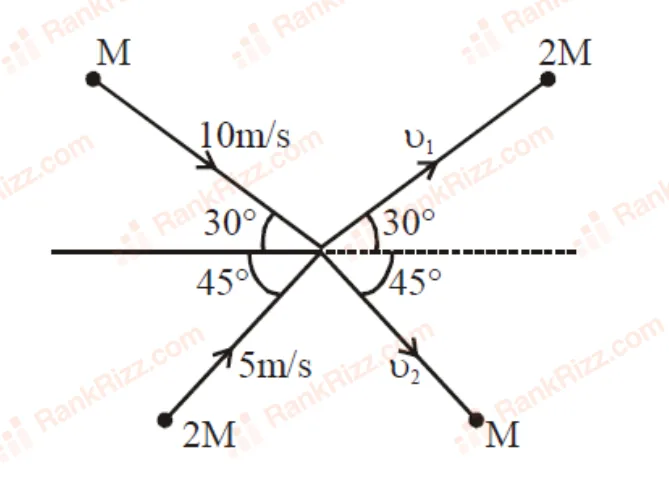
6.5 m s and 6.3 m s
3.2 m s and 12.6 m s
13.02 m s and 19.7 m s
3.2 m s and 6.3 m s
A thin disc of mass M and radius R has mass per unit area where r is the distance from its centre. Its moment of inertia about an axis going through its centre of mass and perpendicular to its plane is:
Two coaxial discs, having moments of inertia and , are rotating with respective angular velocities and , about their common axis. They are brought in contact with each other and thereafter they rotate with a common angular velocity. If and are the final and initial total energies, then is:
The value of acceleration due to gravity at Earth's surface is 9.8 m s. The altitude above its surface at which the acceleration due to gravity decreases to 4.9 m s, is close to: (Radius of earth = m)
m
m
m
m
The ratio of surface tensions of mercury and water is given to be 7.5, while the ratio of their densities is 13.6. Their contact angles, with glass, are close to 135° and 0°, respectively. If it is observed that mercury gets depressed by an amount in a capillary tube of radius , while water rises by the same amount in a capillary tube of radius , then the ratio is close to
n moles of an ideal gas with constant volume heat capacity undergo an isobaric expansion by certain volume. The ratio of the work done in the process, to the heat supplied is:
A cylinder with fixed capacity of 67.2 litre contains helium gas at STP. The amount of heat needed to raise the temperature of the gas by 20°C is:
[Given that R = 8.31 J mol K]
748 J
700 J
350 J
374 J
A m volume cylinder is filled with 1 mol of O gas at room temperature (300 K). The molecular diameter of O, and its root mean square speed, are found to be 0.3 nm and 200 m/s, respectively. What is the average collision rate (per second) for an O molecule?
~10
~10
~10
~10
The displacement of a damped harmonic oscillator is given by . Here t is in seconds. The time taken for its amplitude of vibration to drop to half of its initial value is close to:
27 s
4 s
13 s
7 s
A stationary source emits sound waves of frequency 500 Hz. Two observers moving along a line passing through the source detect sound to be of frequencies 480 Hz and 530 Hz. Their respective speeds are, in m s,
(Given speed of sound = 300 m/s)
16, 14
12, 16
12, 18
8, 18
A uniformly charged ring of radius 3a and total charge q is placed in x-y plane centred at origin. A point charge q is moving towards the ring along the z-axis and has speed v at z = 4a. The minimum value of v such that it crosses the origin is:
Figure shows charge (q) versus voltage (V) graph for series and parallel combination of two given capacitors. The capacitances are:
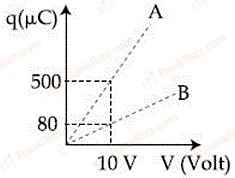
60 μF and 40 μF
50 μF and 30 μF
20 μF and 30 μF
40 μF and 10 μF
A current of 5 A passes through a copper conductor (resistivity = Ω m) of radius of cross-section 5 mm. Find the mobility of the charges if their drift velocity is ms.
1.5 m V s
1.8 m V s
1.0 m V s
1.3 m V s
In the given circuit, an ideal voltmeter connected across the 10 Ω resistance reads 2 V. The internal resistance r, of each cell is:
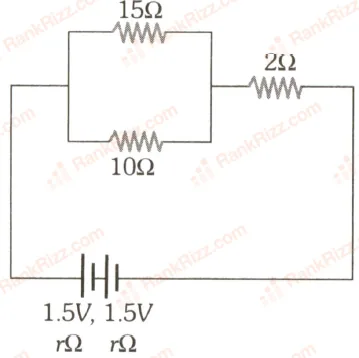
0 Ω
1.5 Ω
0.5 Ω
1 Ω
A moving coil galvanometer allows a full scale current of A. A series resistance of Ω is required to convert the galvanometer into a voltmeter of range 0 - 5 V. Therefore, the value of shunt resistance required to convert the above galvanometer into an ammeter of range 0 - 10 mA is:
100 Ω
200 Ω
300 Ω
10 Ω
In an experiment, the resistance of a material is plotted as a function of temperature (in some range). As shown in the figure, it is a straight line.
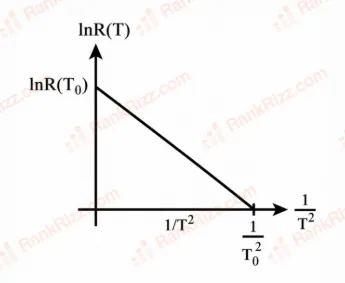
One may conclude that
Two wires A & B are carrying currents I and I as shown in the figure. The separation between them is d. A third wire C carrying a current I is to be kept parallel to them at a distance x from A such that the net force acting on it is zero. The possible values of x are:
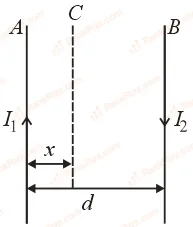
and
and
and
A proton, an electron, and a Helium nucleus, have the same energy. They are in circular orbits in a plane due to magnetic field perpendicular to the plane. Let , and be their respective radii, then,
A transformer consisting of 300 turns in the primary and 150 turns in the secondary gives output power of 2.2 kW. If the current in the secondary coil is 10 A, then the input voltage and current in the primary coil are:
440 V and 20 A
220 V and 20 A
440 V and 5 A
220 V and 10 A
Given below in the left column are different modes of communication using the kinds of waves given in the right column.
(1) Optical Fibre Communication (P) Ultrasound
(2) Radar (Q) Infrared Light
(3) Sonar (R) Microwaves
(4) Mobile Phones (S) Radio Waves
From the options given below, find the most appropriate match between entries in the left and the right column.
1 - Q, 2 - S, 3 - P, 4 - R
1 - S, 2 - Q, 3 - R, 4 - P
1 - Q, 2 - S, 3 - R, 4 - P
1 - R, 2 - P, 3 - S, 4 - Q
The electric field of a plane electromagnetic wave is given by
The corresponding magnetic field is then given by:
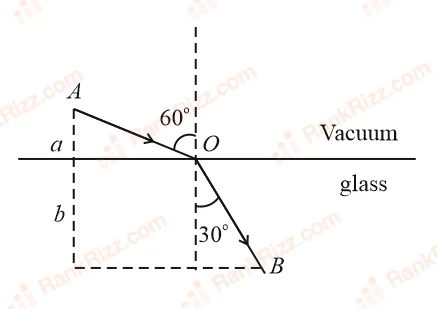
A ray of light AO in vacuum is incident on a glass slab at angle 60° and refracted at angle 30° along OB as shown in the figure. The optical path length of light ray from A to B is:
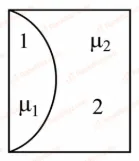
One plano-convex and one plano-concave lens of the same radius of curvature R but of different materials are joined side by side as shown in the figure. If the refractive index of the material of 1 is and that of 2 is , then the focal length of the combination is:
In a photoelectric effect experiment, the threshold wavelength of light is 380 nm. If the wavelength of incident light is 260 nm, the maximum kinetic energy of emitted electrons will be
Given E (in eV) =
4.5 eV
3.0 eV
1.5 eV
15.1 eV
Two radioactive materials A and B have decay constants and , respectively. If initially they have the same number of nuclei, then the ratio of the number of nuclei of A to that of B will be 1/e after a time:
An NPN transistor operates as a common emitter amplifier, with a power gain of 60 dB. The input circuit resistance is 100 Ω and the output load resistance is 10 kΩ. The common emitter current gain β is:
60
A message signal of frequency 100 MHz and peak voltage 100 V is used to execute amplitude modulation on a carrier wave of frequency 300 GHz and peak voltage 400 V. The modulation index and difference between the two side band frequencies are:
4; Hz
0.25; Hz
4; Hz
0.25; Hz
In a meter bridge experiment, the circuit diagram and the corresponding observation table are shown in figure.
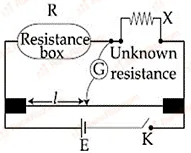
S. No. R(Ω) l(cm)
1. 1000 60
2. 100 13
3. 10 1.5
4. 1 1.0
Which of the reading is inconsistent?
1
3
2
4