Q1Dot and cross product of vectors
Let , and . The value of is:
- A
-112.5
- B
-118.5
- C
-106.5
- D
-99.5
All 90 questions of JEE Main 08 Apr 2019, Shift 2, in the order they were asked, one subject to a page. Pick an answer on any question to check it against the key. Free to read, nothing to download.
Questions
90
Physics · Chemistry · Maths
Answer key
90
questions with a checked key
Price
Free
no sign-up
Let , and . The value of is:
-112.5
-118.5
-106.5
-99.5
In a simple pendulum experiment for determination of acceleration due to gravity (g), time taken for 20 oscillations is measured by using a watch of 1 second least count. The mean value of time taken comes out to be 30 s. The length of the pendulum is measured by using a meter scale of least count 1 mm and the value obtained is 55.0 cm. The percentage error in the determination of g is close to:
0.2%
6.8%
3.5%
0.7%
If Surface tension (S), Moment of Inertia (I) and Planck's constant (h), were to be taken as the fundamental units, the dimensional formula for linear momentum would be:
A particle starts from origin O from rest and moves with a uniform acceleration along the positive -axis. Identify all figures that correctly represent the motion qualitatively. (a = acceleration, v = velocity, x = displacement, t = time)
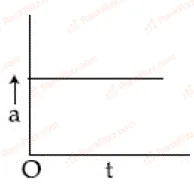
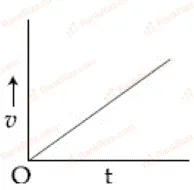
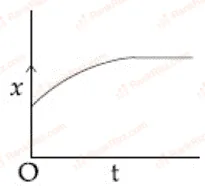
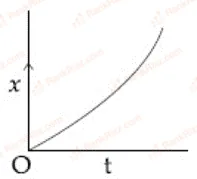
A, B, D
A, B, C
B, C
A
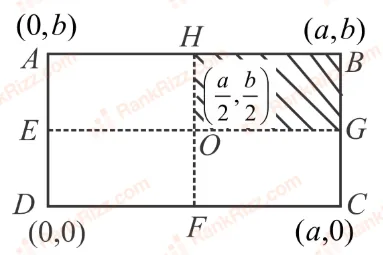
A uniform rectangular thin sheet of mass has length and breadth , as shown in the figure. If the shaded portion is cut-off, the coordinates of the centre of mass of the remaining portion will be:
A body of mass moving with an unknown velocity of , undergoes a collinear collision with a body of mass moving with a velocity . After the collision, and move with velocities of and , respectively. If and , then is:
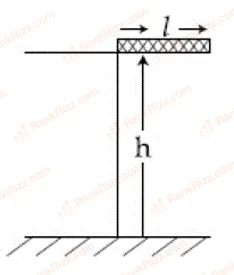
A rectangular solid box of length 0.3 m is held horizontally, with one of its sides on the edge of a platform of height 5 m. When released, it slips off the table in a very short time s, remaining essentially horizontal. The angle by which it would rotate when it hits the ground will be (in radians) close to:
0.5
0.3
0.02
0.28
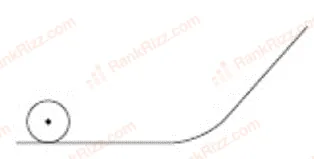
A solid sphere and solid cylinder of identical radii approach an incline with the same linear velocity (see figure). Both roll without slipping all throughout. The two climb maximum heights and on the incline. The ratio is given by:
1
A rocket has to be launched from earth in such a way that it never returns. If is the minimum energy delivered by the rocket launcher, what should be the minimum energy that the launcher should have, if the same rocket is to be launched from the surface of the moon? Assume that the density of the earth and the moon are equal and that the earth's volume is 64 times the volume of the moon.
Young's moduli of two wires A and B are in the ratio 7:4. Wire A is 2 m long and has radius R. Wire B is 1.5 m long and has radius 2 mm. If the two wires stretch by the same length for a given load, the value of R is close to:
1.3 mm
1.9 mm
1.5 mm
1.7 mm
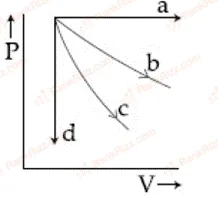
The given diagram shows four processes i.e., isochoric, isobaric, isothermal and adiabatic. The correct assignment of the processes, in the same order is given by:
a d b c
d a b c
a d c b
d a c b
The temperature, at which the root mean square velocity of hydrogen molecules equals their escape velocity from the earth, is closest to:
[Boltzmann Constant J/K, Avogadro number /kg, Radius of Earth: m, Gravitational acceleration on Earth = 10 ms]
K
650 K
800 K
K
A damped harmonic oscillator has a frequency of 5 oscillations per second. The amplitude drops to half its value for every 10 oscillations. The time it will take to drop to of the original amplitude is close to:
50 s
100 s
20 s
10 s
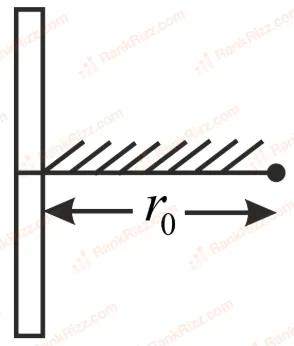
A positive point charge is released from rest at a distance from a positive line charge with uniform charge density. The speed (v) of the point charge, as a function of instantaneous distance r from line charge, is proportional to:
An electric dipole is formed by two equal and opposite charges q with separation d. The charges have same mass m. It is kept in a uniform electric field E. If it is slightly rotated from its equilibrium orientation, then its angular frequency is:
The electric field in a region is given by , where E is in NC and is in metres. The values of constants are A = 20 SI unit and B = 10 SI unit. If the potential at is and that at is , then is:
320 V
-520 V
180 V
-48 V
A parallel plate capacitor has 1F capacitance. One of its two plates is given +2C charge and the other plate, +4C charge. The potential difference developed across the capacitor is:
1 V
2 V
3 V
5 V
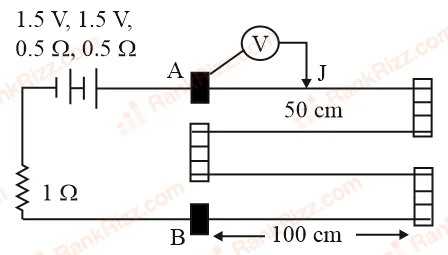
In the circuit shown, a four-wire potentiometer is made of a 400 cm long wire, which extends between A and B. The resistance per unit length of the potentiometer wire is r = 0.01 /cm. If an ideal voltmeter is connected as shown with jockey J at 50 cm from end A, the expected reading of the voltmeter will be:
0.50 V
0.25 V
0.75 V
0.20 V
A cell of internal resistance r drives current through an external resistance R. The power delivered by the cell to the external resistance will be maximum when:
R = 2r
R = r
R = 1000 r
R = 0.001 r
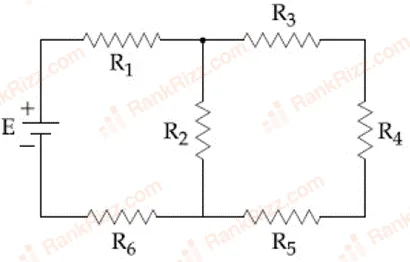
In the figure shown, what is the current (in Ampere) drawn from the battery? You are given: , , , , , , V
9/32
7/18
13/24
20/3
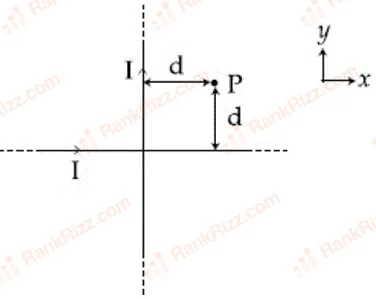
Two very long, straight, and insulated wires are kept at 90° angle from each other in xy-plane as shown in figure. These wires carry currents of equal magnitude I, whose direction are shown in the figure. The net magnetic field at point P will be:
Zero
Two magnetic dipoles X and Y are placed at a separation d, with their axes perpendicular to each other. The dipole moment of Y is twice that of X. A particle of charge q is passing through their mid-point P, at angle with the horizontal line, as shown in figure. What would be the magnitude of force on the particle at that instant? (d is much larger than the dimension of the dipole)
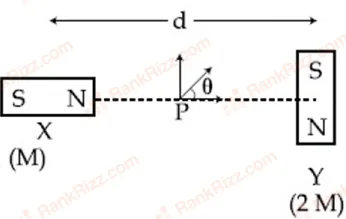
0
A circuit connected to an ac source of emf with t in seconds, gives a phase difference of between the emf and current . Which of the following circuits will exhibit this?
RC circuit with R = 1 k and C = 1 F
RL circuit with R = 1 k and L = 1 mH
RL circuit with R = 1 k and L = 10 mH
RC circuit with R = 1 k and C = 10 F
The magnetic field of an electromagnetic wave is given by:
The associated electric field will be:
Calculate the limit of resolution of a telescope objective having a diameter of 200 cm, if it has to detect light of wavelength 500 nm coming from a star.
radian
radian
radian
radian
A convex lens (of focal length 20 cm) and a concave mirror, having their principal axes along the same lines, are kept 80 cm apart from each other. The concave mirror is to the right of the convex lens. When an object is kept at a distance of 30 cm to the left of the convex lens, its image remains at the same position even if the concave mirror is removed. The maximum distance of the object for which this concave mirror, by itself would produce a virtual image would be:
30 cm
25 cm
20 cm
10 cm
A nucleus A, with a finite de-broglie wavelength , undergoes spontaneous fission into two nuclei B and C of equal mass. B flies in the same direction as that of A, while C flies in the opposite direction with a velocity equal to half of that of B. The de-Broglie wavelengths and of B and C are respectively:
The ratio of mass densities of nuclei of Ca and O is close to:
1
0.1
2
5
A common emitter amplifier circuit, built using an NPN transistor, is shown in the figure. Its dc current gain is 250, k and V. The minimum base current for to reach saturation is:
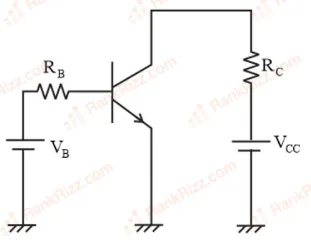
10 A
40 A
7 A
100 A
In a line of sight radio communication, a distance of about 50 km is kept between the transmitting and receiving antennas. If the height of the receiving antenna is 70 m, then the minimum height of the transmitting antenna should be: (Radius of the Earth = m)
20 m
51 m
40 m
32 m