JEE Main 2019 Physics question — LR circuits: growth and decay of current
Consider the LR circuit shown in the figure. If the switch S is closed at t = 0 then the amount of charge that passes through the battery between t = 0 and t = is:
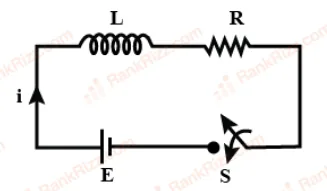
SOLUTION
We are dealing with a series LR circuit whose switch is closed at the instant . At that moment the current is zero, and thereafter it rises according to the well-known growth law for an LR circuit.
First, we recall the current-time relation for a resistor in series with an inductor connected to a constant emf . The standard formula is stated as
This expression comes from solving the differential equation with the initial condition .
We are asked for the total charge that flows through the battery from up to the time . Charge is the time integral of current, so we write
Substituting the expression for obtained above, we have
The constant factor can be taken outside the integral:
Now we integrate term by term. The integral of with respect to is simply . The integral of , where , is because
Using , the integral becomes
We now evaluate the definite integral at its limits. First at the upper limit :
So the expression at the upper limit is
Next, evaluate at the lower limit :
giving
Subtracting the lower-limit value from the upper-limit value we obtain
Hence the definite integral equals , and therefore
Numerically, , so the charge can be written approximately as
This matches exactly with option D.
Hence, the correct answer is Option D.