Q1Errors in measurement and significant figures
The diameter and height of a cylinder are measured by a meter scale to be cm and cm, respectively. What will be the value of its volume in appropriate significant figures?
- A
cm
- B
cm
- C
cm
- D
cm
All 90 questions of JEE Main 10 Jan 2019, Shift 2, in the order they were asked, one subject to a page. Pick an answer on any question to check it against the key. Free to read, nothing to download.
Questions
90
Physics · Chemistry · Maths
Answer key
90
questions with a checked key
Price
Free
no sign-up
The diameter and height of a cylinder are measured by a meter scale to be cm and cm, respectively. What will be the value of its volume in appropriate significant figures?
cm
cm
cm
cm
Two vectors and have equal magnitudes. The magnitude of is '' times the magnitude of . The angle between and is:
Two forces P and Q, of magnitude 2F and 3F, respectively, are at an angle with each other. If the force Q is doubled, then their resultant also gets doubled. Then, the angle is:
120
60
30
90
A particle starts from the origin at time and moves along the positive -axis. The graph of velocity with respect to time is shown in figure. What is the position of the particle at time ?
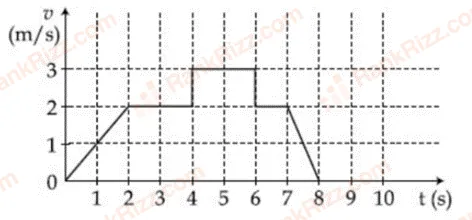
10 m
9 m
6 m
3 m
A particle which is experiencing a force, given by , undergoes a displacement of . If the particle had a kinetic energy of 3 J at the beginning of the displacement, what is its kinetic energy at the end of the displacement?
9 J
15 J
12 J
10 J
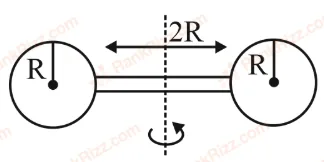
Two identical spherical balls of mass and radius each are stuck on two ends of a rod of length and mass (see figure). The moment of inertia of the system about the axis passing perpendicularly through the centre of the rod is:
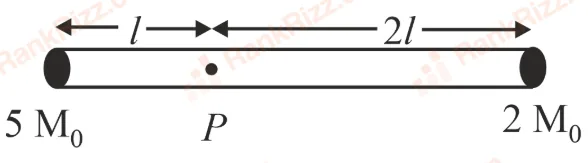
A rigid massless rod of length has two masses attached at each end as shown in the figure. The rod is pivoted at point P on the horizontal axis. When released from the initial horizontal position, its instantaneous angular acceleration will be:
Two stars of masses kg each, and at distance m rotate in a plane about their common centre of mass O. A meteorite passes through O moving perpendicular to the star's rotation plane. In order to escape from the gravitational field of this double star, the minimum speed that meteorite should have at O is: (Take Gravitational constant N m kg)
m s
m s
m s
m s
Half mole of an ideal monoatomic gas is heated at a constant pressure of 1 atm from 20C to 90C. Work done by the gas is
73 J
581 J
291 J
146 J
An unknown metal of mass 192 g heated to a temperature of 100C was immersed into a brass calorimeter of mass 128 g containing 240 g of water at a temperature of 8.4C. Calculate the specific heat of the unknown metal if water temperature stabilizes at 21.5C. (Specific heat of brass is 394 J kgK)
916 J kg K
458 J kg K
654 J kg K
1232 J kg K
2 kg of a monoatomic gas is at a pressure of N m. The density of the gas is 8 kg m. What is the order of energy of the gas due to its thermal motion?
J
J
J
J
A hoop and a solid cylinder of same mass and radius are made of a permanent magnetic material with their respective axes. But the magnetic moment of hoop is twice of solid cylinder. They are placed in a uniform magnetic field in such a manner that their magnetic moments make a small angle with the field. If the oscillation periods of hoop and cylinder are and respectively, then:
A particle executes simple harmonic motion with an amplitude of 5 cm. When the particle is at 4 cm from the mean position, the magnitude of its velocity in SI units is equal to that of its acceleration. Then, its periodic time in seconds is:
A cylindrical plastic bottle of negligible mass is filled with 310 ml of water and left floating in a pond with still water. If pressed downward slightly and released, it starts performing simple harmonic motion at angular frequency . If the radius of the bottle is 2.5 cm then is close to: (density of water kg/m)
5.00 rad sec
2.50 rad sec
7.9 rad sec
3.75 rad sec
A closed organ pipe has a fundamental frequency of 1.5 kHz. The number of overtones that can be distinctly heard by a person with this organ pipe will be (Assume that the highest frequency a person can hear is 20,000 Hz).
7
4
6
5
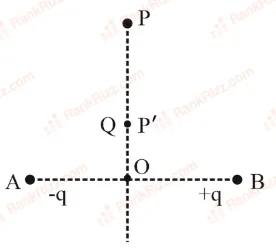
Charges and , located at A and B, respectively, constitute an electric dipole. Distance , is the mid point of the dipole and is perpendicular to . A charge is placed at P where and . The charge experiences an electrostatic force . If is now moved along the equatorial line to P' such that , the force on will be close to ():
27F
3F
9F
Four equal point charges each are placed in the plane at , , and . The work required to put a fifth charge at the origin of the coordinate system will be:
A parallel plate capacitor having capacitance 12 pF is charged by a battery to a potential difference of 10 V between its plates. The charging battery is now disconnected and a porcelain slab of dielectric constant 6.5 is slipped between the plates. The work done by the capacitor on the slab is:
560 pJ
600 pJ
508 pJ
692 pJ
The actual value of resistance , shown in the figure is 30. This is measured in an experiment as shown using the standard formula , where V and I are the readings of the voltmeter and ammeter, respectively. If the measured value of is 5% less, then the internal resistance of the voltmeter is:
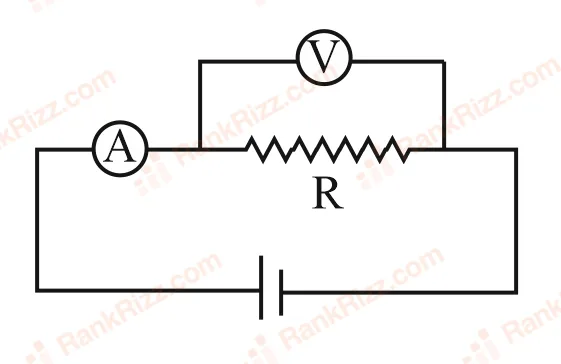
35
600
570
350
The Wheatstone bridge shown in the figure below, gets balanced when the carbon resistor used as has the colour code (orange, red, brown). The resistors and are 80 and 40 , respectively. Assuming that the colour code for the carbon resistors gives their accurate values, the colour code for the carbon resistor, used as , would be:
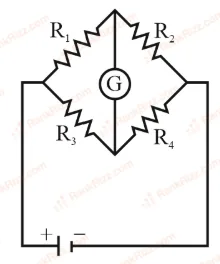
brown, blue, black
brown, blue, brown
grey, black, brown
red, green, brown
A current of 2 mA was passed through an unknown resistor which dissipated a power of 4.4 W. Dissipated power when an ideal power supply of 11 V is connected across it is:
W
W
W
W
At some location the horizontal component of earth's magnetic field is T. At this location, magnetic needle of length 0.12 m and pole strength 1.8 Am is suspended from its mid-point using a thread, it makes 45 angles with horizontal in equilibrium. To keep this needle horizontal, the vertical force that should be applied at one of its ends is:
N
N
N
N
The self induced emf of a coil is 25 volts. When the current in it is changed at uniform rate from 10A to 25A in 1s, the change in the energy of the inductance is:
637.5 J
740 J
437.5 J
540 J
The electric field of a plane polarized electromagnetic wave in free space at time is given by the expression . The magnetic field is given by ( is the velocity of light.)
The eye can be regarded as a single refracting surface. The radius of curvature of this surface is equal to that of the cornea (7.8 mm). This surface separates two media of refractive indices 1 and 1.34. Calculate the distance from the refracting surface at which a parallel beam of light will come to focus.
4.0 cm
1 cm
2 cm
3.07 cm
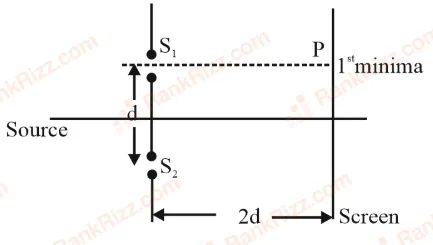
Consider a Young's double slit experiment as shown in figure. What should be the slit separation in terms of wavelength such that the first minima occurs directly in front of the slit ()?
A metal plate of area m is illuminated by a radiation of intensity 16 m W/m. The work function of the metal is 5 eV. The energy of the incident photons is 10 eV and only 10% of it produces photo electrons. The number of emitted photo electrons per second and their maximum energy, respectively, will be: [ J]
and 10 eV
and 5 eV
and 5 eV
and 5 eV
Consider the nuclear fission, . Given that the binding energy/nucleon of , and are 8.03 MeV, 7.86 MeV, respectively. Identify the correct statement:
Energy of 12.4 MeV will be supplied
Energy of 9.72 MeV has to be supplied
Energy of 3.6 MeV will be released
8.3 MeV energy will be released
For the circuit shown below, the current through the Zener diode is:
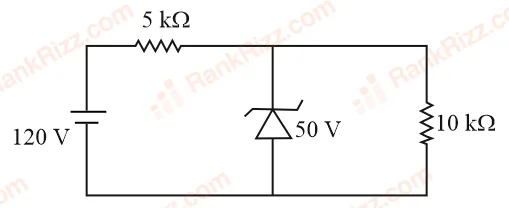
zero
5 mA
9 mA
14 mA
The modulation frequency of an AM radio station is 250 kHz, which is 10% of the carrier wave. If another AM station approaches you for license what broadcast frequency will you allot?
2750 kHz
2000 kHz
2250 kHz
2900 kHz