Q1Dimensional analysis: deriving and checking relations
Time (), velocity () and angular momentum () are chosen as fundamental quantities instead of mass, length and time. In terms of these, the dimensions of mass would be:
- A
- B
- C
- D
All 90 questions of JEE Main 08 Apr 2017, Online, in the order they were asked, one subject to a page. Pick an answer on any question to check it against the key. Free to read, nothing to download.
Questions
90
Physics · Chemistry · Maths
Answer key
89
questions with a checked key
Price
Free
no sign-up
Time (), velocity () and angular momentum () are chosen as fundamental quantities instead of mass, length and time. In terms of these, the dimensions of mass would be:
Which graph corresponds to an object moving with a constant negative acceleration and a positive velocity?
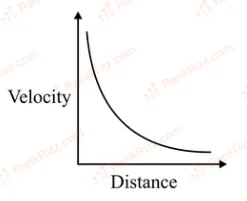
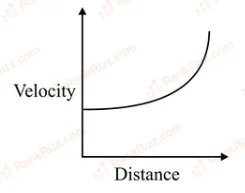
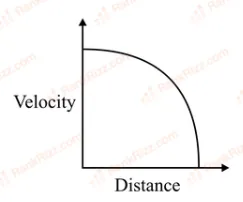
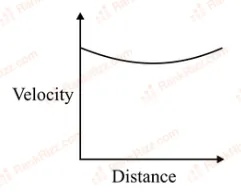
An object is dropped from a height from the ground. Every time it hits the ground it loses 50% of its kinetic energy. The total distance covered as is:
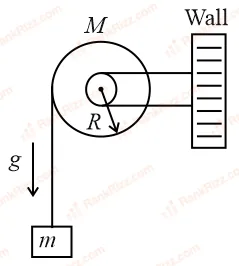
A uniform disc of radius and mass is free to rotate only about its axis. A string is wrapped over its rim and a body of mass is tied to the free end of the string as shown in the figure. The body is released from rest. Then the acceleration of the body is:
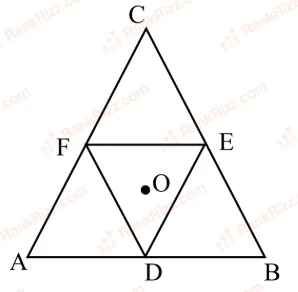
Moment of inertia of an equilateral triangular lamina , about the axis passing through its centre and perpendicular to its plane is as shown in the figure. A cavity is cut out from the lamina, where , , are the mid points of the sides. Moment of inertia of the remaining part of lamina about the same axis is:
In a physical balance working on the principle of moments, when 5 mg weight is placed on the left pan, the beam becomes horizontal. Both the empty pans of the balance are of equal mass. Which of the following statements is correct?
Every object that is weighed using this balance appears lighter than its actual weight
Left arm is shorter than the right arm
Both the arms are of same length
Left arm is longer than the right arm
If the Earth has no rotational motion, the weight of a person on the equator is . Determine the speed with which the earth would have to rotate about its axis so that the person at the equator will weigh . The radius of the Earth is 6400 km and m s.
rad s
rad s
rad s
rad s
A compressive force, is applied at the two ends of a long thin steel rod. It is heated, simultaneously, such that its temperature increases by . The net change in its length is zero. Let be the length of the rod, its area of cross-section, its Young's modulus, and its coefficient of linear expansion. Then, is equal to:
In an experiment, a sphere of aluminium of mass 0.20 kg is heated up to 150°C. Immediately, it is put into water of volume 150 cc at 27°C kept in a calorimeter of water equivalent to 0.025 kg. The final temperature of the system is 40°C. The specific heat of the aluminium is (take 4.2 Joule = 1 calorie):
434 J kg °C
378 J kg °C
315 J kg °C
476 J kg °C
An engine operates by taking moles of an ideal gas through the cycle shown in figure. The thermal efficiency of the engine is: (Take , where is gas constant)
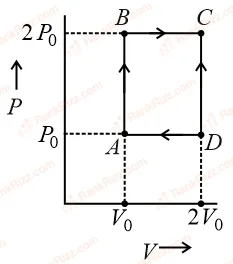
0.24
0.15
0.32
0.08
An ideal gas has molecules with 5 degrees of freedom. The ratio of specific heats at constant pressure () and at constant volume () is:
6
The ratio of maximum acceleration to maximum velocity in a simple harmonic motion is 10 s. At, the displacement is 5 m. What is the maximum acceleration? The initial phase is .
500 m s
m s
750 m s
m s
A 1 kg block attached to a spring vibrates with a frequency of 1 Hz on a frictionless horizontal table. Two springs identical to the original spring are attached in parallel to a 8 kg block placed on the same table. So, the frequency of vibration of the 8 kg block is:
2 Hz
Hz
Hz
Hz
Two wires and have the same radius and respective densities and , such that . They are joined together at the point , as shown in the figure. The combination is used as a sonometer wire and kept under tension . The point is midway between the two bridges. When a stationary wave is set up in the composite wire, the joint is found to be a node. The ratio of the number of antinodes formed in to is:
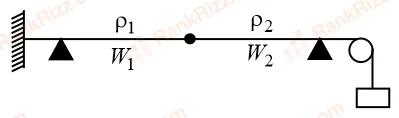
4 : 1
1 : 2
1 : 1
1 : 3
There is a uniform electrostatic field in a region. The potential at various points on a small sphere centred at , in the region, is found to vary between the limits 589.0 V to 589.8 V. What is the potential at a point on the sphere whose radius vector makes an angle of 60° with the direction of the field?
589.4 V
589.5 V
589.2 V
589.6 V
The energy stored in the electric field produced by a metal sphere is 4.5 J. If the sphere contains 4 C charge, its radius will be:
32 mm
16 mm
28 mm
20 mm
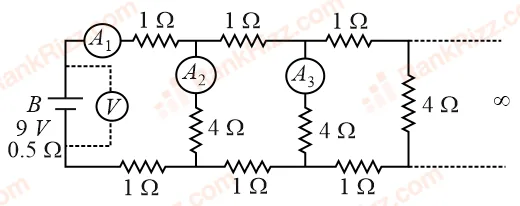
A 9 V battery with an internal resistance of 0.5 is connected across an infinite network, as shown in the figure. All ammeters , , and voltmeter are ideal. Choose the correct statement.
Reading of is 18 A
Reading of is 9 V
Reading of is 7 V
Reading of is 2 A
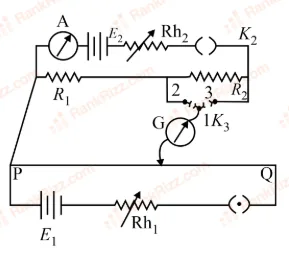
A potentiometer is set up to compare two resistances, as shown in the figure. The ammeter in the circuit reads 1.0 A when the two-way key is open. The balance point is at a length cm from when the two-way key is plugged in between 2 and 1, while the balance point is at a length cm from when the key is plugged in between 3 and 1. The ratio of two resistances , is found to be:
A magnetic dipole in a uniform magnetic field has: (Take zero potential energy when magnetic dipole is perpendicular to magnetic field)
Maximum potential energy when the torque is maximum
Zero potential energy when the torque is maximum
Zero potential energy when the torque is minimum
Minimum potential energy when the torque is maximum
In a certain region static electric and magnetic fields exist. The magnetic field is given by . If a test charge moving with a velocity experiences no force in that region, then the electric field in the region, in SI units, is:
A small circular loop of wire of radius is located at the centre of a much larger circular wire loop of radius . The two loops are in the same plane. The outer loop of radius carries an alternating current . The emf induced in the smaller inner loop is nearly:
Magnetic field in a plane electromagnetic wave is given by, T. Expression for corresponding electric field will be: (Where is speed of light)
V m
V m
V m
V m
Let the refractive index of a denser medium with respect to a rarer medium be and its critical angle be . At an angle of incidence when light is travelling from denser medium to rarer medium, a part of the light is reflected and the rest is refracted and the angle between reflected and refracted rays is 90°. Angle is given by:
A single slit of width is illuminated by a coherent monochromatic light of wavelength . If the second and fourth minima in the diffraction pattern at a distance 1 cm from the slit are at 3 cm and 6 cm respectively from the central maximum, what is the width of the central maximum? (i.e. distance between first minimum on either side of the central maximum)
4.5 cm
1.5 cm
6.0 cm
3.0 cm
The maximum velocity of the photoelectrons emitted from the surface is when light of frequency falls on a metal surface. If the incident frequency is increased to , the maximum velocity of the ejected photoelectrons will be:
more than
equal to
less than
According to Bohr's theory, the time averaged magnetic field at the centre (i.e., nucleus) of a hydrogen atom due to the motion of electrons in the orbit is proportional to: ( = principal quantum number)
Two deuterons undergo nuclear fusion to form a Helium nucleus. The energy released in this process is (given binding energy per nucleon for deuteron = 1.1 MeV and for helium = 7.0 MeV):
23.6 MeV
30.2 MeV
25.8 MeV
32.4 MeV
The characteristic of a diode is shown in the figure. The ratio of forward to reverse bias resistance is:
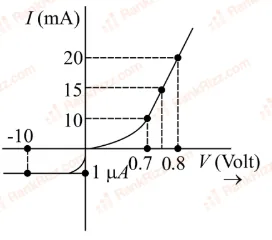
100
10
The conductivity of a semiconductor sample having electron concentration of electrons m, hole concentration of holes m, electron mobility of 2.0 m V s and hole mobility of 0.01 m V s is: (Take charge of an electron as C)
1.83
1.65
1.20
0.59
A signal of frequency 20 kHz and peak voltage of 5 Volt is used to modulate a carrier wave of frequency 1.2 MHz and peak voltage 25 Volts. Choose the correct statement.
Modulation index = 5, side frequency bands are at 1400 kHz and 1000 kHz.
Modulation index = 5, side frequency bands are at 21.2 kHz and 18.8 kHz.
Modulation index = 0.2, side frequency bands are at 1220 kHz and 1180 kHz.
Modulation index = 5, side frequency bands are at 24.2 kHz and 18.8 kHz.