RankRizz

JEE Main 09 Apr 2017, Online Question Paper

All 90 questions of JEE Main 09 Apr 2017, Online, in the order they were asked, one subject to a page. Pick an answer on any question to check it against the key. Free to read, nothing to download.

Questions

90

Physics · Chemistry · Maths

Answer key

89

questions with a checked key

Price

Free

no sign-up

Physics

Q1Errors in measurement and significant figures

A physical quantity PP is described by the relation P=a12b2c3d−4P = a^{\frac{1}{2}} b^2 c^3 d^{-4}. If the relative errors in the measurement of a,b,ca, b, c and dd respectively, are 2%, 1%, 3% and 5%. Then the relative error in PP will be:

  1. A

    12%

  2. B

    8%

  3. C

    25%

  4. D

    32%

Q2Relative motion in one dimension

A car is standing 200 m behind a bus, which is also at rest. The two start moving at the same instant but with different forward accelerations. The bus has acceleration 2 m s−2^{-2} and the car has acceleration 4 m s−2^{-2}. The car will catch up with the bus after time:

  1. A

    120\sqrt{120} s

  2. B

    15 s

  3. C

    110\sqrt{110} s

  4. D

    10210\sqrt{2} s

Q3Dynamics of horizontal circular motion: conical pendulum, rotating drums

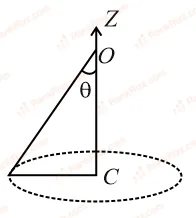
A conical pendulum of length ll makes an angle θ=45∘\theta = 45^\circ with respect to Z-axis and moves in a circle in the XY plane. The radius of the circle is 0.4 m and its center is vertically below O. The speed of the pendulum, in its circular path, will be - (Take g=10g = 10 m s−2^{-2})

Figure for JEE Main 2017 Physics question on Dynamics of horizontal circular motion: conical pendulum, rotating drums
  1. A

    0.2 m s−1^{-1}

  2. B

    0.4 m s−1^{-1}

  3. C

    2 m s−1^{-1}

  4. D

    4 m s−1^{-1}

Q4Rolling without slipping: kinematics and energy

The machine as shown has 2 rods of length 1 m connected by a pivot at the top. The end of one rod is connected to the floor by a stationary pivot and the end of the other rod has a roller that rolls along the floor in a slot. As the roller goes back and forth, a 2 kg weight moves up and down. If the roller is moving towards right at a constant speed, the weight moves up with a:
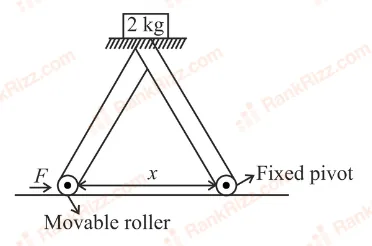
Figure for JEE Main 2017 Physics question on Rolling without slipping: kinematics and energy
  1. A

    Speed which is 34\frac{3}{4} th of that of the roller when the weight is 0.4 m above the ground

  2. B

    Constant speed

  3. C

    Decreasing speed

  4. D

    Increasing speed

Q5Head-on collisions and coefficient of restitution

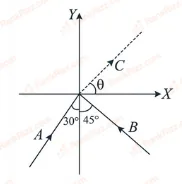
Two particles AA and BB of equal mass MM are moving with the same speed vv as shown in figure. They collide completely inelastic and move as a single particle CC. The angle θ\theta that the path of CC makes with the X-axis is given by-

Figure for JEE Main 2017 Physics question on Head-on collisions and coefficient of restitution
  1. A

    tan⁡θ=3−21−2\tan \theta = \dfrac{\sqrt{3} - \sqrt{2}}{1 - \sqrt{2}}

  2. B

    tan⁡θ=1−22(1+3)\tan \theta = \dfrac{1 - \sqrt{2}}{\sqrt{2}(1 + \sqrt{3})}

  3. C

    tan⁡θ=1−31+2\tan \theta = \dfrac{1 - \sqrt{3}}{1 + \sqrt{2}}

  4. D

    tan⁡θ=3+21−2\tan \theta = \dfrac{\sqrt{3} + \sqrt{2}}{1 - \sqrt{2}}

Q6Moment of inertia of standard bodies and composite systems

A circular hole of radius R4\frac{R}{4} is made in a thin uniform disc having mass and radius RR, as shown in figure. The moment of inertia of the remaining portion of the disc about an axis passing through the point O and perpendicular to the plane of the disc is-
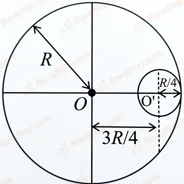
Figure for JEE Main 2017 Physics question on Moment of inertia of standard bodies and composite systems
  1. A

    219MR2256\frac{219MR^2}{256}

  2. B

    237MR2512\frac{237MR^2}{512}

  3. C

    197MR2256\frac{197MR^2}{256}

  4. D

    19MR2512\frac{19MR^2}{512}

Q7Gravitational field and potential of rings, shells and spheres

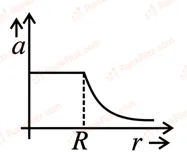
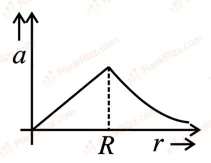
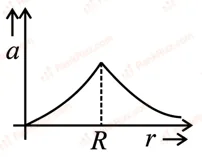
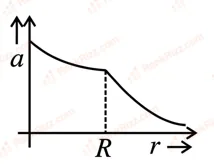
The mass density of a spherical body is given by ρ(r)=kr\rho(r) = \frac{k}{r} for r≤Rr \le R and ρ(r)=0\rho(r) = 0 for r>Rr > R, where rr is the distance from the center. The correct graph that describes qualitatively the acceleration, aa of a test particle as a function of rr is:

  1. A
    Figure for JEE Main 2017 Physics question on Gravitational field and potential of rings, shells and spheres
  2. B
    Figure for JEE Main 2017 Physics question on Gravitational field and potential of rings, shells and spheres
  3. C
    Figure for JEE Main 2017 Physics question on Gravitational field and potential of rings, shells and spheres
  4. D
    Figure for JEE Main 2017 Physics question on Gravitational field and potential of rings, shells and spheres
Q8Viscosity, Poiseuille's equation and Reynolds number

Two tubes of radii r1r_1 and r2r_2 and lengths l1l_1 and l2l_2, respectively, are connected in series and a liquid flows through each of them in stream line conditions. P1P_1 and P2P_2 are pressure differences across the two tubes. If P2P_2 is 4P14P_1 and l2l_2 is l14\frac{l_1}{4} then the radius r2r_2 will be equal to:

  1. A

    4r14r_1

  2. B

    r1r_1

  3. C

    2r12r_1

  4. D

    r12\frac{r_1}{2}

Q9Thermal stress

A steel rail of length 5 m and area of cross section 40 cm2^2 is prevented from expanding along its length while the temperature rises by 10°C. If coefficient of linear expansion and Young's modulus of steel are 1.2×10−51.2 \times 10^{-5} K−1^{-1} and 2×10112 \times 10^{11} N m−2^{-2} respectively, the force developed in the rail is approximately:

  1. A

    2×1072 \times 10^7 N

  2. B

    2×1092 \times 10^9 N

  3. C

    3×10−53 \times 10^{-5} N

  4. D

    1×1051 \times 10^5 N

Q10Work done in thermodynamic processes and P-V diagrams

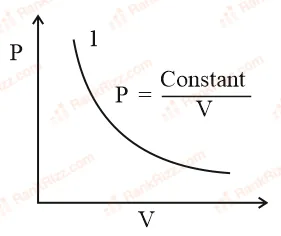
For the P−VP - V diagram given for an ideal gas

Figure for JEE Main 2017 Physics question on Work done in thermodynamic processes and P-V diagrams

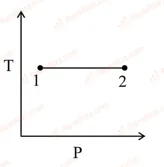
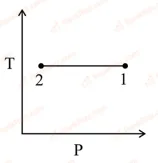
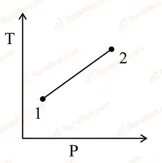
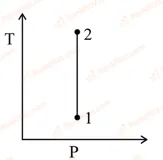
Out of the following which one correctly represents the T−PT - P diagram?

  1. A
    Figure for JEE Main 2017 Physics question on Work done in thermodynamic processes and P-V diagrams
  2. B
    Figure for JEE Main 2017 Physics question on Work done in thermodynamic processes and P-V diagrams
  3. C
    Figure for JEE Main 2017 Physics question on Work done in thermodynamic processes and P-V diagrams
  4. D
    Figure for JEE Main 2017 Physics question on Work done in thermodynamic processes and P-V diagrams
Q11Degrees of freedom, equipartition of energy and internal energy

NN moles of diatomic gas in a cylinder is at a temperature TT. Heat is supplied to the cylinder such that the temperature remains constant but nn moles of the diatomic gas get converted into monoatomic gas. The change in the total kinetic energy of the gas is

  1. A

    0

  2. B

    52nRT\frac{5}{2}nRT

  3. C

    32nRT\frac{3}{2}nRT

  4. D

    12nRT\frac{1}{2}nRT

Q12Damped and forced oscillations and resonance

A block of mass 0.1 kg is connected to an elastic spring of spring constant 640 N m−1^{-1} and oscillates in a damping medium of damping constant 10−210^{-2} kg s−1^{-1}. The system dissipates its energy gradually. The time taken for its mechanical energy of vibration to drop to half of its initial value, is closest to-

  1. A

    2 s

  2. B

    5 s

  3. C

    3 s

  4. D

    7 s

Q13Spring-block oscillations

In an experiment to determine the period of a simple pendulum of length 1 m, it is attached to different spherical bobs of radii r1r_1 and r2r_2. The two spherical bobs have uniform mass distribution. If the relative difference in the periods, is found to be 5×10−45 \times 10^{-4} s, the difference in radii, ∣r1−r2∣|r_1 - r_2| is best-given by

  1. A

    0.01 cm

  2. B

    0.05 cm

  3. C

    0.5 cm

  4. D

    1 cm

Q14Progressive waves: wave equation, phase and intensity

A standing wave is formed by the superposition of two waves travelling in opposite directions. The transverse displacement is given by, y(x,t)=0.5sin⁡(5π4x)cos⁡(200πt)y(x, t) = 0.5 \sin\left(\frac{5\pi}{4}x\right) \cos(200\pi t). What is the speed of the travelling wave moving in the positive xx direction? (xx and tt are in meter and second, respectively)

  1. A

    120 m s−1^{-1}

  2. B

    90 m s−1^{-1}

  3. C

    160 m s−1^{-1}

  4. D

    180 m s−1^{-1}

Q15Electric flux and Gauss's law

Four closed surfaces and corresponding charge distributions are shown below.
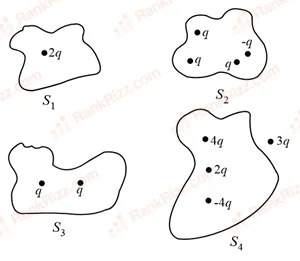
Figure for JEE Main 2017 Physics question on Electric flux and Gauss's law

Let the respective electric fluxes through the surfaces be ϕ1\phi_1, ϕ2\phi_2, ϕ3\phi_3 and ϕ4\phi_4. Then:

  1. A

    ϕ1>ϕ2>ϕ3>ϕ4\phi_1 > \phi_2 > \phi_3 > \phi_4

  2. B

    ϕ1<ϕ2=ϕ3>ϕ4\phi_1 < \phi_2 = \phi_3 > \phi_4

  3. C

    ϕ1>ϕ3\phi_1 > \phi_3; ϕ2<ϕ4\phi_2 < \phi_4

  4. D

    ϕ1=ϕ2=ϕ3=ϕ4\phi_1 = \phi_2 = \phi_3 = \phi_4

Q16Magnetic dipole moment of current loops and torque on loops

A negative test charge is moving near a long straight wire carrying a current. The force acting on the test charge is parallel to the direction of the current. The motion of the charge is:

  1. A

    Away from the wire

  2. B

    Towards the wire

  3. C

    Parallel to the wire along the current

  4. D

    Parallel to the wire opposite to the current

Q17Capacitors with dielectrics

A combination of parallel plate capacitors is maintained at a certain potential difference.
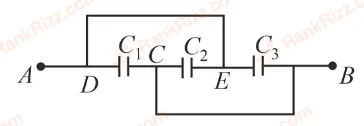
Figure for JEE Main 2017 Physics question on Capacitors with dielectrics

When a 3 mm thick slab is introduced between all the plates, in order to maintain the same potential difference, the distance between the plates is increased by 2.4 mm. Find the dielectric constant of the slab.

  1. A

    6

  2. B

    4

  3. C

    3

  4. D

    5

Q18Meter bridge

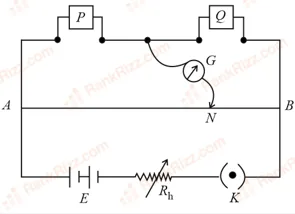
In a meter bridge experiment resistances are connected as shown in the figure. Initially resistance P=4  ΩP = 4 \; \Omega and the neutral point NN is at 60 cm from AA. Now an unknown resistance RR is connected in series to PP and the new position of the neutral point is at 80 cm from AA. The value of unknown resistance RR is -

Figure for JEE Main 2017 Physics question on Meter bridge
  1. A

    335  Ω\frac{33}{5} \; \Omega

  2. B

    6  Ω6 \; \Omega

  3. C

    203  Ω\frac{20}{3} \; \Omega

  4. D

    7  Ω7 \; \Omega

Q19Ohm's law, resistance, resistivity and colour code

A uniform wire of length ll and radius rr has a resistance of 100 Ω\Omega. It is recast into a wire of radius r2\frac{r}{2}. The resistance of new wire will be-

  1. A

    1600 Ω\Omega

  2. B

    100 Ω\Omega

  3. C

    200 Ω\Omega

  4. D

    400 Ω\Omega

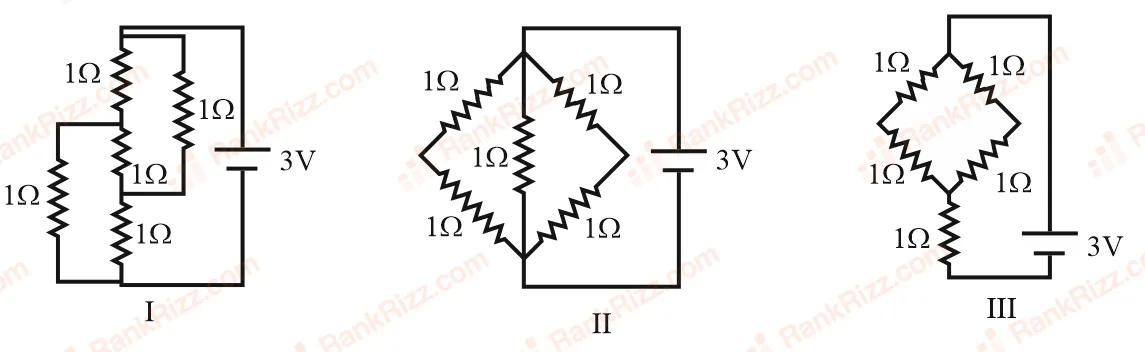
Q20Electric power and heating effect of current

The figure shows three circuits I, II and III which are connected to a 3 V battery. If the powers dissipated by the configurations I, II and III are P1P_1, P2P_2 and P3P_3 respectively, then -

Figure for JEE Main 2017 Physics question on Electric power and heating effect of current
  1. A

    P2>P1>P3P_2 > P_1 > P_3

  2. B

    P1>P2>P3P_1 > P_2 > P_3

  3. C

    P3>P2>P1P_3 > P_2 > P_1

  4. D

    P1>P3>P2P_1 > P_3 > P_2

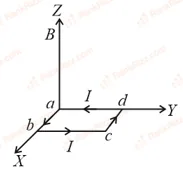
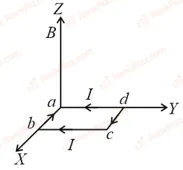
Q21Magnetic dipole moment of current loops and torque on loops

A uniform magnetic field BB of 0.3 T is along the positive Z-direction. A rectangular loop (abcd) of sides 10 cm ×\times 5 cm carries a current II of 12 A. Out of the following different orientations which one corresponds to stable equilibrium?
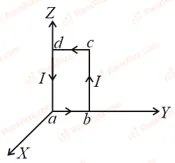
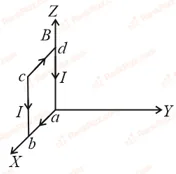
  1. A
    Figure for JEE Main 2017 Physics question on Magnetic dipole moment of current loops and torque on loops
  2. B
    Figure for JEE Main 2017 Physics question on Magnetic dipole moment of current loops and torque on loops
  3. C
    Figure for JEE Main 2017 Physics question on Magnetic dipole moment of current loops and torque on loops
  4. D
    Figure for JEE Main 2017 Physics question on Magnetic dipole moment of current loops and torque on loops
Q22Series LCR circuits: impedance and phase

A sinusoidal voltage of peak value 283 V and angular frequency 320 s−1^{-1} is applied to a series LCR circuit. Given that R=5  ΩR = 5 \; \Omega, L=25L = 25 mH and C=1000  μC = 1000 \; \muF. The total impedance and phase difference between the voltage across the source and the current will respectively be-

  1. A

    10 Ω\Omega and tan⁡−1(53)\tan^{-1}\left(\frac{5}{3}\right)

  2. B

    7 Ω\Omega and 45°

  3. C

    7 Ω\Omega and tan⁡−1(53)\tan^{-1}\left(\frac{5}{3}\right)

  4. D

    10 Ω\Omega and tan⁡−1(83)\tan^{-1}\left(\frac{8}{3}\right)

Q23Properties of EM waves: fields, energy, intensity and momentum

The electric field component of a monochromatic radiation is given by E⃗=2E0cos⁡kzcos⁡ωt  i^\vec{E} = 2E_0 \cos kz \cos \omega t \; \hat{i}. Its magnetic field B⃗\vec{B} is then given by:

  1. A

    2E0csin⁡kzsin⁡ωt  j^\frac{2E_0}{c} \sin kz \sin \omega t \; \hat{j}

  2. B

    2E0ccos⁡kzcos⁡ωt  j^\frac{2E_0}{c} \cos kz \cos \omega t \; \hat{j}

  3. C

    2E0csin⁡kzcos⁡ωt  j^\frac{2E_0}{c} \sin kz \cos \omega t \; \hat{j}

  4. D

    −2E0csin⁡kzsin⁡ωt  j^\frac{-2E_0}{c} \sin kz \sin \omega t \; \hat{j}

Q24Thin lenses: lens formula, lens maker's formula and power

In an experiment a convex lens of focal length 15 cm is placed coaxially on an optical bench in front of a convex mirror at a distance of 5 cm from it. It is found that an object and its image coincide, if the object is placed at a distance of 20 cm from the lens. The focal length of the convex mirror is-

  1. A

    20.0 cm

  2. B

    30.5 cm

  3. C

    25.0 cm

  4. D

    27.5 cm

Q25Single slit diffraction

A single slit of width 0.1 mm is illuminated by a parallel beam of light of wavelength 6000 Å and diffraction bands are observed on a screen 0.5 m from the slit. The distance of the third dark band from the central bright band is:

  1. A

    9 mm

  2. B

    3 mm

  3. C

    4.5 mm

  4. D

    1.5 mm

Q26Photons: energy, momentum and radiation pressure

A laser light of wavelength 660 nm is used to weld Retina detachment. If a laser pulse of width 60 ms and power 0.5 kW is used, the approximate number of photons in the pulse are (Take Planck's Constant, h=6.62×10⁻³⁴h = 6.62 \times 10^{-34} J s)

  1. A

    102210^{22}

  2. B

    101910^{19}

  3. C

    102010^{20}

  4. D

    101810^{18}

Q27Hydrogen spectrum and spectral series

The acceleration of an electron in the first orbit of the hydrogen atom (n=1n = 1) is:

  1. A

    h24πm2r3\frac{h^2}{4\pi m^2 r^3}

  2. B

    h2π2m2r3\frac{h^2}{\pi^2 m^2 r^3}

  3. C

    h28π2m2r3\frac{h^2}{8\pi^2 m^2 r^3}

  4. D

    h24π2m2r3\frac{h^2}{4\pi^2 m^2 r^3}

Q28Nuclear size, mass defect and binding energy

Imagine that a reactor converts all the given mass into energy and that it operates at a power level of 10910^9 Watt. The mass of the fuel consumed per hour, in the reactor, will be: (velocity of light, cc is 3×1083 \times 10^8 m s−1^{-1})

  1. A

    6.6×10−56.6 \times 10^{-5} g

  2. B

    0.96 g

  3. C

    4×10⁻²⁴ \times 10^{-2} g

  4. D

    0.8 g

Q29Transistors (older syllabus)

The current gain of a common emitter amplifier is 69. If the emitter current is 7.0 mA, collector current is:

  1. A

    69 mA

  2. B

    0.69 mA

  3. C

    6.9 mA

  4. D

    9.6 mA

Q30Elements of communication and propagation of EM waves

A signal is to be transmitted through a wave of wavelength λ\lambda, using a linear antenna. The length ll of the antenna and effective power radiated PeffP_{\text{eff}} will be given, respectively, as- (KK is a constant of proportionality)

  1. A

    λ8\frac{\lambda}{8}, Peff=K(lλ)P_{\text{eff}} = K\left(\frac{l}{\lambda}\right)

  2. B

    λ16\frac{\lambda}{16}, Peff=K(lλ)3P_{\text{eff}} = K\left(\frac{l}{\lambda}\right)^3

  3. C

    λ5\frac{\lambda}{5}, Peff=K(lλ)12P_{\text{eff}} = K\left(\frac{l}{\lambda}\right)^{\frac{1}{2}}

  4. D

    λ\lambda, Peff=K(lλ)2P_{\text{eff}} = K\left(\frac{l}{\lambda}\right)^2

NEXT IN THIS PAPER →Chemistry, Q31 onwards