All 90 questions of JEE Main 02 Apr 2017, Offline, in the order they were asked, one subject to a page. Pick an answer on any question to check it against the key. Free to read, nothing to download.
Questions
90
Physics · Chemistry · Maths
Answer key
90
questions with a checked key
Price
Free
no sign-up
Physics
Q1Errors in measurement and significant figures
The following observations were taken for determining surface tension T of water by capillary method: diameter of capillary, D=1.25×10⁻² m rise of water, h=1.45×10⁻² m Using g=9.80 m s−2 and the simplified relation T=2rhg×103 N m−1, the possible error in surface tension is closest to:
A time dependent force F=6t acts on a particle of mass 1 kg. If the particle starts from the rest, the work done by the force during the first 1 sec will be:
Q4Newton's laws, free-body diagrams and equilibrium of a particle
A body of mass m=10−2 kg is moving in a medium and experiences a frictional force F=−kv2. Its initial speed is v0=10 m s−1. After 10 s its kinetic energy is 81mv02, then the value of k will be:
Q5Moment of inertia of standard bodies and composite systems
The moment of inertia of a uniform cylinder of length l and radius R about its perpendicular bisector is I. What is the ratio l/R such that the moment of inertia is minimum?
Q6Torque and the rotational form of Newton's second law
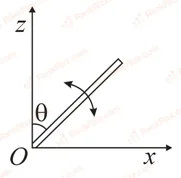
A slender uniform rod of mass M and length l is pivoted at one end so that it can rotate in a vertical plane (see figure). There is negligible friction at the pivot. The free end is held vertically above the pivot and then released. The angular acceleration of the rod when it makes an angle θ with the vertical is:
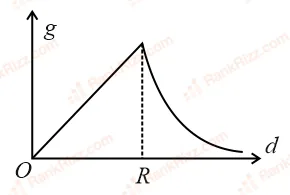
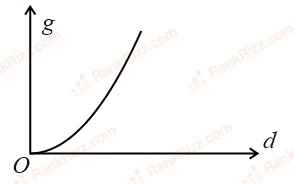
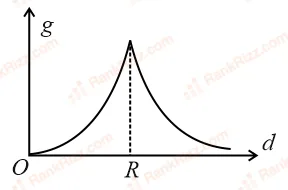
A man grows into a giant such that his linear dimensions increase by a factor of 9. Assuming that his density remains same, the stress in the leg will change by a factor of:
A copper ball of mass 100 g is at a temperature T. It is dropped in a copper calorimeter of mass 100 g, filled with 170 g of water at room temperature. Subsequently, the temperature of the system is found to be 75°C. T is given by: (Given: room temperature = 30°C, specific heat of copper = 0.1 cal g−1 °C−1)
An external pressure P is applied on a cube at 0°C so that it is equally compressed from all sides. K is the bulk modulus of the material of the cube and α is its coefficient of linear expansion. Suppose we want to bring the cube to its original size by heating. The temperature should be raised by:
Q11Molar specific heats of gases, Mayer's relation and gas mixtures
Cp−Cv=MR and Cv are specific heats at constant pressure and constant volume respectively. It is observed that, Cp−Cv=a for hydrogen gas and Cp−Cv=b for nitrogen gas. The correct relation between a and b is:
The temperature of an open room of volume 30 m3 increases from 17°C to 27°C due to the sunshine. The atmospheric pressure in the room remains 1×10⁵ Pa. If ni and nf are the number of molecules in the room before and after heating, then nf−ni will be:
Q13SHM: equation, phase, velocity and acceleration
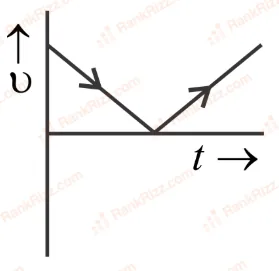
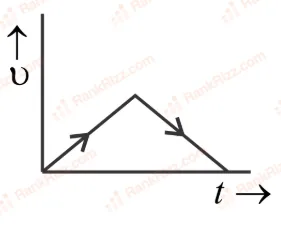
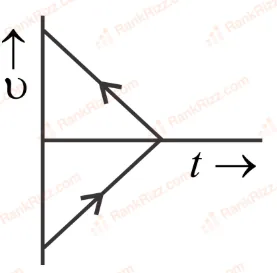
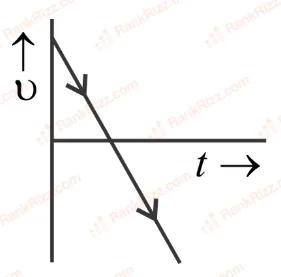
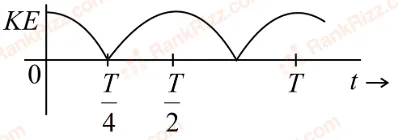
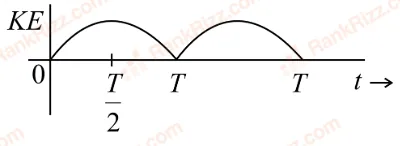
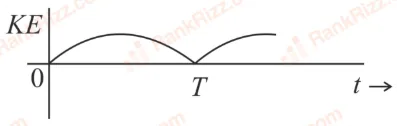
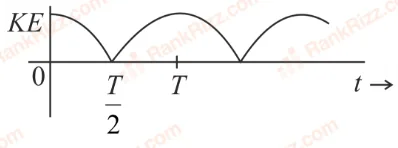
A particle is executing simple harmonic motion with a time period T. At time t=0, it is at its position of equilibrium. The kinetic energy - time graph of the particle will look like:
An observer is moving with half the speed of light towards a stationary microwave source emitting waves at frequency 10 GHz. What is the frequency of the microwave measured by the observer? (speed of light = 3×10⁸ m s−1)
An electric dipole has fixed dipole moment p, which makes angle θ with respect to x-axis. When subjected to an electric field E1=Ei^, it experiences a torque T1=τk^. When subjected to another electric field E2=3E1j^, it experiences a torque T2=−T1. The angle θ is:
A capacitance of 2 μF is required in an electrical circuit across a potential difference of 1.0 kV. A large number of 1 μF capacitors are available which can withstand a potential difference of not more than 300 V. The minimum number of capacitors required to achieve this is:
Q20Galvanometer conversion to ammeter and voltmeter
When a current of 5 mA is passed through a galvanometer having a coil of resistance 15 Ω, it shows full-scale deflection. The value of the resistance to be put in series with the galvanometer to convert it into a voltmeter of range 0 - 10 V is:
A magnetic needle of magnetic moment 6.7×10⁻² A m2 and moment of inertia 7.5×10⁻⁶ kg m2 is performing simple harmonic oscillations in a magnetic field of 0.01 T. Time taken for 10 complete oscillations is:
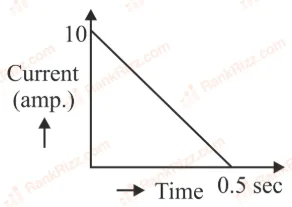
In a coil of resistance 100 Ω, a current is induced by changing the magnetic flux through it as shown in the figure. The magnitude of change in flux through the coil is:
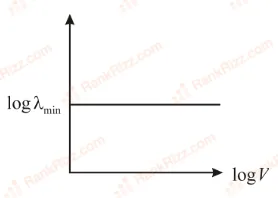
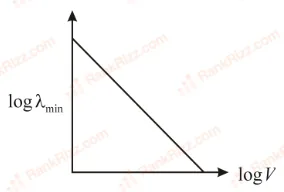
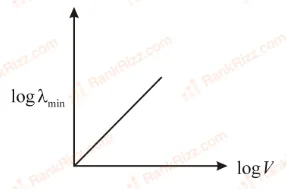
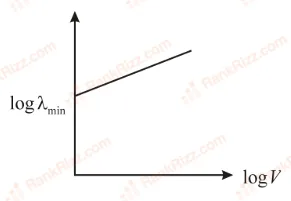
An electron beam is accelerated by a potential difference V to hit a metallic target to produce X-rays. It produces continuous as well as characteristic X-rays. If λmin is the smallest possible wavelength of X-ray in the spectrum, the variation of logλmin with logV is correctly represented in:
Q24Thin lenses: lens formula, lens maker's formula and power
A diverging lens with magnitude of focal length 25 cm is placed at a distance of 15 cm from a converging lens of magnitude of focal length 20 cm. A beam of parallel light falls on the diverging lens. The final image formed is:
A
Real and at a distance of 6 cm from the convergent lens
B
Real and at a distance of 40 cm from the convergent lens
C
Virtual and at a distance of 40 cm from the convergent lens
D
Real and at a distance of 40 cm from the divergent lens
Q25Young's double slit experiment: fringe width and intensity
In a Young's double slit experiment, slits are separated by 0.5 mm, and the screen is placed 150 cm away. A beam of light consisting of two wavelengths, 650 nm and 520 nm, is used to obtain interference fringes on the screen. The least distance from the common central maximum to the point where the bright fringes due to both the wavelengths coincide is:
A particle A of mass m and initial velocity v collides with a particle B of mass 2m which is at rest. The collision is head on, and elastic. The ratio of the de-Broglie wavelengths λA to λB after the collision is:
Q28Radioactivity: decay law, half-life and decay modes
A radioactive nucleus A with a half-life T, decays into a nucleus B. At t=0, there is no nucleus B. At some time t, the ratio of the number of B to that of A is 0.3. Then, t is given by: (Consider logex=logx)
In amplitude modulation, the sinusoidal carrier frequency used is denoted by ωc and the signal frequency is denoted by ωm. The bandwidth Δωm of the signal is such that Δωm≪ωc. Which of the following frequencies is not contained in the modulated wave?