Q1Dimensional analysis: deriving and checking relations
In the following refers to current and other symbols have their usual meaning. Choose the option that corresponds to the dimensions of electrical conductivity:
- A
- B
- C
- D
All 90 questions of JEE Main 09 Apr 2016, Online, in the order they were asked, one subject to a page. Pick an answer on any question to check it against the key. Free to read, nothing to download.
Questions
90
Physics · Chemistry · Maths
Answer key
89
questions with a checked key
Price
Free
no sign-up
In the following refers to current and other symbols have their usual meaning. Choose the option that corresponds to the dimensions of electrical conductivity:
A rocket is fired vertically from the earth with an acceleration of 2g, where g is the gravitational acceleration. On an inclined plane inside the rocket, making an angle with the horizontal, a point object of mass m is kept. The minimum coefficient of friction between the mass and the inclined surface such that the mass does not move is:
Which of the following option correctly describes the variation of the speed v and acceleration 'a' of a point mass falling vertically in a viscous medium that applies a force , where 'k' is a constant, on the body? (Graphs are schematic and not drawn to scale)
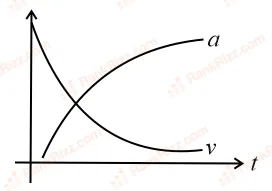
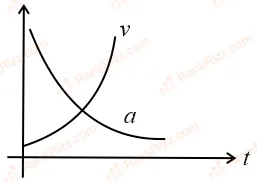
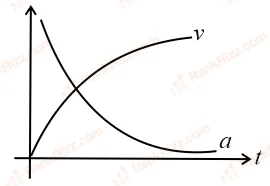
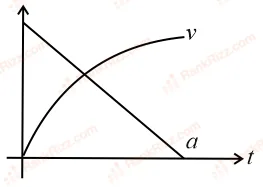
A car of weight W is on an inclined road that rises by 100 m over a distance of 1 km and applies a constant frictional force on the car. While moving uphill on the road at a speed of 10 ms, the car needs power P. If it needs power while moving downhill at speed v then the value of v is:
20 ms
5 ms
15 ms
10 ms
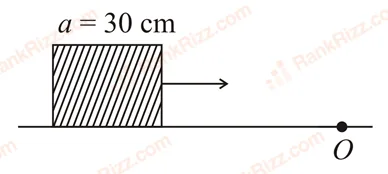
A cubical block of side 30 cm is moving with velocity 2 m s on a smooth horizontal surface. The surface has a bump at a point O as shown in the figure. The angular velocity (in rad/s) of the block immediately after it hits the bump, is:
13.3
5.0
9.4
6.7
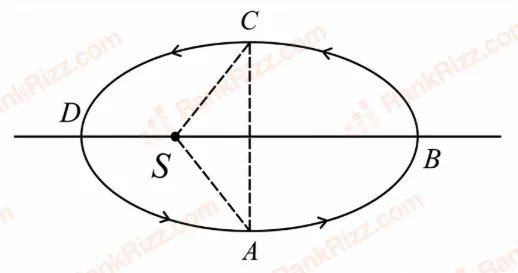
The figure shows an elliptical path of a planet around the sun such that the area of triangle is the area of the ellipse (see the figure below) with as the major axis, and as the minor axis. If is the time taken for the planet to go over the path and for the path taken over then:
A uniformly tapering conical wire is made from a material of Young's modulus and has a normal, unextended length . The radii, at the upper and lower ends of this conical wire, have values and , respectively. The upper end of the wire is fixed to a rigid support and a mass is suspended from its lower end. The equilibrium extended length, of this wire, would equal:
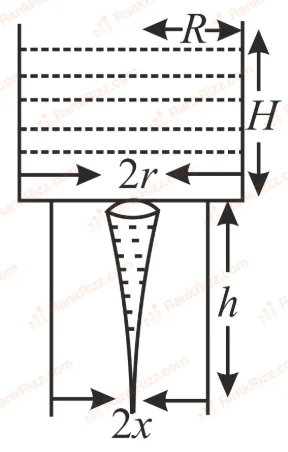
Consider a water jar of radius R that has water filled up to height H and is kept on a stand of height h. Through a hole of radius r (r << R) at its bottom, the water leaks out and the stream of water coming down towards the ground has a shape like a funnel as shown in the figure. If the radius of the cross-section of water stream when it hits the ground is x, then:
A simple pendulum made of a bob of mass m and a metallic wire of a negligible mass has a time period of 2 s at . If the temperature of the wire is increased, and the corresponding change in its time period is plotted against its temperature, the resulting graph is a line of slope . If the coefficient of linear expansion of metal is , then the value of is
The ratio of work done by an ideal monoatomic gas to the heat supplied to it in an isobaric process is
200 g water is heated from 40°C to 60°C. Ignoring the slight expansion of water, the change in its internal energy is close to (Given specific heat of water = 4184 J kg K):
167.4 kJ
8.4 kJ
4.2 kJ
16.7 kJ
Two particles are performing simple harmonic motion in a straight line about the same equilibrium point. The amplitude and time period for both particles are same and equal to A and T, respectively. At time one particle has displacement A while the other one has displacement and they are moving towards each other. If they cross each other at time t, then t is:
Two engines pass each other moving in opposite directions with uniform speed of 30 m/s. One of them is blowing a whistle of frequency 540 Hz. Calculate the frequency heard by driver of second engine before they pass each other. Speed of sound is 330 m/sec:
450 Hz
540 Hz
270 Hz
648 Hz
The potential (in volts) of a charge distribution is given by
for m
for m.
does not depend on x and y. If this potential is generated by a constant charge per unit volume (in units of ) which is spread over a certain region, then choose the correct statement.
in the entire region
for m and else where
for m and else where
in the entire region
Three capacitors each of 4 F are to be connected in such a way that the effective capacitance is 6 F. This can be done by connecting them
all in series
all in parallel
two in parallel and one in series
two in series and one in parallel
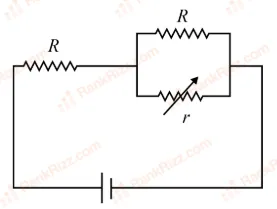
In the circuit shown, the resistance r is a variable resistance. If for , the heat generation in r is maximum then the value of f is
1
To know the resistance of a galvanometer by half deflection method, a battery of emf and resistance is used to deflect the galvanometer by angle . If a shunt of resistance is needed to get half deflection the , and are related by the equation:
A 50 resistance is connected to a battery of 5 V. A galvanometer of resistance 100 is to be used as an ammeter to measure current through the resistance, for this a resistance is connected to the galvanometer. Which of the following connections should be employed if the measured current is with in 1% of the current without the ammeter in the circuit?
in series with galvanometer
in series with galvanometer
in parallel with galvanometer
in parallel with the galvanometer
A magnetic dipole is acted upon by two magnetic fields which are inclined to each other at an angle of 75°. One of the fields has a magnitude of 15 mT. The dipole attains stable equilibrium at an angle of 30° with this field. The magnitude of the other field (in mT) is close to
1
11
36
1060
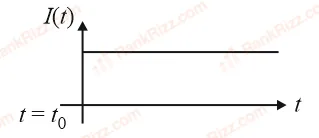
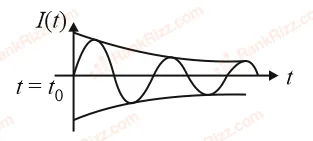
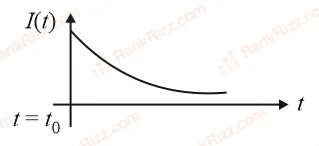
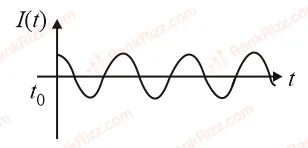
A series circuit is connected to a voltage source with . After a very large time, current behaves as :
Microwave oven acts on the principle of:
giving rotational energy to water molecules
giving translational energy to water molecules
giving vibrational energy to water molecules
transferring electrons from lower to higher energy levels in water molecule
To find the focal length of a convex mirror, a student records the following data:
Object pin: 22.2 cm, Convex Lens: 32.2 cm, Convex Mirror: 45.8 cm, Image Pin: 71.2 cm
The focal length of the convex lens is and that of mirror is . Then taking index correction to be negligibly small, and are close to:
cm, cm
cm, cm
cm, cm
cm, cm
A convex lens, of focal length 30 cm, a concave lens of focal length 120 cm, and a plane mirror are arranged as shown. For an object kept at a distance of 60 cm from the convex lens, the final image, formed by the combination, is a real image, at a distance of:
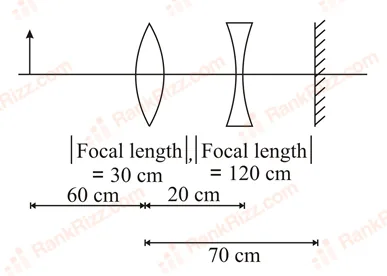
60 cm from the convex lens
60 cm from the concave lens
70 cm from the convex lens
70 cm from the concave lens
In Young's double-slit experiment, the distance between slits and the screen is 1 m and monochromatic light of wavelength 600 nm is being used. A person standing near the slits is looking at the fringe pattern. When the separation between the slits is varied, the interference pattern disappears for a particular distance between the slits. If the angular resolution of the eye is , then the value of is close to
1 mm
3 mm
2 mm
4 mm
When photons of wavelength are incident on an isolated sphere, the corresponding stopping potential is found to be . When photons of wavelength are used, the corresponding stopping potential was thrice that of the above value. If light of wavelength is used then find the stopping potential for this case:
An electron in a hydrogen atom makes a transition from to and emits a photon. This photon strikes a doubly ionized lithium atom which was already in an excited state and completely removes the orbiting electron. The least quantum number for the excited state of the lithium-ion for the process is
2
4
5
3
An unknown transistor needs to be identified as a npn or pnp type. A multimeter, with +ve and -ve terminals, is used to measure resistance between different terminals of transistor. If terminal 2 is the base of the transistor then which of the following is correct for a pnp transistor?
+ve terminal 2, -ve terminal 3, resistance low
+ve terminal 2, -ve terminal 1, resistance high
+ve terminal 1, -ve terminal 2, resistance high
+ve terminal 3, -ve terminal 2, resistance high
A Zener diode with a breakdown voltage of 4 V is connected in series with a resistance to a battery of emf 10 V. The maximum power dissipation rating for the Zener diode is 1 W. The value of to ensure maximum power dissipation across the diode is
12
24
36
6
The truth table given in fig. represents:
| A | B | Y |
|---|---|---|
| 0 | 0 | 0 |
| 0 | 1 | 1 |
| 1 | 0 | 1 |
| 1 | 1 | 1 |
OR-Gate
NAND-Gate
AND-Gate
NOR-Gate
An audio signal consists of two distinct sounds: one a human speech signal in the frequency band of 200 Hz to 2700 Hz, while the other is a high frequency music signal in the frequency band of 10200 Hz to 15200 Hz. The ratio of the AM signal band width required to send both the signals together to the AM signal band width required to send just the human speech is:
3
5
6
2