RankRizz

JEE Main 03 Apr 2016, Offline Question Paper

All 90 questions of JEE Main 03 Apr 2016, Offline, in the order they were asked, one subject to a page. Pick an answer on any question to check it against the key. Free to read, nothing to download.

Questions

90

Physics · Chemistry · Maths

Answer key

90

questions with a checked key

Price

Free

no sign-up

Physics

Q1Errors in measurement and significant figures

A student measures the time period of 100 oscillations of a simple pendulum four times. The data set is 90 s, 91 s, 95 s and 92 s. If the minimum division in the measuring clock is 1 s, then the reported mean time should be:

  1. A

    92±1.892 \pm 1.8 s

  2. B

    92±392 \pm 3 s

  3. C

    92±5.092 \pm 5.0 s

  4. D

    92±292 \pm 2 s

Q2Conservation of mechanical energy

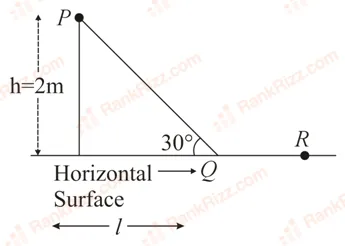
A point particle of mass m, moves along the uniformly rough track PQR as shown in the figure. The coefficient of friction, between the particle and the rough track equals μ\mu. The particle is released, from rest, from the point P and it comes to rest at a point R. The energies, lost by the ball, over the parts, PQ and QR, of the track, are equal to each other, and no energy is lost when particle changes direction from PQ to QR. The values of the coefficient of friction μ\mu and the distance x = (QR), are respectively close to:

Figure for JEE Main 2016 Physics question on Conservation of mechanical energy
  1. A

    0.29 and 3.5 m

  2. B

    0.29 and 6.5 m

  3. C

    0.2 and 6.5 m

  4. D

    0.2 and 3.5 m

Q3Conservation of mechanical energy

A person trying to lose weight by burning fat lifts a mass of 10 kg upto a height of 1 m 1000 times. Assume that the potential energy lost each time he lowers the mass is dissipated. How much fat will he use up considering the work done only when the weight is lifted up? Fat supplies 3.8×1073.8 \times 10^{7} J of energy per kg which is converted to mechanical energy with a 20% efficiency rate. Take g=9.8g = 9.8 ms−2^{-2}:

  1. A

    9.89×10−39.89 \times 10^{-3} kg

  2. B

    12.89×10−312.89 \times 10^{-3} kg

  3. C

    2.45×10−32.45 \times 10^{-3} kg

  4. D

    6.45×10−36.45 \times 10^{-3} kg

Q4Angular momentum of particles and rigid bodies

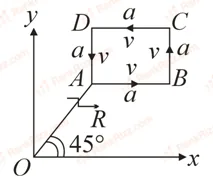
A particle of mass m is moving along the side of a square of side 'a', with a uniform speed v in the x-y plane as shown in the figure:

Figure for JEE Main 2016 Physics question on Angular momentum of particles and rigid bodies


Which of the following statements is false for the angular momentum L⃗\vec{L} about the origin?

  1. A

    L⃗=mv[R2+a]k^\vec{L} = mv\left[\frac{R}{\sqrt{2}} + a\right]\hat{k} when the particle is moving from B to C.

  2. B

    L⃗=mv2Rk^\vec{L} = \frac{mv}{\sqrt{2}}R\hat{k} when the particle is moving from D to A.

  3. C

    L⃗=−mv2Rk^\vec{L} = -\frac{mv}{\sqrt{2}}R\hat{k} when the particle is moving from A to B.

  4. D

    L⃗=mv[R2+a]k^\vec{L} = mv\left[\frac{R}{\sqrt{2}} + a\right]\hat{k} when the particle is moving from C to D.

Q5Torque and the rotational form of Newton's second law

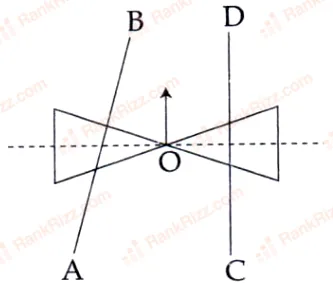
A roller is made by joining together two cones at their vertices O. It is kept on two rails AB and CD which are placed asymmetrically, with its axis perpendicular to CD and its centre O at the centre of line joining AB and CD (see the figure below). It is given a light push so that it starts rolling with its centre O moving parallel to CD in the direction shown. As it moves, the roller will tend to:

Figure for JEE Main 2016 Physics question on Torque and the rotational form of Newton's second law
  1. A

    go straight.

  2. B

    turn left and right alternately.

  3. C

    turn left.

  4. D

    turn right.

Q6Escape speed

A satellite is revolving in a circular orbit at a height hh from the earth's surface (radius of earth RR; h<<Rh << R). The minimum increase in its orbital velocity required, so that the satellite could escape from the earth's gravitational field, is close to (Neglect the effect of atmosphere.)

  1. A

    gR2\sqrt{\frac{gR}{2}}

  2. B

    gR(2−1)\sqrt{gR}\left(\sqrt{2} - 1\right)

  3. C

    2 gR\sqrt{2\,gR}

  4. D

    gR\sqrt{gR}

Q7Temperature scales and thermal expansion

A pendulum clock loses 12 s a day if the temperature is 40°C and gains 4 s a day if the temperature is 20°C. The temperature at which the clock will show correct time, and the co-efficient of linear expansion (α\alpha) of the metal of the pendulum shaft are respectively:

  1. A

    30°C; α=1.85×10⁻³\alpha = 1.85 \times 10^{-3} /°C

  2. B

    55°C; α=1.85×10⁻²\alpha = 1.85 \times 10^{-2} /°C

  3. C

    25°C; α=1.85×10⁻⁵\alpha = 1.85 \times 10^{-5} /°C

  4. D

    60°C; α=1.85×10⁻⁴\alpha = 1.85 \times 10^{-4} /°C

Q8Work done in thermodynamic processes and P-V diagrams

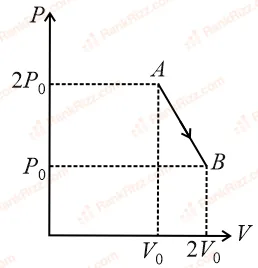
nn moles of an ideal gas undergoes a process A→BA \to B as shown in the figure. The maximum temperature of the gas during the process will be:

Figure for JEE Main 2016 Physics question on Work done in thermodynamic processes and P-V diagrams
  1. A

    9P0V02nR\frac{9P_0V_0}{2nR}

  2. B

    9P0V0nR\frac{9P_0V_0}{nR}

  3. C

    9P0V04nR\frac{9P_0V_0}{4nR}

  4. D

    3P0V02nR\frac{3P_0V_0}{2nR}

Q9Isobaric, isochoric and polytropic processes

An ideal gas undergoes a quasi-static, reversible process in which its molar heat capacity C remains constant. If during this process the relation of pressure P and volume V is given by PVnPV^n = constant, then n is given by (Here CPC_P and CVC_V are molar specific heat at constant pressure and constant volume, respectively):

  1. A

    n=CP−CC−CVn = \frac{C_P - C}{C - C_V}

  2. B

    n=C−CVC−CPn = \frac{C - C_V}{C - C_P}

  3. C

    n=CPCVn = \frac{C_P}{C_V}

  4. D

    n=C−CPC−CVn = \frac{C - C_P}{C - C_V}

Q10SHM: equation, phase, velocity and acceleration

A particle performs simple harmonic motion with amplitude A. Its speed is tripled at the instant that it is at a distance 2A3\frac{2A}{3} from equilibrium position. The new amplitude of the motion is:

  1. A

    A3A\sqrt{3}

  2. B

    7A3\frac{7A}{3}

  3. C

    A341\frac{A}{3}\sqrt{41}

  4. D

    3A

Q11Superposition, interference and beats

A pipe open at both ends has a fundamental frequency ff in air. The pipe is dipped vertically in water so that half of it is in water. The fundamental frequency of the air column is now:

  1. A

    2ff

  2. B

    ff

  3. C

    f2\frac{f}{2}

  4. D

    3f4\frac{3f}{4}

Q12Progressive waves: wave equation, phase and intensity

A uniform string of length 20 m is suspended from a rigid support. A short wave pulse is introduced at its lowest end. It starts moving up the string. The time taken to reach the support is (Take, g=10g = 10 m s−2^{-2})

  1. A

    222\sqrt{2} s

  2. B

    2\sqrt{2} s

  3. C

    2π22\pi\sqrt{2} s

  4. D

    2 s

Q13Electric flux and Gauss's law

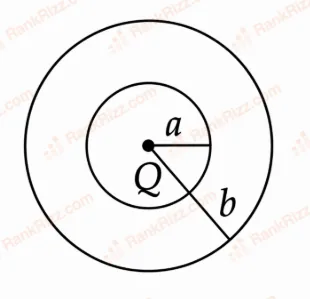
The region between two concentric spheres of radii 'a' and 'b', respectively (see figure), has volume charge density ρ=Ar\rho = \frac{A}{r}, where A is a constant and r is the distance from the centre. At the centre of the spheres is a point charge Q. The value of A such that the electric field in the region between the spheres will be constant, is:

Figure for JEE Main 2016 Physics question on Electric flux and Gauss's law
  1. A

    2Qπ(a2−b2)\frac{2Q}{\pi(a^2 - b^2)}

  2. B

    2Qπa2\frac{2Q}{\pi a^2}

  3. C

    Q2πa2\frac{Q}{2\pi a^2}

  4. D

    Q2π(b2−a2)\frac{Q}{2\pi(b^2 - a^2)}

Q14Capacitors in DC circuits (steady state)

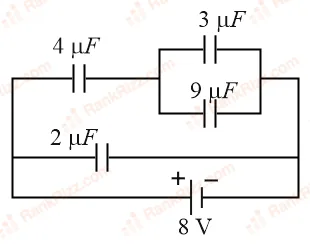
A combination of capacitors is set up as shown in the figure. The magnitude of the electric field, due to a point charge Q (having a charge equal to the sum of the charges on the 4 μ\muF and 9 μ\muF capacitors), at a point distant 30 m from it, would equal:

Figure for JEE Main 2016 Physics question on Capacitors in DC circuits (steady state)
  1. A

    420 N/C

  2. B

    480 N/C

  3. C

    240 N/C

  4. D

    360 N/C

Q15Galvanometer conversion to ammeter and voltmeter

A galvanometer having a coil resistance of 100 Ω\Omega gives a full scale deflection, when a current of 1 mA is passed through it. The value of the resistance, which can convert this galvanometer into ammeter giving a full scale deflection for a current of 10 A, is:

  1. A

    0.1 Ω\Omega

  2. B

    3 Ω\Omega

  3. C

    0.01 Ω\Omega

  4. D

    2 Ω\Omega

Q16Magnetisation, magnetic intensity, susceptibility and permeability

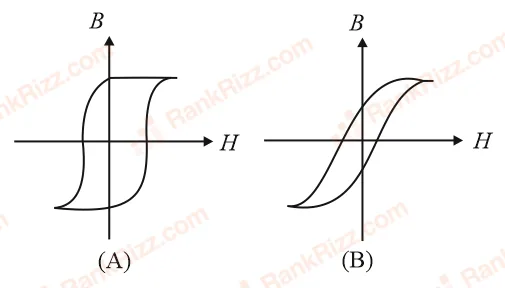
Hysteresis loops for two magnetic materials A and B are given below:

Figure for JEE Main 2016 Physics question on Magnetisation, magnetic intensity, susceptibility and permeability


These materials are used to make magnets for electric generators, transformer core and electromagnet core. Then it is proper to use:

  1. A

    A for transformers and B for electric generators.

  2. B

    B for electromagnets and transformers.

  3. C

    A for electric generators and transformers.

  4. D

    A for electromagnets and B for electric generators.

Q17Biot-Savart law: straight wires and moving charges

Two identical wires A and B, each of length ll, carry the same current II. Wire A is bent into a circle of radius R and wire B is bent to form a square of side aa. If BAB_A and BBB_B are the values of magnetic field at the centres of the circle and square respectively, then the ratio BABB\frac{B_A}{B_B} is

  1. A

    π216\frac{\pi^2}{16}

  2. B

    π282\frac{\pi^2}{8\sqrt{2}}

  3. C

    π28\frac{\pi^2}{8}

  4. D

    π2162\frac{\pi^2}{16\sqrt{2}}

Q18Series LCR circuits: impedance and phase

An arc lamp requires a direct current of 10 A at 80 V to function. If it is connected to a 220 V (rms), 50 Hz AC supply, the series inductor needed for it to work is close to:

  1. A

    0.044 H

  2. B

    0.065 H

  3. C

    80 H

  4. D

    0.08 H

Q19Electromagnetic spectrum and uses

Arrange the following electromagnetic radiations per quantum in the order of increasing energy:
A: Blue light
B: Yellow light
C: X-ray
D: Radiowave

  1. A

    C, A, B, D

  2. B

    B, A, D, C

  3. C

    D, B, A, C

  4. D

    A, B, D, C

Q20Optical instruments: microscopes and telescopes

An observer looks at a distant tree of height 10 m with a telescope of magnifying power of 20. To the observer, the tree appears as

  1. A

    20 times taller.

  2. B

    20 times nearer.

  3. C

    10 times taller.

  4. D

    10 times nearer.

Q21Refraction at plane surfaces, Snell's law and apparent depth

In an experiment for determination of refractive index of glass of a prism by i v/s δ\delta plot, it was found that a ray incident at angle 35°, suffers a deviation of 40° and that it emerges at angle 79°. In that case which of the following is closest to the maximum possible value of the refractive index?

  1. A

    1.7

  2. B

    1.8

  3. C

    1.5

  4. D

    1.6

Q22Single slit diffraction

The box of a pin hole camera, of length L, has a hole of radius a. It is assumed that when the hole is illuminated by a parallel beam of light of wavelength λ\lambda the spread of the spot (obtained on the opposite wall of the camera) is the sum of its geometrical spread and the spread due to diffraction. The spot would then have its minimum size (say bminb_{min}) when:

  1. A

    a=λLa = \sqrt{\lambda L} and bmin=4λLb_{min} = \sqrt{4\lambda L}

  2. B

    a=λ2La = \frac{\lambda^2}{L} and bmin=4λLb_{min} = \sqrt{4\lambda L}

  3. C

    a=λ2La = \frac{\lambda^2}{L} and bmin=(2λ2L)b_{min} = \left(\frac{2\lambda^2}{L}\right)

  4. D

    a=λLa = \sqrt{\lambda L} and bmin=(2λ2L)b_{min} = \left(\frac{2\lambda^2}{L}\right)

Q23Photoelectric effect and Einstein's equation

Radiation of wavelength λ\lambda is incident on a photocell. The fastest emitted photoelectron has a speed v. If the wavelength is changed to 3λ4\frac{3\lambda}{4}, the speed of the fastest emitted photoelectron will be:

  1. A

    =v(43)1/2=v\left(\frac{4}{3}\right)^{1/2}

  2. B

    =v(34)1/2=v\left(\frac{3}{4}\right)^{1/2}

  3. C

    >v(43)1/2> v\left(\frac{4}{3}\right)^{1/2}

  4. D

    <v(43)1/2< v\left(\frac{4}{3}\right)^{1/2}

Q24Radioactivity: decay law, half-life and decay modes

Half-lives of two radioactive elements A and B are 20 minutes and 40 minutes, respectively. Initially, the samples have an equal number of nuclei. After 80 minutes, the ratio of decayed numbers of A and B nuclei will be:

  1. A

    1 : 4

  2. B

    5 : 4

  3. C

    1 : 16

  4. D

    4 : 1

Q25Transistors (older syllabus)

For a common emitter configuration, if α\alpha and β\beta have their usual meanings, the correct relationship between α\alpha and β\beta is:

  1. A

    α=β1+β\alpha = \frac{\beta}{1+\beta}

  2. B

    α=β21+β2\alpha = \frac{\beta^2}{1+\beta^2}

  3. C

    1α=1β−1\frac{1}{\alpha} = \frac{1}{\beta} - 1

  4. D

    α=β1−β\alpha = \frac{\beta}{1-\beta}

Q26Logic gates and digital circuits

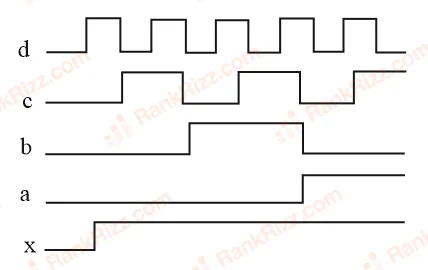
If a, b, c, d are inputs to a gate and x is its output, then, as per the following time graph, the gate is:

Figure for JEE Main 2016 Physics question on Logic gates and digital circuits
  1. A

    OR

  2. B

    NAND

  3. C

    NOT

  4. D

    AND

Q27p-n junction diode and its characteristics

The temperature dependence of resistance of Cu and undoped Si in the temperature range 300 - 400 K is best described by:

  1. A

    linear increase for Cu, exponential decrease for Si

  2. B

    linear decrease for Cu, linear decrease for Si

  3. C

    linear increase for Cu, linear increase for Si

  4. D

    linear increase for Cu, exponential increase for Si

Q28Zener diode, LED, photodiode and solar cell

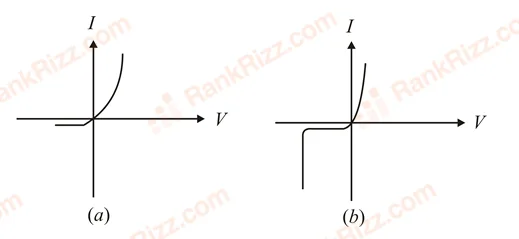
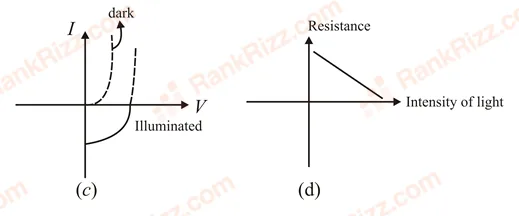
Identify the semiconductor devices whose characteristics are given below, in the order (a), (b), (c), (d):

Figure for JEE Main 2016 Physics question on Zener diode, LED, photodiode and solar cell Figure for JEE Main 2016 Physics question on Zener diode, LED, photodiode and solar cell
  1. A

    Solar cell, Light dependent resistance, Zener diode, Simple diode

  2. B

    Zener diode, Solar cell, Simple diode, Light dependent resistance

  3. C

    Simple diode, Zener diode, Solar cell, Light dependent resistance

  4. D

    Zener diode, Simple diode, Light dependent resistance, Solar cell

Q29Modulation and demodulation

Choose the correct statement:

  1. A

    In frequency modulation the amplitude of the high frequency carrier wave is made to vary in proportion to the amplitude of the audio signal.

  2. B

    In frequency modulation the amplitude of the high frequency carrier wave is made to vary in proportion to the frequency of the audio signal.

  3. C

    In amplitude modulation the amplitude of the high frequency carrier wave is made to vary in proportion to the amplitude of the audio signal.

  4. D

    In amplitude modulation the frequency of the high frequency carrier wave is made to vary in proportion to the amplitude of the audio signal.

Q30Screw gauge: pitch, least count and zero error

A screw gauge with a pitch of 0.5 mm and a circular scale with 50 divisions is used to measure the thickness of a thin sheet of aluminium. Before starting the measurement, it is found that when the two jaws of the screw gauge are brought in contact, the 45th division coincides with the main scale line and that the zero of the main scale is barely visible. What is the thickness of the sheet if the main scale reading is 0.5 mm and the 25th division coincides with the main scale line?

  1. A

    0.70 mm

  2. B

    0.50 mm

  3. C

    0.75 mm

  4. D

    0.80 mm

NEXT IN THIS PAPER →Chemistry, Q31 onwards