RankRizz

JEE Main 10 Apr 2016, Online Question Paper

All 90 questions of JEE Main 10 Apr 2016, Online, in the order they were asked, one subject to a page. Pick an answer on any question to check it against the key. Free to read, nothing to download.

Questions

90

Physics · Chemistry · Maths

Answer key

90

questions with a checked key

Price

Free

no sign-up

Physics

Q1Errors in measurement and significant figures

A thin 1 m long rod has a radius of 5 mm. A force of 50π×10350\pi \times 10^3 N is applied at one end to determine its Young's modulus. Assume that the force is exactly known. If the least count in the measurement of all lengths is 0.01 mm, which of the following statements is false?

  1. A

    The maximum value of Y that can be determined is 2×10142 \times 10^{14} N m−2^{-2}

  2. B

    ΔYY\frac{\Delta Y}{Y} gets minimum contribution from the uncertainty in the length.

  3. C

    ΔYY\frac{\Delta Y}{Y} gets its minimum contribution from the uncertainty in strain.

  4. D

    The figure of merit is the largest for the length of the rod.
Q2Dimensional analysis: deriving and checking relations

AA, BB, CC, and DD are four different physical quantities having different dimensions. None of them is dimensionless. But we know that the equation AD=Cln⁡(BD)AD = C\ln(BD) holds true. Then which of the combination is not a meaningful quantity?

  1. A

    CBD−A2D2C\frac{C}{BD} - \frac{A^2D^2}{C}

  2. B

    A2−B2C2A^2 - B^2C^2

  3. C

    AB−C\frac{A}{B} - C

  4. D

    A2−ACD\frac{A^2 - AC}{D}

Q3Newton's laws, free-body diagrams and equilibrium of a particle

A particle of mass mm is acted upon by a force FF given by the empirical law F=Rt2v(t)F = \frac{R}{t^2}v(t). If this law is to be tested experimentally by observing the motion starting from rest, the best way is to plot

  1. A

    log⁡v(t)\log v(t) against 1t\frac{1}{t}

  2. B

    v(t)v(t) against t2t^2

  3. C

    log⁡v(t)\log v(t) against 1t2\frac{1}{t^2}

  4. D

    log⁡v(t)\log v(t) against tt

Q4Vertical circular motion

Concrete mixture is made by mixing cement, stone and sand in a rotating cylindrical drum. If the drum rotates too fast, the ingredients remain stuck to the wall of the drum and proper mixing of ingredients does not take place. The maximum rotational speed of the drum in revolutions per minute (rpm) to ensure proper mixing is close to:
(Take the radius of the drum to be 1.25 m and its axle to be horizontal):

  1. A

    27.0

  2. B

    0.4

  3. C

    1.3

  4. D

    8.0

Q5Conservation of mechanical energy

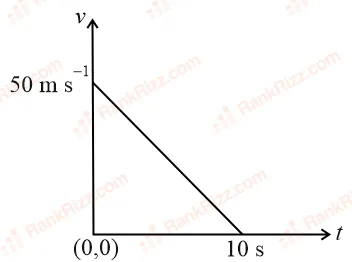
The velocity-time graph of a particle of mass 10 kg is shown in the figure. The net work done on the particle in the first two seconds of the motion is

Figure for JEE Main 2016 Physics question on Conservation of mechanical energy
  1. A

    −9300-9300 J

  2. B

    12000 J

  3. C

    −4500-4500 J

  4. D

    −12000-12000 J

Q6Power

A particle of mass M is moving in a circle of fixed radius R in such a way that its centripetal acceleration at time t is given by n2Rt2n^2Rt^2, where nn is a constant. The power delivered to the particle by the force acting on it, is:

  1. A

    12Mn2R2t2\frac{1}{2}Mn^2R^2t^2

  2. B

    Mn2R2tMn^2R^2t

  3. C

    MnR2t2MnR^2t^2

  4. D

    MnR2tMnR^2t

Q7Centre of mass of continuous bodies and cavities

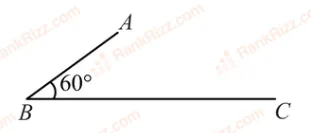
In the figure shown ABCABC is a uniform wire. If the center of mass of the wire lies vertically below point AA, then BCAB\frac{BC}{AB} is close to

Figure for JEE Main 2016 Physics question on Centre of mass of continuous bodies and cavities
  1. A

    1.85

  2. B

    1.5

  3. C

    1.37

  4. D

    3

Q8Kepler's laws and planetary motion

An astronaut of mass mm is working on a satellite orbiting the earth at a distance hh from the earth's surface. The radius of the earth is RR, while its mass is MM. The gravitational pull FGF_G on the astronaut is

  1. A

    Zero since astronaut feels weightless

  2. B

    GMm(R+h)2<FG<GMmR2\frac{GMm}{(R+h)^2} < F_G < \frac{GMm}{R^2}

  3. C

    FG=GMm(R+h)2F_G = \frac{GMm}{(R+h)^2}

  4. D

    0<FG<GMmR20 < F_G < \frac{GMm}{R^2}

Q9Bulk modulus and compressibility

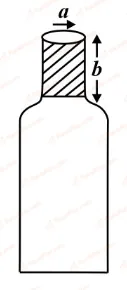
A bottle has an opening of radius a and length b. A cork of length b and radius (a+Δa)(a + \Delta a) where (Δa≪a)(\Delta a \ll a), is compressed to fit into the opening completely (see figure). If the bulk modulus of the cork is B and the coefficient of friction between the bottle and the cork is μ\mu, then the force needed to push the cork into the bottle is

Figure for JEE Main 2016 Physics question on Bulk modulus and compressibility
  1. A

    (πμBb)a(\pi \mu Bb)a

  2. B

    (2πμBb)Δa(2\pi \mu Bb) \Delta a

  3. C

    (πμBb)Δa(\pi \mu Bb) \Delta a

  4. D

    (4πμBb)Δa(4\pi \mu Bb) \Delta a

Q10Carnot engine and Carnot cycle

A Carnot freezer takes heat from water at 0°C0°C inside it and rejects it to the room at a temperature of 27°C27°C. The latent heat of ice is 336×103336 \times 10^3 J kg−1^{-1}. If 5 kg of water at 0°C0°C is converted into ice at 0°C0°C by the freezer, then the energy consumed by the freezer is close to:

  1. A

    1.51×1051.51 \times 10^5 J

  2. B

    1.68×1061.68 \times 10^6 J

  3. C

    1.71×1071.71 \times 10^7 J

  4. D

    1.67×1051.67 \times 10^5 J

Q11Ideal gas equation and gas laws

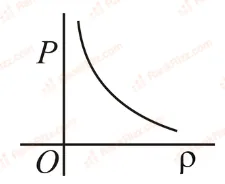
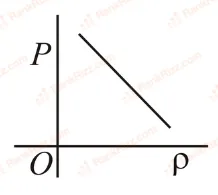
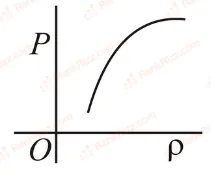
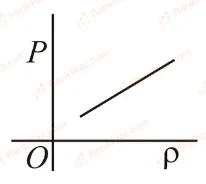
Which of the following shows the correct relationship between the pressure PP and density ρ\rho of an ideal gas at constant temperature?

  1. A
    Figure for JEE Main 2016 Physics question on Ideal gas equation and gas laws
  2. B
    Figure for JEE Main 2016 Physics question on Ideal gas equation and gas laws
  3. C
    Figure for JEE Main 2016 Physics question on Ideal gas equation and gas laws
  4. D
    Figure for JEE Main 2016 Physics question on Ideal gas equation and gas laws
Q12SHM: equation, phase, velocity and acceleration

In an engine the piston undergoes vertical simple harmonic motion with amplitude 7 cm. A washer rests on top of the piston and moves with it. The motor speed is slowly increased. The frequency of the piston at which the washer no longer stays in contact with the piston, is close to:

  1. A

    0.7 Hz

  2. B

    1.9 Hz

  3. C

    1.2 Hz

  4. D

    0.1 Hz

Q13Doppler effect in sound

A toy-car, blowing its horn, is moving with a steady speed of 5 m s−1^{-1}, away from a wall. An observer, towards whom the toy car is moving, is able to hear 5 beats per second. If the velocity of sound in air is 340 m s−1^{-1}, the frequency of the horn of the toy car is close to

  1. A

    680 Hz

  2. B

    510 Hz

  3. C

    340 Hz

  4. D

    170 Hz

Q14Relation between field and potential, equipotential surfaces

Within a spherical charge distribution of charge density ρ(r)\rho(r), N equipotential surfaces of potential V0V_0, V0+ΔVV_0 + \Delta V, V0+2ΔVV_0 + 2\Delta V, ... V0+NΔVV_0 + N\Delta V (ΔV>0)(\Delta V > 0), are drawn and have increasing radii r0r_0, r1r_1, r2r_2, ... rNr_N, respectively. If the difference in the radii of the surfaces is constant for all values of V0V_0 and ΔV\Delta V then:

  1. A

    ρ(r)=\rho(r) = constant

  2. B

    ρ(r)∝1r2\rho(r) \propto \frac{1}{r^2}

  3. C

    ρ(r)∝1r\rho(r) \propto \frac{1}{r}

  4. D

    ρ(r)∝r\rho(r) \propto r

Q15Series and parallel combinations of capacitors

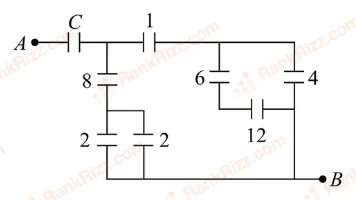
The figure shows a network of capacitors where the number indicates capacitances in micro Farad. The value of capacitance C if the equivalent capacitance between point A and B is to be 1 μF\mu F is:

Figure for JEE Main 2016 Physics question on Series and parallel combinations of capacitors
  1. A

    3223\frac{32}{23} μF\mu F

  2. B

    3123\frac{31}{23} μF\mu F

  3. C

    3323\frac{33}{23} μF\mu F

  4. D

    3423\frac{34}{23} μF\mu F

Q16Galvanometer conversion to ammeter and voltmeter

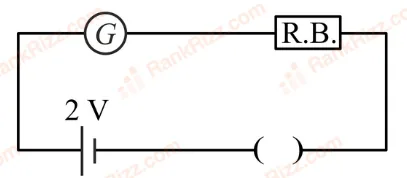
A galvanometer has a 50 division scale. Battery has no internal resistance. It is found that there is deflection of 40 divisions when R.B. = 2400 Ω\Omega. Deflection becomes 20 divisions when resistance taken from resistance box is 4900 Ω\Omega. Then we can conclude:

Figure for JEE Main 2016 Physics question on Galvanometer conversion to ammeter and voltmeter


Note: This question is awarded as the bonus. Now the question is corrected.

  1. A

    Current sensitivity of galvanometer is 20 μA/division\mu A/division

  2. B

    Resistance of galvanometer is 200 Ω\Omega.

  3. C

    Resistance required on R.B. for a deflection of 10 divisions is 9800 Ω\Omega.

  4. D

    Full scale deflection current is 2 mA.

Q17Electric power and heating effect of current

The resistance of an electrical toaster has a temperature dependence given by R(T)=R0[1+α(T−T0)]R(T) = R_0[1 + \alpha(T - T_0)] in its range of operation. At T0=300T_0 = 300 K, R=100R = 100 Ω\Omega and at T=500T = 500 K, R=120R = 120 Ω\Omega. The toaster is connected to a voltage source at 200 V and its temperature is raised at a constant rate from 300 to 500 K in 30 s. The total work done in raising the temperature is:
Note: This question was awarded as the bonus since all options were incorrect in the exam.

  1. A

    60000ln⁡(65)60000 \ln\left(\frac{6}{5}\right) J

  2. B

    200ln⁡23200 \ln \frac{2}{3} J

  3. C

    300 J

  4. D

    400ln⁡(1.51.3)400 \ln\left(\frac{1.5}{1.3}\right) J

Q18Motional emf in moving rods and loops

A fighter plane of length 20 m, wing span (distance from tip of one wing to the tip of the other wing) of 15 m and height 5 m is flying towards east over Delhi. Its speed is 240 m s−1^{-1}. The earth's magnetic field over Delhi is 5×10−55 \times 10^{-5} T with the declination angle ~0° and dip of θ\theta such that sin⁡θ=23\sin \theta = \frac{2}{3}. If the voltage developed is VBV_B between the lower and upper side of the plane and VWV_W between the tips of the wings then VBV_B and VWV_W are close to:

  1. A

    VB=40V_B = 40 mV; VW=135V_W = 135 mV with left side of pilot at higher voltage

  2. B

    VB=45V_B = 45 mV; VW=120V_W = 120 mV with right side of pilot at higher voltage

  3. C

    VB=40V_B = 40 mV; VW=135V_W = 135 mV with right side of pilot at higher voltage

  4. D

    VB=45V_B = 45 mV; VW=120V_W = 120 mV with left side of pilot at higher voltage

Q19Magnetic flux, Faraday's law and Lenz's law

A conducting metal circular-wire-loop of radius rr is placed perpendicular to a magnetic field which varies with time as B=B0e−t/τB = B_0 e^{-t/\tau}, where B0B_0 and τ\tau are constants at time t=0t = 0. If the resistance of the loop is RR, then the heat generated in the loop after a long time (t→∞)(t \to \infty) is

  1. A

    π2r4B042τR\frac{\pi^2 r^4 B_0^4}{2\tau R}

  2. B

    π2r4B022τR\frac{\pi^2 r^4 B_0^2}{2\tau R}

  3. C

    π2r4B02Rτ\frac{\pi^2 r^4 B_0^2 R}{\tau}

  4. D

    π2r4B02τR\frac{\pi^2 r^4 B_0^2}{\tau R}

Q20Motional emf in moving rods and loops

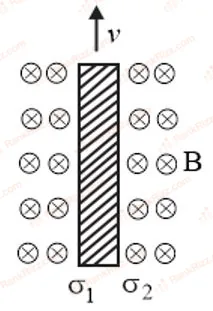
Consider a thin metallic sheet perpendicular to the plane of the paper moving with speed v in a uniform magnetic field B going into the plane of the paper (see the figure below). If the charge densities σ1\sigma_1 and σ2\sigma_2 are induced on the left and right surfaces respectively of the sheet, then (ignore fringe effects)

Figure for JEE Main 2016 Physics question on Motional emf in moving rods and loops
  1. A

    σ1=−ϵ0vB2\sigma_1 = \frac{-\epsilon_0 vB}{2}, σ2=ϵ0vB2\sigma_2 = \frac{\epsilon_0 vB}{2}

  2. B

    σ1=ϵ0vB\sigma_1 = \epsilon_0 vB, σ2=−ϵ0vB\sigma_2 = -\epsilon_0 vB

  3. C

    σ1=ϵ0vB2\sigma_1 = \frac{\epsilon_0 vB}{2}, σ2=−ϵ0vB2\sigma_2 = \frac{-\epsilon_0 vB}{2}

  4. D

    σ1=σ2=ϵ0vB\sigma_1 = \sigma_2 = \epsilon_0 vB

Q21Properties of EM waves: fields, energy, intensity and momentum

Consider an electromagnetic wave propagating in vacuum. Choose the correct statement:

  1. A

    For an electromagnetic wave propagating in +y direction the electric field is E⃗=12Eyz(x,t)z^\vec{E} = \frac{1}{\sqrt{2}}E_{yz}(x,t)\hat{z} and the magnetic field is B⃗=12Bz(x,t)y^\vec{B} = \frac{1}{\sqrt{2}}B_z(x,t)\hat{y}

  2. B

    For an electromagnetic wave propagating in +y direction the electric field is E⃗=12Eyz(x,t)y^\vec{E} = \frac{1}{\sqrt{2}}E_{yz}(x,t)\hat{y} and the magnetic field is B⃗=12Byx(x,t)z^\vec{B} = \frac{1}{\sqrt{2}}B_{yx}(x,t)\hat{z}

  3. C

    For an electromagnetic wave propagating in +x direction the electric field is E⃗=12Eyz(y,z,t)(y^+z^)\vec{E} = \frac{1}{\sqrt{2}}E_{yz}(y,z,t)(\hat{y}+\hat{z}) and the magnetic field is B⃗=12Eyz(y,z,t)(y^+z^)\vec{B} = \frac{1}{\sqrt{2}}E_{yz}(y,z,t)(\hat{y}+\hat{z})

  4. D

    For an electromagnetic wave propagating in +x direction the electric field is E⃗=12Eyz(x,t)(y^−z^)\vec{E} = \frac{1}{\sqrt{2}}E_{yz}(x,t)(\hat{y}-\hat{z}) and the magnetic field is B⃗=12Byz(x,t)(y^+z^)\vec{B} = \frac{1}{\sqrt{2}}B_{yz}(x,t)(\hat{y}+\hat{z})

Q22Refraction at plane surfaces, Snell's law and apparent depth

To determine refractive index of glass slab using a travelling microscope, minimum number of readings required are:

  1. A

    Two

  2. B

    Four

  3. C

    Three

  4. D

    Five

Q23Spherical mirrors: mirror formula and magnification

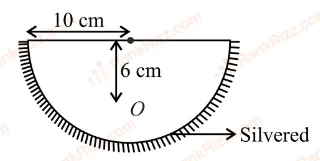
A hemispherical glass body of radius 10 cm and refractive index 1.5 is silvered on its curved surface. A small air bubble is 6 cm below the flat surface inside it along the axis. The position of the image of the air bubble made by the mirror is seen:

Figure for JEE Main 2016 Physics question on Spherical mirrors: mirror formula and magnification
  1. A

    14 cm below flat surface

  2. B

    20 cm below flat surface

  3. C

    16 cm below flat surface

  4. D

    30 cm below flat surface

Q24Resolving power of microscopes and telescopes

Two stars are 10 light years away from the earth. They are seen through a telescope of objective diameter 30 cm. The wavelength of light is 600 nm. To see the stars just resolved by the telescope, the minimum distance between them should be (1 light year = 9.46×10159.46 \times 10^{15} m) of the order of: 

  1. A

    10810^8 km

  2. B

    101010^{10} km

  3. C

    101110^{11} km

  4. D

    10610^6 km

Q25Photoelectric effect and Einstein's equation

A photoelectric surface is illuminated successively by monochromatic light of wavelengths λ\lambda and λ2\frac{\lambda}{2}. If the maximum kinetic energy of the emitted photoelectrons in the second case is 3 times that in the first case, the work function of the surface is:

  1. A

    hc2λ\frac{hc}{2\lambda}

  2. B

    hcλ\frac{hc}{\lambda}

  3. C

    hc3λ\frac{hc}{3\lambda}

  4. D

    3hcλ\frac{3hc}{\lambda}

Q26Hydrogen spectrum and spectral series

A neutron moving with a speed 'v' makes a head on collision with a stationary hydrogen atom in ground state. The minimum kinetic energy of the neutron for which perfectly inelastic collision will take place is:

  1. A

    20.4 eV

  2. B

    10.2 eV

  3. C

    12.1 eV

  4. D

    16.8 eV

Q27Transistors (older syllabus)

The ratio (R) of output resistance r0r_0, and the input resistance rir_i in measurements of input and output characteristics of a transistor is typically in the range:

  1. A

    R∼102−103R \sim 10^2 - 10^3

  2. B

    R∼1−10R \sim 1 - 10

  3. C

    R∼0.1−1.0R \sim 0.1 - 1.0

  4. D

    R∼0.1−0.01R \sim 0.1 - 0.01

Q28Logic gates and digital circuits

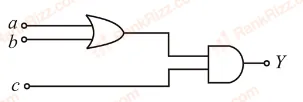
To get an output of 1 from the circuit shown in the figure the input must be:

Figure for JEE Main 2016 Physics question on Logic gates and digital circuits
  1. A

    a=0,b=0,c=1a = 0, b = 0, c = 1

  2. B

    a=1,b=0,c=0a = 1, b = 0, c = 0

  3. C

    a=1,b=0,c=1a = 1, b = 0, c = 1

  4. D

    a=0,b=1,c=0a = 0, b = 1, c = 0

Q29Transistors (older syllabus)

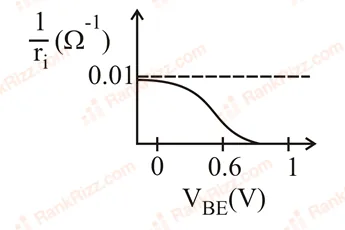
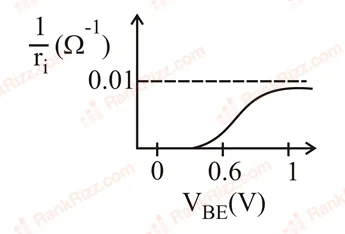
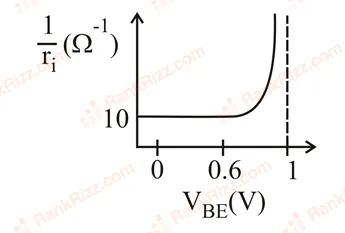
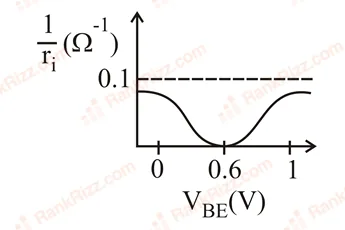
A realistic graph depicting the variation of the reciprocal of input resistance in an input characteristics measurement in a common emitter transistor configuration is:

  1. A
    Figure for JEE Main 2016 Physics question on Transistors (older syllabus)
  2. B
    Figure for JEE Main 2016 Physics question on Transistors (older syllabus)
  3. C
    Figure for JEE Main 2016 Physics question on Transistors (older syllabus)
  4. D
    Figure for JEE Main 2016 Physics question on Transistors (older syllabus)
Q30Modulation and demodulation

A modulated signal Cm(t)C_m(t) has the form Cm(t)=30sin⁡300πt+10(cos⁡200πt−cos⁡400πt)C_m(t) = 30\sin 300\pi t + 10(\cos 200\pi t - \cos 400\pi t). The carrier frequency fc′f'_c, the modulating frequency (message frequency) fωf_\omega and the modulation index μ\mu are respectively given by:

  1. A

    fc=200f_c = 200 Hz; fm=50f_m = 50 Hz; μ=12\mu = \frac{1}{2}

  2. B

    fc=150f_c = 150 Hz; fm=50f_m = 50 Hz; μ=23\mu = \frac{2}{3}

  3. C

    fc=150f_c = 150 Hz; fm=30f_m = 30 Hz; μ=13\mu = \frac{1}{3}

  4. D

    fc=200f_c = 200 Hz; fm=30f_m = 30 Hz; μ=12\mu = \frac{1}{2}

NEXT IN THIS PAPER →Chemistry, Q31 onwards