RankRizz

JEE Main 10 Apr 2015, Online Question Paper

All 90 questions of JEE Main 10 Apr 2015, Online, in the order they were asked, one subject to a page. Pick an answer on any question to check it against the key. Free to read, nothing to download.

Questions

90

Physics · Chemistry · Maths

Answer key

90

questions with a checked key

Price

Free

no sign-up

Physics

Q1Dimensional analysis: deriving and checking relations

If the capacitance of a nanocapacitor is measured in terms of a unit uu, made by combining the electronic charge ee, Bohr radius a0a_0, Planck's constant hh and speed of light cc then

  1. A

    u=e2a0hcu = \frac{e^2 a_0}{hc}

  2. B

    u=hce2a0u = \frac{hc}{e^2 a_0}

  3. C

    u=e2cha0u = \frac{e^2 c}{ha_0}

  4. D

    u=e2hca0u = \frac{e^2 h}{ca_0}

Q2Head-on collisions and coefficient of restitution

A block of mass m=10m = 10 kg rests on a horizontal table. The coefficient of friction between the block and the table is 0.05. When hit by a bullet of mass 50 g moving with speed vv, that gets embedded in it, the block moves and comes to stop after moving a distance of 2 m on the table. If a freely falling object were to acquire speed v10\frac{v}{10} after being dropped from height HH, then neglecting energy losses and taking g=10g = 10 m s−2^{-2}, the value of HH is close to

  1. A

    0.2 km.

  2. B

    0.5 km.

  3. C

    0.4 km.

  4. D

    None of these.

Q3Conservation of mechanical energy

A block of mass m=0.1m = 0.1 kg is connected to a spring of unknown spring constant k. It is compressed to a distance xx from its equilibrium position and released from rest. After approaching half the distance (x2)\left(\frac{x}{2}\right) from the equilibrium position, it hits another block and comes to rest momentarily, while the other block moves with velocity 3 m s−1^{-1}. The total initial energy of the spring is:

  1. A

    0.6 J

  2. B

    0.8 J

  3. C

    1.5 J

  4. D

    0.3 J

Q4Kinematics of uniform circular motion

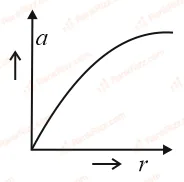
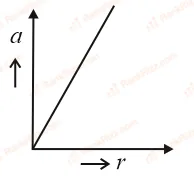
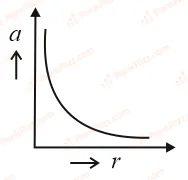
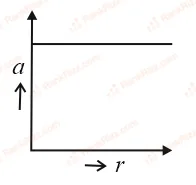
If a body moving in a circular path maintains constant speed of 10 m s−1^{-1}, then which of the following correctly describes the relation between acceleration and radius?
  1. A
    Figure for JEE Main 2015 Physics question on Kinematics of uniform circular motion
  2. B
    Figure for JEE Main 2015 Physics question on Kinematics of uniform circular motion
  3. C
    Figure for JEE Main 2015 Physics question on Kinematics of uniform circular motion
  4. D
    Figure for JEE Main 2015 Physics question on Kinematics of uniform circular motion
Q5Moment of inertia of standard bodies and composite systems

Consider a thin uniform square sheet made of a rigid material. If its side is aa, mass m and moment of inertia II about one of its diagonals, then:

  1. A

    I=ma224I = \frac{ma^2}{24}

  2. B

    ma224<I<ma212\frac{ma^2}{24} < I < \frac{ma^2}{12}

  3. C

    I>ma212I > \frac{ma^2}{12}

  4. D

    I=ma212I = \frac{ma^2}{12}

Q6Rolling with friction, slipping and impulsive forces

A uniform solid cylindrical roller of mass mm is being pulled on a horizontal surface with force FF parallel to the surface and applied at its centre. If the acceleration of the cylinder is aa and it is rolling without slipping then the value of FF is:

  1. A

    32ma\frac{3}{2}ma

  2. B

    2ma2ma

  3. C

    53ma\frac{5}{3}ma

  4. D

    mama

Q7Gravitational field and potential of rings, shells and spheres

A very long (length LL) cylindrical galaxy is made of uniformly distributed mass and has radius RR (R<<L)(R << L). A star outside the galaxy is orbiting the galaxy in a plane perpendicular to the galaxy and passing through its centre. If the time period of the star is TT and its distance from the galaxy's axis is rr, then

  1. A

    T∝rT \propto \sqrt{r}

  2. B

    T∝rT \propto r

  3. C

    T∝r2T \propto r^2

  4. D

    T2∝r3T^2 \propto r^3

Q8Excess pressure in drops and bubbles

If two glass plates have water between them and are separated by very small distance (see the figure below), it is very difficult to pull them apart. It is because the water in between forms cylindrical surface on the side that gives rise to lower pressure in the water in comparison to atmosphere. If the radius of the cylindrical surface is R and surface tension of water is T then the pressure in water between the plates is lower by:
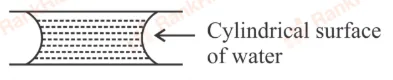
Figure for JEE Main 2015 Physics question on Excess pressure in drops and bubbles
  1. A

    TR\frac{T}{R}

  2. B

    T4R\frac{T}{4R}

  3. C

    4TR\frac{4T}{R}

  4. D

    2TR\frac{2T}{R}

Q9Viscosity, Poiseuille's equation and Reynolds number

If it takes 5 minutes to fill a 15 litre bucket from a water tap of diameter 2π\frac{2}{\sqrt{\pi}} cm then the Reynolds number for the flow is (density of water = 10310^3 kg/m3^3 and viscosity of water = 10−310^{-3} Pa.s) close to:

  1. A

    5500

  2. B

    550

  3. C

    1100

  4. D

    11,000

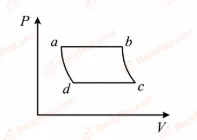
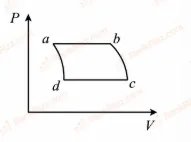
Q10Work done in thermodynamic processes and P-V diagrams

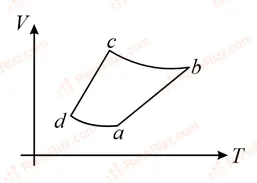
An ideal gas goes through a reversible cycle a→b→c→da \rightarrow b \rightarrow c \rightarrow d has the V - T diagram shown below. Process d→ad \rightarrow a and b→cb \rightarrow c are adiabatic.

Figure for JEE Main 2015 Physics question on Work done in thermodynamic processes and P-V diagrams

The corresponding P - V diagram for the process is (all figures are schematic and not drawn to scale):
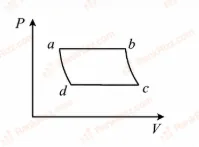
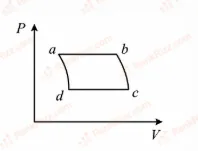
  1. A
    Figure for JEE Main 2015 Physics question on Work done in thermodynamic processes and P-V diagrams
  2. B
    Figure for JEE Main 2015 Physics question on Work done in thermodynamic processes and P-V diagrams
  3. C
    Figure for JEE Main 2015 Physics question on Work done in thermodynamic processes and P-V diagrams
  4. D
    Figure for JEE Main 2015 Physics question on Work done in thermodynamic processes and P-V diagrams
Q11Kinetic interpretation of pressure and temperature

In an ideal gas at temperature T, the average force that a molecule applies on the walls of a closed container depends on TT as TqT^q. A good estimate for qq is:

  1. A

    2

  2. B

    12\frac{1}{2}

  3. C

    1

  4. D

    14\frac{1}{4}

Q12SHM: equation, phase, velocity and acceleration

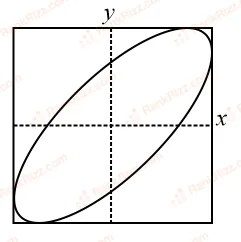
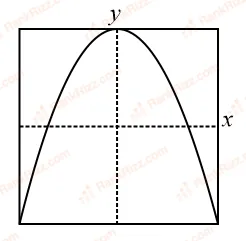
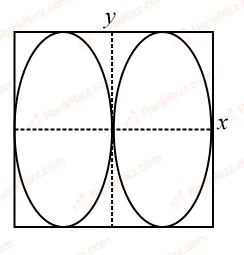
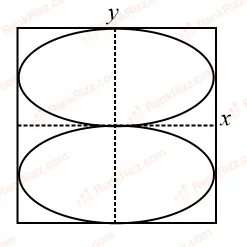
xx and yy are displacements of a particle are given as x(t)=asin⁡ωtx(t) = a \sin \omega t and y(t)=asin⁡2ωty(t) = a \sin 2\omega t. Its trajectory will look like:

  1. A
    Figure for JEE Main 2015 Physics question on SHM: equation, phase, velocity and acceleration
  2. B
    Figure for JEE Main 2015 Physics question on SHM: equation, phase, velocity and acceleration
  3. C
    Figure for JEE Main 2015 Physics question on SHM: equation, phase, velocity and acceleration
  4. D
    Figure for JEE Main 2015 Physics question on SHM: equation, phase, velocity and acceleration
Q13Damped and forced oscillations and resonance

A simple harmonic oscillator of angular frequency 2 rad s−1^{-1} is acted upon by an external force F=sin⁡tF = \sin t N. If the oscillator is at rest in its equilibrium position at t=0t = 0, its position at later times is proportional to:

  1. A

    sin⁡t+12cos⁡2t\sin t + \frac{1}{2}\cos 2t

  2. B

    cos⁡t−12sin⁡2t\cos t - \frac{1}{2}\sin 2t

  3. C

    sin⁡t−12sin⁡2t\sin t - \frac{1}{2}\sin 2t

  4. D

    sin⁡t+12sin⁡2t\sin t + \frac{1}{2}\sin 2t

Q14Doppler effect in sound

A bat moving at 10 m s−1^{-1} towards a wall sends a sound signal of 8000 Hz towards it. On reflection, it hears a sound of frequency ff. The value of ff in Hz is close to (speed of sound = 320 m s−1^{-1})

  1. A

    8258

  2. B

    8424

  3. C

    8000

  4. D

    8516

Q15Conductors, concentric shells and earthing

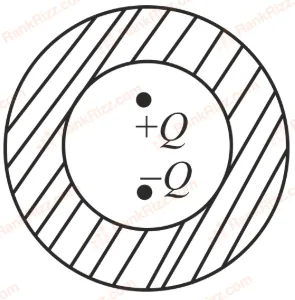
Shown in the figure are two point charges +Q+Q and −Q-Q inside the cavity of a spherical shell. The charges are kept near the surface of the cavity on opposite sides of the centre of the shell. If σ1\sigma_1 is the surface charge on the inner surface and Q1Q_1 net charge on it and σ2\sigma_2 the surface charge on the outer surface and Q2Q_2 net charge on it then:

Figure for JEE Main 2015 Physics question on Conductors, concentric shells and earthing
  1. A

    σ1=0,Q1=0,σ2=0,Q2=0\sigma_1 = 0, Q_1 = 0, \sigma_2 = 0, Q_2 = 0

  2. B

    σ1≠0,Q1=0,σ2≠0,Q2=0\sigma_1 \neq 0, Q_1 = 0, \sigma_2 \neq 0, Q_2 = 0

  3. C

    σ1≠0,Q1≠0,σ2≠0,Q2≠0\sigma_1 \neq 0, Q_1 \neq 0, \sigma_2 \neq 0, Q_2 \neq 0

  4. D

    σ1≠0,Q1=0,σ2=0,Q2=0\sigma_1 \neq 0, Q_1 = 0, \sigma_2 = 0, Q_2 = 0

Q16Electric field of continuous charge distributions

A thin disc of radius b=2ab = 2a has a concentric hole of radius aa in it (see figure). It carries uniform surface charge σ\sigma on it. If the electric field on its axis at a height h (h <<<< a) from its centre is given as Ch then the value of C is
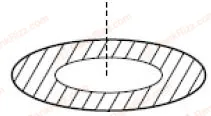
Figure for JEE Main 2015 Physics question on Electric field of continuous charge distributions
  1. A

    σ4aϵ0\frac{\sigma}{4a\epsilon_0}

  2. B

    σaϵ0\frac{\sigma}{a\epsilon_0}

  3. C

    σ5aϵ0\frac{\sigma}{5a\epsilon_0}

  4. D

    σ2aϵ0\frac{\sigma}{2a\epsilon_0}

Q17LR circuits: growth and decay of current

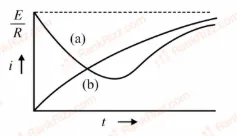
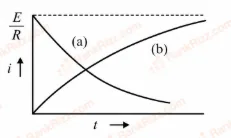
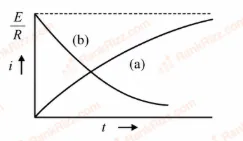
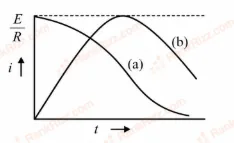
In the given circuits (a) and (b), switches S1S_1 and S2S_2 are closed at t=0t = 0 and kept close for a long time. The variation of currents in the two circuits for t≥0t \geq 0 are shown in the options. (Figures are schematic and not drawn to scale.)
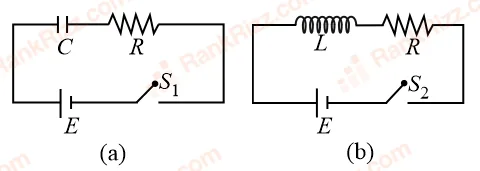
Figure for JEE Main 2015 Physics question on LR circuits: growth and decay of current
  1. A
    Figure for JEE Main 2015 Physics question on LR circuits: growth and decay of current
  2. B
    Figure for JEE Main 2015 Physics question on LR circuits: growth and decay of current
  3. C
    Figure for JEE Main 2015 Physics question on LR circuits: growth and decay of current
  4. D
    Figure for JEE Main 2015 Physics question on LR circuits: growth and decay of current
Q18Cells: emf, internal resistance and combinations

A 10 V battery with internal resistance 1 Ω\Omega and a 15 V battery with internal resistance 0.6 Ω\Omega are connected in parallel to a voltmeter (see figure). The reading in the voltmeter will be close to:
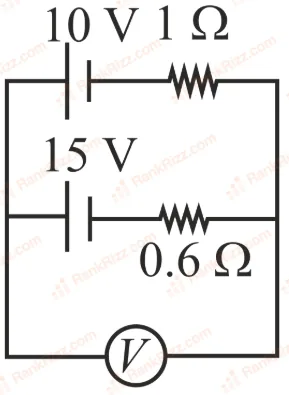
Figure for JEE Main 2015 Physics question on Cells: emf, internal resistance and combinations
  1. A

    11.9 V

  2. B

    13.1 V

  3. C

    12.5 V

  4. D

    24.5 V

Q19Electric current, current density and drift velocity

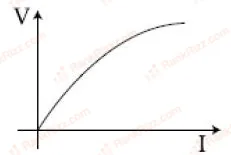
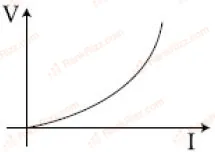
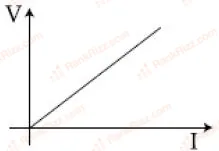
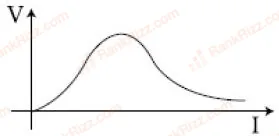
Suppose the drift velocity vdv_d in a material varied with the applied electric field E as vd∝Ev_d \propto \sqrt{E}. Then V - I graph for a wire made of such a material is best given by:
  1. A
    Figure for JEE Main 2015 Physics question on Electric current, current density and drift velocity
  2. B
    Figure for JEE Main 2015 Physics question on Electric current, current density and drift velocity
  3. C
    Figure for JEE Main 2015 Physics question on Electric current, current density and drift velocity
  4. D
    Figure for JEE Main 2015 Physics question on Electric current, current density and drift velocity
Q20Magnetic dipole moment of current loops and torque on loops

A 25 cm long solenoid has the radius 2 cm and 500 turns. It carries a current of 15 A. If it is equivalent to a magnet of the same size and magnetization M⃗\vec{M} (Magnetic Momentvolume)\left(\frac{\text{Magnetic Moment}}{\text{volume}}\right), then ∣M⃗∣|\vec{M}| is:

  1. A

    3π3\pi A m−1^{-1}

  2. B

    30000 A m−1^{-1}

  3. C

    30000π30000\pi A m−1^{-1}

  4. D

    300 A m−1^{-1}

Q21Motion of charged particles in a magnetic field

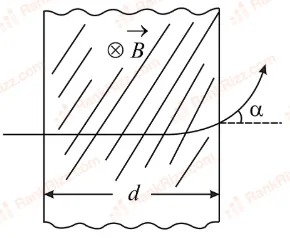
A proton (mass mm), accelerated by a potential difference VV, flies through a uniform transverse magnetic field BB. The field occupies a region of the space by a width dd. Let α\alpha be the angle of deviation of the proton from the initial direction of motion (see the figure), then the value of sin⁡α\sin \alpha will be:

Figure for JEE Main 2015 Physics question on Motion of charged particles in a magnetic field
  1. A

    B2qdmV\frac{B}{2}\sqrt{\frac{qd}{mV}}

  2. B

    Bdq2mVBd\sqrt{\frac{q}{2mV}}

  3. C

    Bdq2mV\frac{B}{d}\sqrt{\frac{q}{2mV}}

  4. D

    qVBd2mqV\sqrt{\frac{Bd}{2m}}

Q22Self inductance and energy stored in inductors

When the current in a coil changes from 5 A to 2 A in 0.1 s, an average voltage of 50 V is produced. The self-inductance of the coil is

  1. A

    1.67 H

  2. B

    6 H

  3. C

    3 H

  4. D

    0.67 H

Q23Properties of EM waves: fields, energy, intensity and momentum

An electromagnetic wave travelling in the x−x- direction has frequency of 2×10142 \times 10^{14} Hz and electric field amplitude of 27 V m−1^{-1} oscillates in Y−Y-direction. From the options given below, which one describes the magnetic field for this wave?

  1. A

    B⃗(x,t)=(9×10⁻⁸ T)j^sin⁡[1.5×10⁻⁶x−2×10¹⁴t]\vec{B}(x, t) = \left(9 \times 10^{-8}\text{ T}\right)\hat{j}\sin\left[1.5 \times 10^{-6} x - 2 \times 10^{14}t\right]

  2. B

    B⃗(x,t)=(9×10⁻⁸T)i^sin⁡[2π(1.5×10⁻⁸x−2×10¹⁴t)]\vec{B}(x, t) = \left(9 \times 10^{-8}\text{T}\right)\hat{i}\sin\left[2\pi(1.5 \times 10^{-8} x - 2 \times 10^{14}t)\right]

  3. C

    B⃗(x,t)=(3×10⁻⁸T)j^sin⁡2π[(x1.5×10−6)−2×10¹⁴t]\vec{B}(x, t) = \left(3 \times 10^{-8}\text{T}\right)\hat{j}\sin 2\pi\left[\left(\frac{x}{1.5 \times 10^{-6}}\right) - 2 \times 10^{14}t\right]

  4. D

    B⃗(x,t)=(9×10⁻⁸T)k^sin⁡2π[(x1.5×10−6)−2×10¹⁴t]\vec{B}(x, t) = \left(9 \times 10^{-8}\text{T}\right)\hat{k}\sin 2\pi\left[\left(\frac{x}{1.5 \times 10^{-6}}\right) - 2 \times 10^{14}t\right]

Q24Optical instruments: microscopes and telescopes

A telescope has an objective lens of focal length 150 cm and an eyepiece of focal length 5 cm. If a 50 m tall tower at a distance of 1 km is observed through this telescope in a normal setting, the angle formed by the image of the tower is θ\theta, then θ\theta is close to

  1. A

    30∘^\circ

  2. B

    15∘^\circ

  3. C

    1∘^\circ

  4. D

    86∘^\circ

Q25Spherical mirrors: mirror formula and magnification

You are asked to design a shaving mirror assuming that a person keeps it at 10 cm from his face and views the magnified image of the face at the closest comfortable distance of 25 cm. The radius of curvature of the mirror would then be:

  1. A

    24 cm

  2. B

    30 cm

  3. C

    60 cm

  4. D

    -24 cm

Q26de Broglie wavelength of matter waves

A parallel beam of electrons travelling in x - direction falls on a slit of width d (see the figure below). If after passing the slit, an electron acquires momentum pyp_y in the y - direction, then for a majority of electrons passing through the slit (h is Planck's constant):
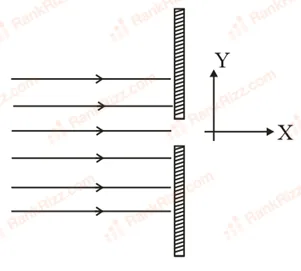
Figure for JEE Main 2015 Physics question on de Broglie wavelength of matter waves
  1. A

    ∣py∣d<h|p_y|d < h

  2. B

    ∣py∣d>h|p_y|d > h

  3. C

    ∣py∣d≃h|p_y|d \simeq h

  4. D

    ∣py∣d>>h|p_y|d >> h

Q27de Broglie wavelength of matter waves

De-Broglie wavelength of an electron accelerated by a voltage of 50 V is close to (∣e∣=1.6×10⁻¹⁹(|e| = 1.6 \times 10^{-19} C, me=9.1×10⁻³¹m_e = 9.1 \times 10^{-31} kg, h=6.6×10⁻³⁴h = 6.6 \times 10^{-34} J s))

  1. A

    0.5 A˚\mathring{A}

  2. B

    1.2 A˚\mathring{A}

  3. C

    1.7 A˚\mathring{A}

  4. D

    2.4 A˚\mathring{A}

Q28Hydrogen spectrum and spectral series

If one were to apply the Bohr model to a particle of mass mm and charge qq moving in a plane under the influence of a magnetic field 'B', the energy of the charged particle in the nthn^{th} level will be:

  1. A

    n(hqBπm)n\left(\frac{hqB}{\pi m}\right)

  2. B

    n(hqB4πm)n\left(\frac{hqB}{4\pi m}\right)

  3. C

    n(hqB2πm)n\left(\frac{hqB}{2\pi m}\right)

  4. D

    n(hqB8πm)n\left(\frac{hqB}{8\pi m}\right)

Q29p-n junction diode and its characteristics

In an unbiased p - n junction electrons diffuse from n-region to p-region because:

  1. A

    electrons travel across the junction due to potential difference

  2. B

    only electrons move from n to p region and not the vice - versa

  3. C

    electron concentration in n - region is more as compared to that in p - region

  4. D

    holes in p - region attract them

Q30Vernier calipers: least count and zero error

Diameter of a steel ball is measured using a Vernier calipers which has divisions of 0.1 cm on its main scale (MS) and 10 divisions of its Vernier scale (VS) match 9 divisions on the main scale. Three such measurements for a ball are given as:

S.No.   MS (cm)   VS divisions
1.            0.5          8
2.            0.5         4
3.            0.5          6

If the zero error is -0.03 cm, then mean corrected diameter is:

  1. A

    0.53 cm

  2. B

    0.56 cm

  3. C

    0.59 cm

  4. D

    0.52 cm

NEXT IN THIS PAPER →Chemistry, Q31 onwards