All 90 questions of JEE Main 04 Apr 2015, Offline, in the order they were asked, one subject to a page. Pick an answer on any question to check it against the key. Free to read, nothing to download.
Questions
90
Physics · Chemistry · Maths
Answer key
90
questions with a checked key
Price
Free
no sign-up
Physics
Q1Errors in measurement and significant figures
The period of oscillation of a simple pendulum is T=2πgL. Measured value of l is 20.0 cm, known to 1 mm accuracy and time for 100 oscillations of the pendulum is found to be 90 s using a wristwatch of 1 s resolution. The accuracy in the determination of g is
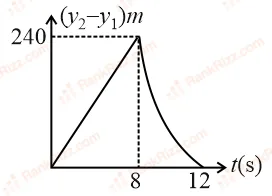
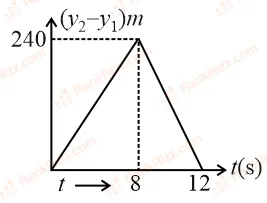
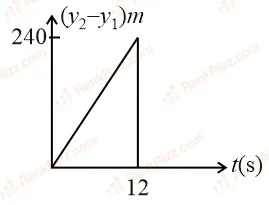
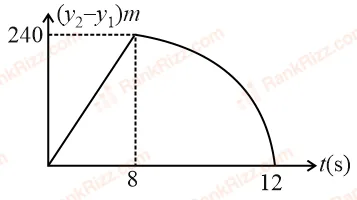
Two stones are thrown up simultaneously from the edge of a cliff 240 m high with an initial speed of 10 m s−1 and 40 m s−1 respectively. Which of the following graph best represents the time variation of the relative position of the second stone with respect to the first? (Assume stones do not rebound after hitting the ground and neglect air resistance, take g=10 ms−2)(the figures are schematic and not drawn to scale)
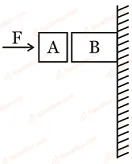
Given in the figure are two blocks A and B of weight 20 N and 100 N, respectively. These are being pressed against a wall by a force F and kept in equilibrium as shown. If the coefficient of friction between the blocks is 0.1 and between block B and the wall is 0.15, the frictional force applied by the wall on block B is:
Q5Head-on collisions and coefficient of restitution
A particle of mass m moving in the x direction with speed 2v is hit by another particle of mass 2m moving in the y direction with speed v. If the collision is perfectly inelastic, the percentage loss in the energy during the collision is close to
Q6Moment of inertia of standard bodies and composite systems
From a solid sphere of mass M and radius R, a cube of the maximum possible volume is cut. Moment of inertia of cube about an axis passing through its centre and perpendicular to one of its faces is:
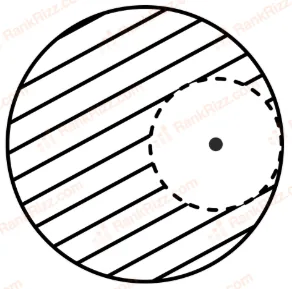
From a solid sphere of mass M and radius R, a spherical portion of radius (2R) is removed as shown in the figure. Taking gravitational potential V=0 at r=∞, the potential at the centre of the cavity thus formed is (G = gravitational constant)
A pendulum made of a uniform wire of cross sectional area A has time period T. When an additional mass M is added to its bob, the time period changes to TM. If the Young's modulus of the material of the wire is Y, then Y1 is equal to: (g = gravitational acceleration)
Consider an ideal gas confined in an isolated closed chamber. As the gas undergoes an adiabatic expansion, the average time of collision between molecules increases as Vq, where V is the volume of the gas. The value of q is (γ=CvCp)
Consider a spherical shell of radius R at temperature T. The black body radiation inside it can be considered as an ideal gas of photons with internal energy per unit volume u=VU∝T4 and pressure p=31(VU). If the shell now undergoes an adiabatic expansion the relation between T and R is:
Q11Second law, heat engines, refrigerators and reversibility
A solid body of constant heat capacity 1 J (∘C)−1 is being heated by keeping it in contact with reservoirs in two ways: (i) Sequentially keeping in contact with 2 reservoirs such that each reservoir supplies the same amount of heat. (ii) Sequentially keeping in contact with 8 reservoirs such that each reservoir supplies the same amount of heat. In both cases the body is brought from initial temperature 100 K to final temperature 200 K. Entropy change of the body in the two cases respectively is: Note: This question was awarded as a bonus since temperatures were given in centigrade instead of in Kelvin. Proper corrections are made in the question to avoid it.
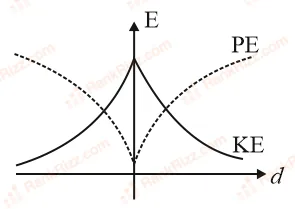
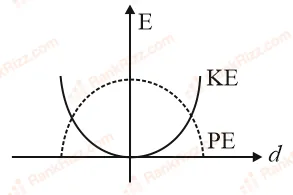
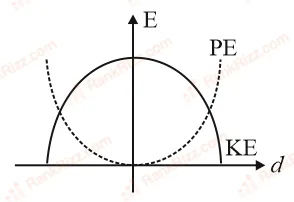
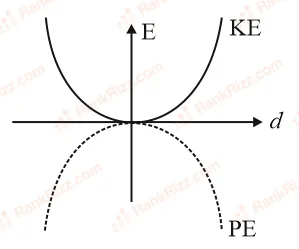
For a simple pendulum, a graph is plotted between its kinetic energy (K.E.) and potential energy (P.E.) against its displacement d. Which one of the following represents these correctly? (graphs are schematic and not drawn to scale)
A train is moving on a straight track with speed 20 m s−1. It is blowing its whistle at the frequency of 1000 Hz. The percentage change in the frequency heard by a person standing near the track as the train passes him is (speed of sound = 320 m s−1) close to:
Q14Magnetic dipole moment of current loops and torque on loops
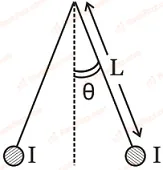
Two long currents carrying thin wires, both with current I, are held by insulating threads of length L and are in equilibrium as shown in the figure, with threads making an angle θ with the vertical. If wires have a mass λ per unit length then the value of I is: (g = gravitational acceleration)
A uniformly charged solid sphere of radius R has potential V0 (measured with respect to ∞) on its surface. For this sphere the equipotential surfaces with potential 23V0, 45V0, 43V0 and 4V0 have radius R1, R2, R3 and R4 respectively. Then Note: This question had two options correct at the time of examination. Proper corrections are made in the question to avoid it.
Q16Electric field of continuous charge distributions
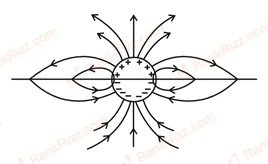
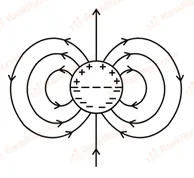
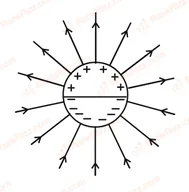
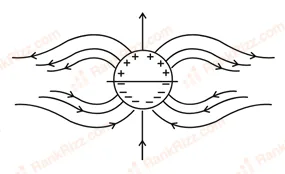
A long cylindrical shell carries positive surface charge σ in the upper half and negative surface charge −σ in the lower half. The electric field lines around the cylinder will look like figure given in: (figures are schematic and not drawn to scale)
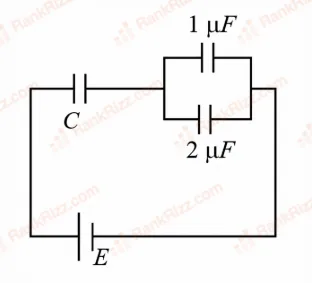
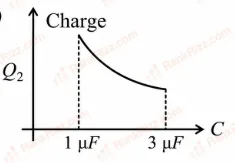
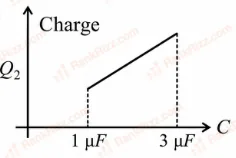
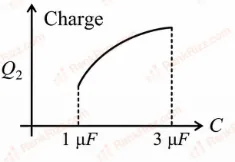
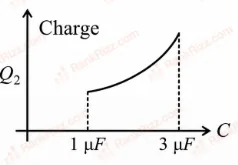
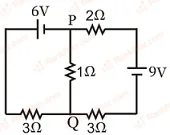
In the given circuit, charge Q2 on the 2 μF capacitor changes as C is varied from 1 μF to 3 μF. Q2 as a function of 'C' is given properly by: (figures are drawn schematically and are not to scale)
Q19Ohm's law, resistance, resistivity and colour code
When 5 V potential difference is applied across a wire of length 0.1 m, the drift speed of electrons is 2.5×10⁻⁴ m s−1. If the electron density in the wire is 8×1028 m−3, the resistivity of the material is close to:
Q20Magnetic dipole moment of current loops and torque on loops
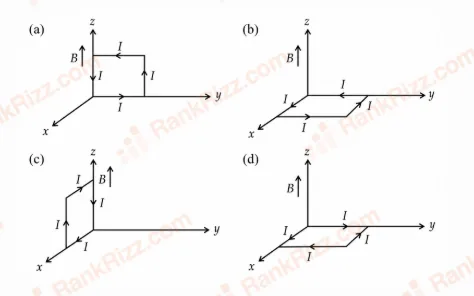
A rectangular loop of sides 10 cm and 5 cm, carrying a current I of 12 A, is placed in different orientations as shown in the figures below.
If there is a uniform magnetic field of 0.3 T in the positive z direction, in which orientations the loop would be in (i) stable equilibrium and (ii) unstable equilibrium?
Two coaxial solenoids of different radii carry current I in the same direction. Let F1 be the magnetic force on the inner solenoid due to the outer one and F2 be the magnetic force on the outer solenoid due to the inner one. Then:
A
F1 is radially outwards and F2=0
B
F1=F2=0
C
F1 is radially inwards and F2 is radially outwards
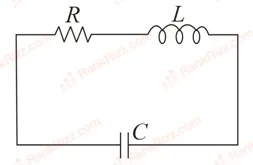
An LCR circuit is equivalent to a damped pendulum. In an LCR circuit the capacitor is charged to Q0 and then connected to the L and R as shown below:
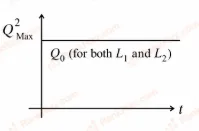
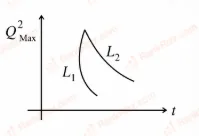
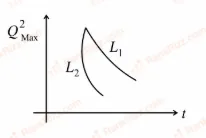
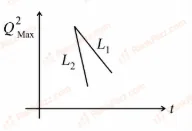
If a student plots graphs of the square of maximum charge (QMax2) on the capacitor with time (t) for two different values L1 and L2 (L1>L2) of L then which of the following represents this graph correctly? (plots are schematic and not drawn to scale)
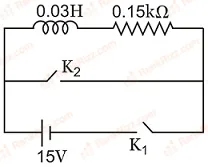
An inductor (L=0.03 H) and a resistor (R=0.15 kΩ) are connected in series to a battery of 15 V E.M.F. in the circuit shown below. The key K1 has been kept closed for a long time. Then at t=0, K1 is opened and key K2 is closed simultaneously. At t=1 ms, the current in the circuit will be: (Take, e5≈150)
Q25Refraction at plane surfaces, Snell's law and apparent depth
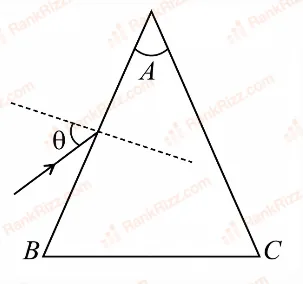
Monochromatic light is incident on a glass prism of angle A. If the refractive index of the material of the prism is μ, a ray, incident at an angle θ, on the face AB would get transmitted through the face AC of the prism provided:
Q26Young's double slit experiment: fringe width and intensity
On a hot summer night, the refractive index of air is the smallest near the ground and increases with a height from the ground. When a light beam is directed horizontally, the Huygens' principle leads us to conclude that as it travels, the light beam,
Assuming that the human pupil has a radius of 0.25 cm and a comfortable viewing distance of 25 cm. The minimum separation between two point objects that the human eye can resolve for the light of wavelength 500 nm is
Match list-I (Fundamental Experiment) with List-II (its conclusion) and select the correct option from the choices given below the list:
List-I List-II A. Franck-Hertz Experiment (i) Particle nature of light B. Photo-electric experiment (ii) Discrete energy levels of the atom C. Davison-Germer Experiment (iii) Wave nature of electron (iv) Structure of atom