Q1Vectors: addition, subtraction, resolution and unit vectors
A vector is rotated by a small angle radians to get a new vector . In that case is:
- A
- B
0
- C
- D
All 90 questions of JEE Main 11 Apr 2015, Online, in the order they were asked, one subject to a page. Pick an answer on any question to check it against the key. Free to read, nothing to download.
Questions
90
Physics · Chemistry · Maths
Answer key
90
questions with a checked key
Price
Free
no sign-up
A vector is rotated by a small angle radians to get a new vector . In that case is:
0
A beaker contains a fluid of density , specific heat and viscosity . The beaker is filled up to height h. To estimate the rate of heat transfer per unit area by convection when beaker is put on a hot plate, a student proposes that it should depend on , and when (in ) is the difference in the temperature between the bottom and top of the fluid. In that situation the correct option for is:
If electronic charge , electron mass , speed of light in vacuum and Planck's constant are taken as fundamental quantities, the permeability of vacuum can be expressed in units of:
From the top of a 64 metres high tower, a stone is thrown upwards vertically with the velocity of 48 m/s. The greatest height (in metres) attained by the stone, assuming the value of the gravitational acceleration m/s, is:
112
88
128
100
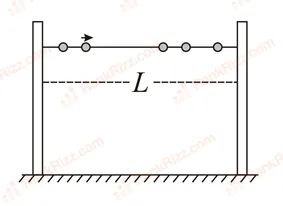
A large number of identical beads, each of mass and radius are strung on a thin smooth rigid horizontal rod of length and are at rest at random positions. The rod is mounted between two rigid supports (see the figure below). If one of the beads is now given a speed , the average force experienced by each support after a long time is (assume all collisions are elastic):
Zero
A particle is moving in a circle of radius under the action of a force which is directed towards centre of the circle. Total mechanical energy (kinetic energy + potential energy) of the particle is (take potential energy = 0 for ):
A uniform thin rod AB of length has linear mass density , where is measured from A. If the CM of the rod lies at a distance of from A, then and are related as:
A particle of mass 2 kg is on a smooth horizontal table and moves in a circular path of radius 0.6 m. The height of the table from the ground is 0.8 m. If the angular speed of the particle is 12 rad s, the magnitude of its angular momentum about a point on the ground right under the center of the circle is:
14.4 kg m s
11.52 kg m s
20.16 kg m s
8.64 kg m s
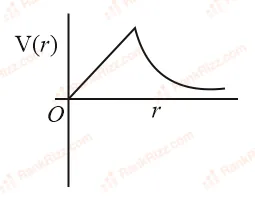
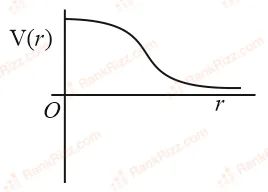
Which of the following most closely depicts the correct variation of the gravitation potential, with distance due to a large planet of radius and uniform mass density? (figures are not drawn to scale)
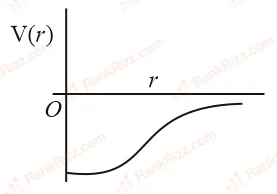
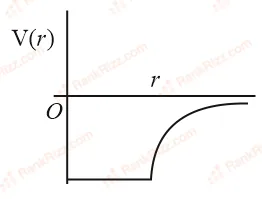
An experiment takes 10 min to raise the temperature of water in a container from 0C to 100C and another 55 min to convert it totally into steam by a heater supplying heat at a uniform rate. Neglecting the specific heat of the container and taking specific heat of the water to be 1 cal (gC), the heat of vaporization according to this experiment will come out to be:
530 cal g
550 cal g
540 cal g
560 cal g
Using equipartition of energy, the specific heat (in J kg K) of Aluminium at high temperature can be estimated to be (atomic weight of Aluminium = 27)
25
1850
410
925
A pendulum with the time period of 1 s is losing energy due to damping. At a certain time, its energy is 45 J. If after completing 15 oscillations its energy has become 15 J, then its damping constant (in s) will be
2
A cylindrical block of wood (density = 650 kg m), of base area 30 cm and height 54 cm, floats in a liquid of density 900 kg m. The block is depressed slightly and then released. The time period of the resulting oscillations of the block would be equal to that of a simple pendulum of length (nearly):
52 cm
26 cm
39 cm
65 cm
A source of sound emits sound waves at frequency . It is moving towards an observer with fixed speed , where is the speed of sound in air. If the observer were to move towards the source with speed , one of the following two graphs (A and B) will give the correct variation of the frequency heard by the observer as is changed.
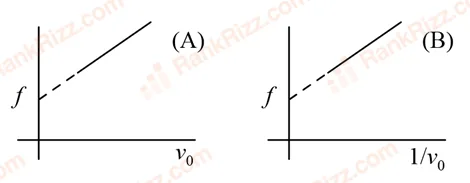
The variation of with is given correctly by:
Graph A with slope =
Graph A with slope =
Graph B with slope =
Graph B with slope =
A wire of length cm is bent into a semi-circular arc and the two equal halves of the arc are uniformly charged with charges and as shown in the figure. The magnitude of the charge on each half is , where is the permittivity of free space. The net electric field at the centre is
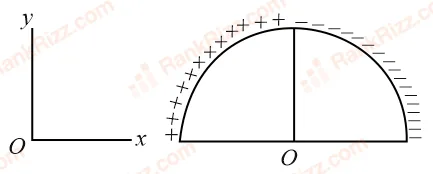
N C
N C
N C
N C
An electric field N C exists in a region of space. If the potential at the origin is taken to be zero then the potential at m, m is:
J C
J C
J C
J C
In the figure is shown a system of four capacitors connected across a 10 V battery. The charge that will flow from switch S when it is closed is:
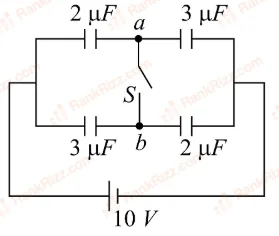
Zero
20 C from a to b
5 C from b to a
5 C from a to b
In the electric network shown, when no current flows through the 4 resistor in the arm EB, the potential difference between the points A and D will be:
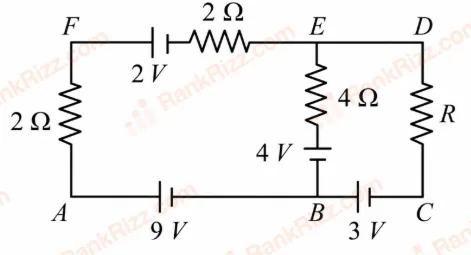
5 V
3 V
4 V
6 V
A short bar magnet is placed in the magnetic meridian of the earth with North Pole pointing north. Neutral points are found at a distance of 30 cm from the magnet on the East-West line, drawn through the middle point of the magnet. The magnetic moment of the magnet in Am is close to: (Given in SI units and = Horizontal component of earth's magnetic field = Tesla.)
4.9
14.6
19.4
9.7
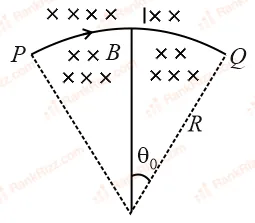
A wire carrying current is tied between points and and is in the shape of a circular arc of radius due to a uniform magnetic field (perpendicular to the plane of the paper, as shown in the figure) in the vicinity of the wire. If the wire subtends an angle at the center of the circle (of which it forms an arch) then the tension in the wire is:
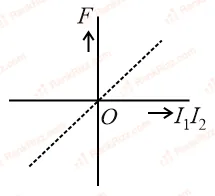
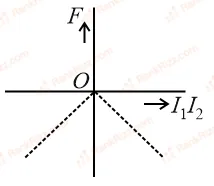
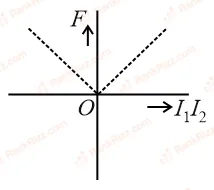
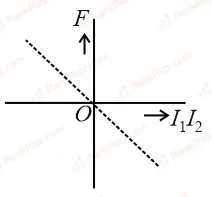
Two long straight parallel wires, carrying (adjustable) currents and , are kept at a distance apart. If the force between the two wires is taken as 'positive' when the wires repel each other and 'negative' when the wires attract each other, the graph showing the dependence of , on the product , would be:
The AC voltage across a resistance can be measured using a:
Moving magnet galvanometer
Moving coil galvanometer
Hot wire voltmeter
Potentiometer
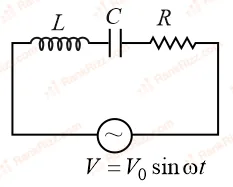
For the LCR circuit, shown here, the current is observed to lead the applied voltage. An additional capacitor , when joined with the capacitor C present in the circuit, makes the power factor of the circuit unity. The capacitor , must have been connected in:
Parallel with C and has a magnitude
Series with C and has a magnitude
Series with C and has a magnitude
Parallel with C and has a magnitude
For plane electromagnetic waves propagating in the -direction, which one of the following combinations gives the correct possible direction for and field respectively?
and
and
and
and
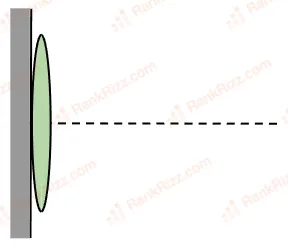
A thin convex lens of focal length is put on a plane mirror as shown in the figure. When an object is kept at a distance from the lens-mirror combination, its image is formed at a distance in front of the combination. The value of is:
In a Young's double slit experiment with light of wavelength , the separation of slits is and distance of screen is such that . If the Fringe width is , the distance from point of maximum intensity to the point where intensity falls to half of the maximum intensity on either side is:
Unpolarized light of intensity is incident on surface of a block of glass at Brewster's angle. In that case, which one of the following statements is true?
transmitted light is partially polarized with intensity
transmitted light is completely polarized with intensity less than
reflected light is partially polarized with intensity
reflected light is completely polarized with intensity less than
The de-Broglie wavelength associated with the electron in the level is:
Half of the de-Broglie wavelength of the electron in the ground state
Four times the de-Broglie wavelength of the electron in the ground state
th of the de-Broglie wavelength of the electron in the ground state
Two times the de-Broglie wavelength of the electron in the ground state
Let be the number of particle emitted by 1 gram of Na radioactive nuclei having a half life of 15 h. In 7.5 h, the number is close to mole
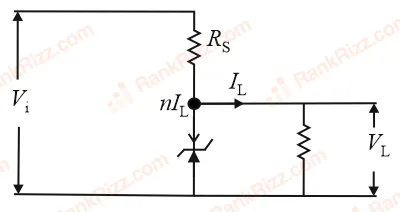
The value of the resistor, , needed in the DC voltage regulator circuit shown here, equals: