Q1Dimensional analysis: deriving and checking relations
From the following combinations of physical constants (expressed through their usual symbols) the only combination, that would have the same value in different systems of units, is:
- A
- B
- C
- D
All 90 questions of JEE Main 12 Apr 2014, Online, in the order they were asked, one subject to a page. Pick an answer on any question to check it against the key. Free to read, nothing to download.
Questions
90
Physics · Chemistry · Maths
Answer key
90
questions with a checked key
Price
Free
no sign-up
From the following combinations of physical constants (expressed through their usual symbols) the only combination, that would have the same value in different systems of units, is:
A person climbs up a stalled escalator in 60 s. If standing on the same but escalator running with constant velocity he takes 40 s. How much time is taken by the person to walk up the moving escalator?
37 s
27 s
24 s
45 s
A bullet of mass 4 g is fired horizontally with a speed of 300 m/s into 0.8 kg block of wood at rest on a table. If the coefficient of friction between the block and the table is 0.3, how far will the block slide approximately?
0.19 m
0.379 m
0.569 m
0.758 m
A spring of unstretched length l has a mass m with one end fixed to a rigid support. Assuming spring to be made of a uniform wire, the kinetic energy possessed by it if its free end is pulled with uniform velocity v is:
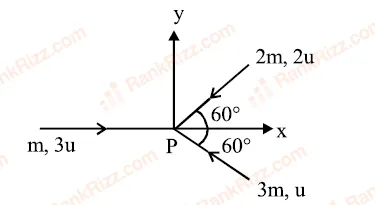
Three masses m, 2m and 3m are moving in the x-y plane with speeds 3u, 2u and u respectively as shown in the figure. The three masses collide at the same point at P and stick together. The velocity of the resulting mass will be:
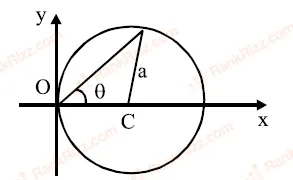
A particle of mass 1 unit is moving in a circular path of radius a, with a constant velocity v as shown in the figure. The centre of circle is marked by 'C'. The angular momentum from the origin O can be written as:
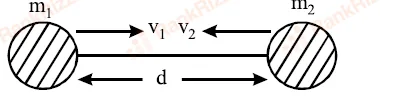
Two hypothetical planets of masses m and m are at rest when they are infinite distance apart. Because of the gravitational force they move towards each other along the line joining their centres. What is their speed when their separation is 'd'? (Speed of m is v and that of m is v)
,
,
,
Steel ruptures when a shear of N m is applied. The force needed to punch a 1 cm diameter hole in a steel sheet 0.3 cm thick is nearly:
N
N
N
N
A cylindrical vessel of cross-section A contains water to a height h. There is a hole in the bottom of radius 'a'. The time in which it will be emptied is:
Two soap bubbles coalesce to form a single bubble. If V is the subsequent change in volume of contained air and S change in total surface area, T is the surface tension and P atmospheric pressure, then which of the following relation is correct?
4PV + 3ST = 0
3PV + 4ST = 0
2PV + 3ST = 0
3PV + 2ST = 0
Hot water cools from 60°C to 50°C in the first 10 minutes and to 42°C in the next 10 minutes. The temperature of the surroundings is:
25°C
10°C
15°C
20°C
A Carnot engine absorbs 1000 J of heat energy from a reservoir at 127°C and rejects 600 J of heat energy during each cycle. The efficiency of engine and temperature of sink will be:
20% and °C
40% and °C
50% and °C
70% and °C
At room temperature a diatomic gas is found to have an r.m.s. speed of 1930 ms. The gas is:
H
Cl
O
F
Which of the following expressions corresponds to simple harmonic motion along a straight line, where x is the displacement and a, b, c are positive constants?
A source of sound A emitting waves of frequency 1800 Hz is falling towards ground with a terminal speed v. The observer B on the ground directly beneath the source receives waves of frequency 2150 Hz. The source A receives waves, reflected from ground of frequency nearly: (Speed of sound = 343 m/s)
2150 Hz
2500 Hz
1800 Hz
2400 Hz
A spherically symmetric charge distribution is characterised by the following charge density variations: for , for . Where r is the distance from the centre of the charge distribution and is a constant. The electric field at an internal point () is:
The space between the plates of a parallel plate capacitor is filled with a 'dielectric' whose 'dielectric constant' varies with distance as per the relation: ( = a constant). The capacitance C, of the capacitor, would be related to its vacuum capacitance C for the relation:
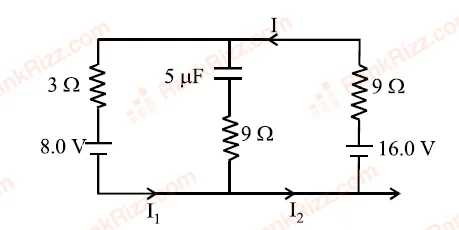
The circuit shown here has two batteries of 8.0 V and 16.0 V and three resistors 3, 9 and 9 and a capacitor of 5.0 F. How much is the current I in the circuit in steady state?
1.6 A
0.67 A
2.5 A
0.25 A
In the experiment of calibration of voltmeter, a standard cell of e.m.f. 1.1 volt is balanced against 440 cm of potential wire. The potential difference across the ends of resistance is found to balance against 220 cm of the wire. The corresponding reading of voltmeter is 0.5 volt. The error in the reading of volmeter will be:
volt
0.15 volt
0.5 volt
volt
A positive charge 'q' of mass 'm' is moving along the +x axis. We wish to apply a uniform magnetic field B for time so that the charge reverses its direction crossing the y axis at a distance d. Then:
and
and
and
and
Consider two thin identical conducting wires covered with very thin insulating material. One of the wires is bent into a loop and produces magnetic field B, at its centre when a current I passes through it. The ratio B : B is:
1:1
1 : 3
1 : 9
9 : 1
A sinusoidal voltage V(t) = 100 sin(500t) is applied across a pure inductance of L = 0.02H. The current through the coil is:
10 cos(500t)
cos(500t)
10 sin(500t)
sin(500t)
A lamp emits monochromatic green light uniformly in all directions. The lamp is 3% efficient in converting electrical power to electromagnetic waves and consumes 100 W of power. The amplitude of the electric field associated with the electromagnetic radiation at a distance of 5 m from the lamp will be nearly:
1.34 V/m
2.68 V/m
4.02 V/m
5.36 V/m
The refractive index of the material of a concave lens is . It is immersed in a medium of refractive index . A parallel beam of light is incident on the lens. The path of the emergent rays when is:
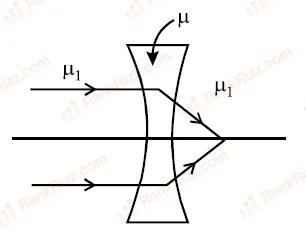
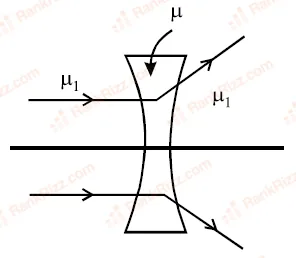
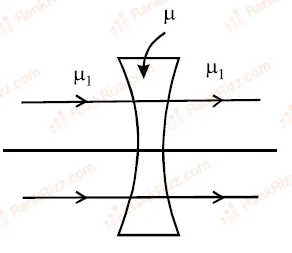
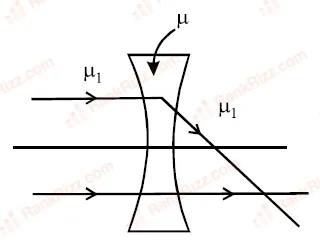
Interference pattern is observed at 'P' due to superimposition of two rays coming out from a source 'S' as shown in the figure. The value of 'l' for which maxima is obtained at 'P' is: (R is perfect reflecting surface)
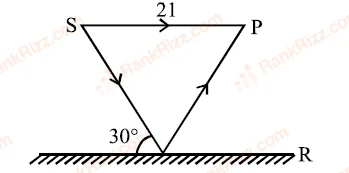
In an experiment of single slit diffraction pattern, first minimum for red light coincides with first maximum of some other wavelength. If wavelength of red light is 6600 , then wavelength of first maximum will be:
3300
4400
5500
6600
A beam of light has two wavelengths of 4972 and 6216 with a total intensity of Wm equally distributed among the two wavelengths. The beam falls normally on an area of 1 cm of a clean metallic surface of work function 2.3 eV. Assume that there is no loss of light by reflection and that each capable photon ejects one electron. The number of photoelectrons liberated in 2 s is approximately:
For LED's to emit light in visible region of electromagnetic light, it should have energy band gap in the range of:
0.1eV to 0.4eV
0.5eV to 0.8eV
0.9eV to 1.6eV
1.7eV to 3.0eV
A piece of bone of an animal from a ruin is found to have C activity of 12 disintegrations per minute per gm of its carbon content. The C activity of a living animal is 16 disintegrations per minute per gm. How long ago nearly did the animal die? (Given half life of C is = 5760 years)
1672 years
2391 years
3291 years
4453 years
For sky wave propagation, the radio waves must have a frequency range in between:
1MHz to 2MHz
5MHz to 25MHz
35MHz to 40MHz
45MHz to 50MHz