Q1Kinetic energy and the work-energy theorem
A bullet loses of its velocity passing through one plank. Considering uniform retardation, the number of such planks that are required to stop the bullet can be:
- A
Infinite
- B
- C
- D
All 90 questions of JEE Main 19 Apr 2014, Online, in the order they were asked, one subject to a page. Pick an answer on any question to check it against the key. Free to read, nothing to download.
Questions
90
Physics · Chemistry · Maths
Answer key
89
questions with a checked key
Price
Free
no sign-up
A bullet loses of its velocity passing through one plank. Considering uniform retardation, the number of such planks that are required to stop the bullet can be:
Infinite
A heavy box is to be dragged along a rough horizontal floor. To do so, the person A pushes it at an angle 30° from the horizontal and requires a minimum force , while the person B pulls the box at an angle 60° from the horizontal and needs minimum force . If the coefficient of friction between the box and the floor is , the ratio is:
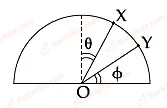
A particle is released on a vertical smooth semicircular track from point X so that, OX makes an angle from the vertical (see the figure). The normal reaction of the track on the particle vanishes at point Y, where OY makes an angle with the horizontal. Then:
Consider a cylinder of mass M resting on a rough horizontal rug that is pulled out from under it with acceleration 'a' perpendicular to the axis of the cylinder. What is at point P? It is assumed that the cylinder does not slip.
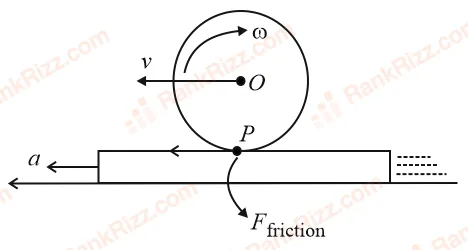
Ma
Mg
A ball of mass 160 g is thrown up at an angle of 60° to the horizontal at a speed of 10 m s. The angular momentum of the ball at the highest point of the trajectory with respect to the point from which the ball is thrown is nearly (g = 10 m s)
1.73 kg m s
3.46 kg m s
3.0 kg m s
6.0 kg m s
Match List-I (Event) with List-II (Order of the time interval for the happening of the event) and select the correct option from the options given below the lists.
List-I: List-II:
(a) The rotation period of earth (i) 10 s
(b) Revolution period of earth (ii) 10 s
(c) Period of a light wave (iii) 10 s
(d) Period of a sound wave (iv) 10 s
(a)-(i), (b)-(ii), (c)-(iii), (d)-(iv)
(a)-(ii), (b)-(i), (c)-(iii), (d)-(iv)
(a)-(i), (b)-(ii), (c)-(iv), (d)-(iii)
(a)-(ii), (b)-(i), (c)-(iv), (d)-(iii)
The gravitational field in a region is given by N kg. The change in the gravitational potential energy of a particle of mass 2 kg when it is taken from the origin to a point (7 m, m) is:
71 J
J
2 J
1 J
The velocity of water in a river is 18 km h near the surface. If the river is 5 m deep, find the shearing stress between the horizontal layers of water. The coefficient of viscosity of water = poise.
N m
N m
N m
N m
A large number of liquid drops each of radius r coalesce to form a single drop of the radius R. The energy released in the process is converted into kinetic energy of the big drop so formed. The speed of the big drop is (given surface tension of the liquid T, density )
In the diagram shown, the difference in the two tubes of the manometer is 5 cm, the cross-section of the tube at A and B is 6 mm and 10 mm respectively. The rate at which water flows through the tube is (g = 10 m s)
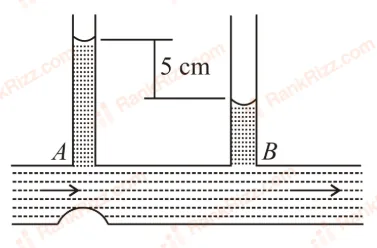
7.5 cc s
12.5 cc s
8.0 cc s
10.0 cc s
A black coloured solid sphere of radius R and mass M is inside a cavity with vacuum inside. The walls of the cavity are maintained at temperature . The initial temperature of the sphere is . If the specific heat of the material of the sphere varies as per unit mass with the temperature T of the sphere, where is a constant, then the time taken for the sphere to cool down to temperature will be ( is Stefan Boltzmann constant)
A monoatomic gas is compressed from a volume of 2 m to a volume of 1 m at a constant pressure of 100 N m. Then it is heated at constant volume by supplying 150 J of energy. As a result, the internal energy of the gas:
Decreases by 50 J
Increases by 250 J
Decreases by 250 J
0 J
A gas molecule of mass M at the surface of the earth has kinetic energy equivalent to 0 °C. If it were to go up straight without colliding with any other molecules, how high it would rise? Assume that the height attained is much less than the radius of the earth. (k is Boltzmann constant)
0
A body is in simple harmonic motion with time period s and amplitude cm. Find the average velocity in the interval in which it moves from equilibrium position to half of its amplitude.
16 cm/s
6 cm/s
4 cm/s
12 cm/s
The total length of a sonometer wire fixed between two bridges is 110 cm. Now, two more bridges are placed to divide the length of the wire in the ratio 6 : 3 : 2. If the tension in the wire is 400 N and the mass per unit length of the wire is 0.01 kg m, then the minimum common frequency with which all the three parts can vibrate, is:
1000 Hz
1100 Hz
100 Hz
110 Hz
The electric field in a region of space is given by, where N C. The flux of this field through a circular surface of radius 0.02 m parallel to the Y-Z plane is nearly:
0.02 N m C
0.005 N m C
0.125 N m C
3.14 N m C
The gap between the plates of a parallel plate capacitor of area A and distance between plates d, is filled with a dielectric whose relative permittivity varies linearly from at one plate to at the other. The capacitance of the capacitor is:
Four bulbs B, B, B and B of 100 W each are connected to 220 V main as shown in the figure. The reading in the ideal ammeter will be:
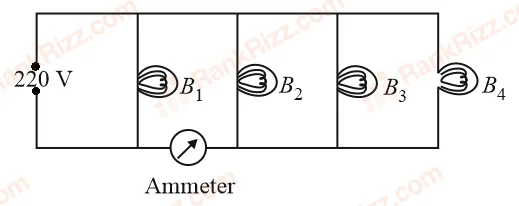
0.90 A
1.35 A
0.45 A
1.80 A
An example of a perfect diamagnet is a superconductor. This implies that when a superconductor is put in a magnetic field of intensity B, the magnetic field inside the superconductor will be such that:
but
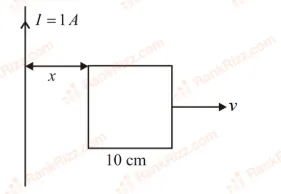
A square frame of side 10 cm and a long straight wire carrying current 1 A are in the plane of the paper. Starting from close to the wire, the frame moves towards the right with a constant speed of 10 m s (see figure). The e.m.f induced at the time the left arm of the frame is at x = 10 cm from the wire is:
0.75 V
1 V
2 V
0.5 V
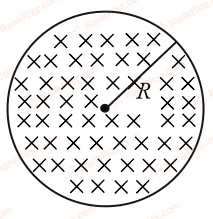
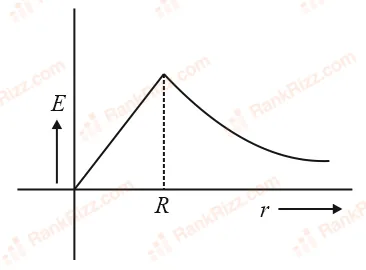
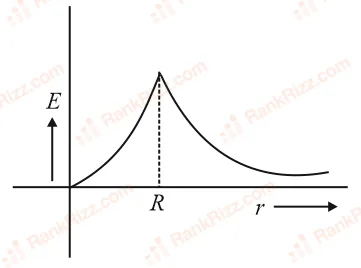
The figure shows a circular area of radius R where a uniform magnetic field is going into the plane of the paper and increasing in magnitude at a constant rate. In that case, which of the following graphs, drawn schematically, correctly shows the variation of the induced electric field E(r)?
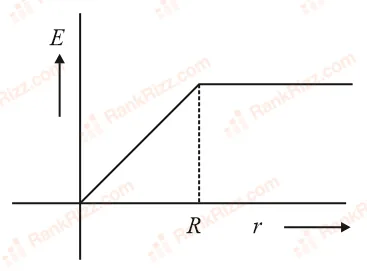
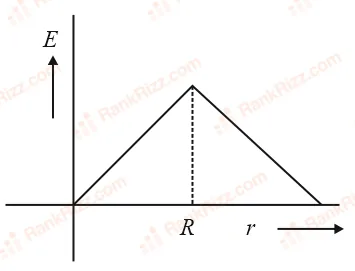
If microwaves, X-rays, infrared, gamma rays, ultraviolet, radio waves and visible parts of the electromagnetic spectrum are denoted respectively by M, X, I, G, U, R and V the following is the arrangement in ascending order of the wavelength:
I, M, R, U, V, X and G
R, M, I, V, U, X and G
M, R, V, X, U, G and I
G, X, U, V, I, M and R
The diameter of the objective lens of the microscope makes an angle at the focus of the microscope. Further, the medium between the object and the lens is the oil of the refractive index n. Then the resolving power of the microscope:
Increases with decreasing value of
Increases with increasing value of
Increases with increasing value of
Increases with decreasing value of
A ray of light is incident from a denser to a rarer medium. The critical angle for total internal reflection is and Brewster's angle of incidence is , such that . The relative refractive index of the two media is:
0.4
0.2
0.9
0.8
In Young's double-slit experiment, the distance between the two identical slits is 6.1 times larger than the slit width. Then the number of intensity maxima observed within the central maximum of the single-slit diffraction pattern is:
3
6
24
12
Match List-I (Experiment performed) with List-II (Phenomena discovered/associated) and select the correct option from the options given below the lists.
List-I: List-II:
(a) Davisson and Germer experiment (i) Wave nature of electrons
(b) Millikan's oil drop experiment (ii) Charge of an electron
(c) Rutherford experiment (iii) Quantisation of energy levels
(d) Franck-Hertz experiment (iv) Existence of the nucleus
(a)-(iii), (b)-(iv), (c)-(i), (d)-(ii)
(a)-(i), (b)-(ii), (c)-(iv), (d)-(iii)
(a)-(iv), (b)-(iii), (c)-(ii), (d)-(i)
(a)-(i), (b)-(ii), (c)-(iii), (d)-(iv)
A piece of wood from a recently cut tree shows 20 decays per minute. A wooden piece of the same size placed in a museum (obtained from a tree cut many years back) shows 2 decays per minute. If the half-life of C is 5730 years, then the age of the wooden piece placed in the museum is approximately: [This question was awarded a bonus and proper correction was made to avoid that]
10439 years
39049 years
19042 years
13094 years
Given, A and B are input terminals. Logic 1 is > 5 V, Logic 0 is < 1 V. Which logic gate operation, the following circuit does?
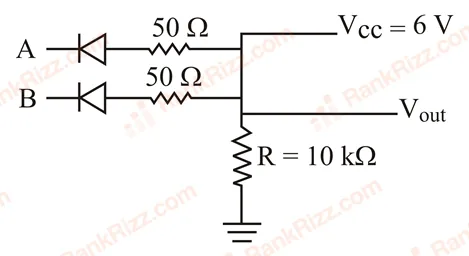
Note: This question was awarded a bonus. C option changed.
OR gate
NOR gate
Output will always be one
XOR gate
Long-range radio transmission is possible when the radio waves are reflected from the ionosphere. For this to happen the frequency of the radio waves must be in the range:
150 500 kHz
80 150 MHz
1 3 MHz
8 25 MHz
In an experiment to determine the gravitational acceleration g of a place with the help of a simple pendulum, the measured time period squared is plotted against the string length of the pendulum in the figure. What is the value of g at the place?
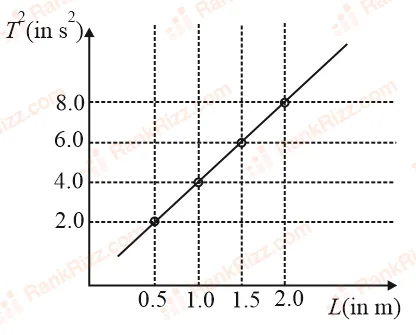
10.0 m s
9.87 m s
9.91 m s
9.81 m s