Q1Dimensional analysis: deriving and checking relations
From the following, the quantity (constructed from the basic constants of nature), that has the dimensions, as well as correct order of magnitude, vis-a-vis typical atomic size, is:
- A
- B
- C
- D
All 90 questions of JEE Main 09 Apr 2013, Online, in the order they were asked, one subject to a page. Pick an answer on any question to check it against the key. Free to read, nothing to download.
Questions
90
Physics · Chemistry · Maths
Answer key
86
questions with a checked key
Price
Free
no sign-up
From the following, the quantity (constructed from the basic constants of nature), that has the dimensions, as well as correct order of magnitude, vis-a-vis typical atomic size, is:
Two springs of force constants 300 N/m (Spring A) and 400 N/m (Spring B) are joined together in series. The combination is compressed by 8.75 cm. The ratio of energy stored in A and B is . Then is equal to:
A bullet of mass 10 g and speed 500 m/s is fired into a door and gets embedded exactly at the centre of the door. The door is 1.0 m wide and weighs 12 kg. It is hinged at one end and rotates about a vertical axis practically without friction. The angular speed of the door just after the bullet embeds into it will be :
6.25 rad/sec
0.625 rad/sec
3.35 rad/sec
0.335 rad/sec
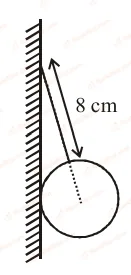
A uniform sphere of weight W and radius 5 cm is being held by a string as shown in the figure. The tension in the string will be :
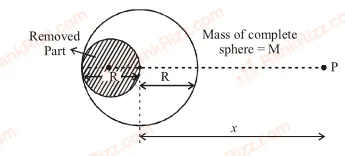
The gravitational field, due to the 'left over part' of a uniform sphere (from which a part as shown, has been 'removed out'), at a very far off point, P, located as shown, would be (nearly) :
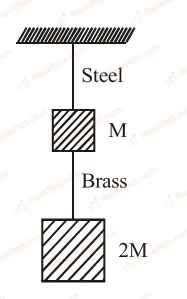
If the ratio of lengths, radii and Young's moduli of steel and brass wires in the figure are a, b and c respectively, then the corresponding ratio of increase in their lengths is :
This question has Statement-1 and Statement-2. Of the four choices given after the Statements, choose the one that best describes the two Statements.
Statement-1: A capillary is dipped in a liquid and liquid rises to a height h in it. As the temperature of the liquid is raised, the height h increases (if the density of the liquid and the angle of contact remain the same).
Statement-2: Surface tension of a liquid decreases with the rise in its temperature.
Statement-1 is true, Statement-2 is true; Statement-2 is not the correct explanation for Statement-1.
Statement-1 is false, Statement-2 is true.
Statement-1 is true, Statement-2 is false.
Statement-1 is true, Statement-2 is true; Statement-2 is the correct explanation for Statement-1.
On a linear temperature scale Y, water freezes at Y and boils at Y. On this Y scale, a temperature of 340 K would be read as : (water freezes at 273 K and boils at 373 K)
Y
Y
Y
Y
Figure shows the variation in temperature () with the amount of heat supplied (Q) in an isobaric process corresponding to a monoatomic (M), diatomic (D) and a polyatomic (P) gas. The initial state of all the gases are the same and the scales for the two axes coincide. Ignoring vibrational degrees of freedom, the lines a, b and c respectively correspond to :
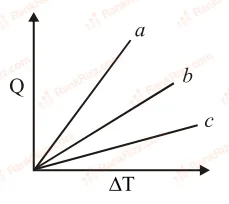
P, M and D
M, D and P
P, D and M
D, M and P
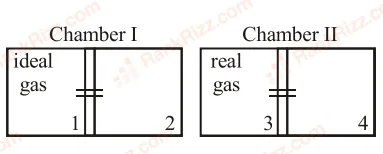
There are two identical chambers, completely thermally insulated from surroundings. Both chambers have a partition wall dividing the chambers in two compartments. Compartment 1 is filled with an ideal gas and Compartment 3 is filled with a real gas. Compartments 2 and 4 are vacuum. A small hole (orifice) is made in the partition walls and the gases are allowed to expand in vacuum.
Statement - 1 : No change in the temperature of the gas takes place when ideal gas expands in vacuum. However, the temperature of real gas goes down (cooling) when it expands in vacuum.
Statement - 2 : The internal energy of an ideal gas is only kinetic. The internal energy of a real gas is kinetic as well as potential.
Statement-1 is false and Statement-2 is true.
Statement-1 and Statement-2 both are true. Statement-2 is the correct explanation of Statement-1.
Statement-1 is true and Statement-2 is false.
Statement-1 and Statement-2 both are true. Statement-2 is not correct explanation of Statement-1.
Two simple pendulums of length 1 m and 4 m respectively are both given small displacement in the same direction at the same instant. They will be again in phase after the shorter pendulum has completed number of oscillations equal to:
2
7
5
3
When two sound waves travel in the same direction in a medium, the displacements of a particle located at 'x' at time 't' is given by :
where , and x are in meters and t in seconds. The speed of sound in the medium is :
92 m/s
200 m/s
100 m/s
332 m/s
An engine approaches a hill with a constant speed. When it is at a distance of 0.9 km, it blows a whistle whose echo is heard by the driver after 5 seconds. If the speed of sound in air is 330 m/s, then the speed of the engine is :
32 m/s
27.5 m/s
60 m/s
30 m/s
Two point dipoles of dipole moment and are at a distance x from each other and . The force between the dipoles is :
Two balls of same mass and carrying equal charge are hung from a fixed support of length . At electrostatic equilibrium, assuming that angles made by each thread is small, the separation, x between the balls is proportional to :
In a metre bridge experiment null point is obtained at 40 cm from one end of the wire when resistance X is balanced against another resistance Y. If X < Y, then the new position of the null point from the same end, if one decides to balance a resistance of 3X against Y, will be close to :
80 cm
75 cm
67 cm
50 cm
A letter 'A' is constructed of a uniform wire with resistance 1.0 per cm. The sides of the letter are 20 cm and the cross piece in the middle is 10 cm long. The apex angle is 60°. The resistance between the ends of the legs is close to:
50.0
10
36.7
26.7
A shunt of resistance 1 is connected across a galvanometer of 120 resistance. A current of 5.5 ampere gives full scale deflection in the galvanometer. The current that will give full scale deflection in the absence of the shunt is nearly :
5.5 ampere
0.5 ampere
0.004 ampere
0.045 ampere
A uniform electric field exists between the plates of a charged condenser. A charged particle enters the space between the plates and perpendicular to . The path of the particle between the plates is a:
straight line
hyperbola
parabola
circle
An electric current is flowing through a circular coil of radius R. The ratio of the magnetic field at the centre of the coil and that at a distance from the centre of the coil and on its axis is :
27
36
8
Two coils, X and Y, are kept in close vicinity of each other. When a varying current, , flows through coil X, the induced emf in coil Y, varies in the manner shown here. The variation of , with time, can then be represented by the graph labelled as graph :
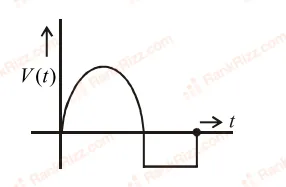
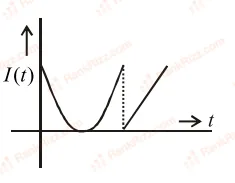
(A)
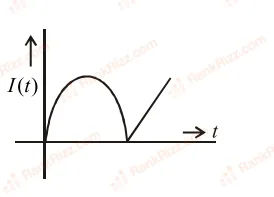
(B)
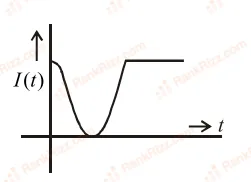
(c)
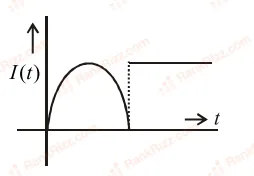
(D)
A
C
B
D
In the circuit shown here, the voltage across E and C are respectively 300 V and 400 V. The voltage E of the ac source is :
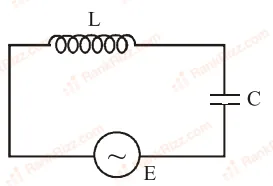
400 Volt
500 Volt
100 Volt
700 Volt
Photons of an electromagnetic radiation has an energy 11 keV each. To which region of electromagnetic spectrum does it belong?
X-ray region
Ultra violet region
Infrared region
Visible region
Light is incident from a medium into air at two possible angles of incidence (A) 20° and (B) 40°. In the medium light travels 3.0 cm in 0.2 ns. The ray will :
suffer total internal reflection in both cases (A) and (B)
suffer total internal reflection in case (B) only
have partial reflection and partial transmission in case (B)
have 100% transmission in case (A)
A ray of light of intensity I is incident on a parallel glass slab at point A as shown in the diagram. It undergoes partial reflection and refraction. At each reflection, 25% of incident energy is reflected. The rays AB and A'B' undergo interference. The ratio of and is :
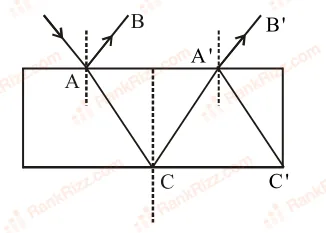
49 : 1
7 : 1
4 : 1
8 : 1
A person lives in a high-rise building on the bank of a river 50 m wide. Across the river is a well lit tower of height 40 m. When the person, who is at a height of 10 m, looks through a polarizer at an appropriate angle at light of the tower reflecting from the river surface, he notes that intensity of light coming from distance X from his building is the least and this corresponds to the light coming from light bulbs at height 'Y' on the tower. The values of X and Y are respectively close to (refractive index of water )
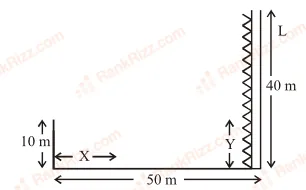
25 m, 10 m
13 m, 27 m
22 m, 13 m
17 m, 20 m
In the Bohr model an electron moves in a circular orbit around the proton. Considering the orbiting electron to be a circular current loop, the magnetic moment of the hydrogen atom, when the electron is in excited state, is :
When Uranium is bombarded with neutrons, it undergoes fission. The fission reaction can be written as :
(energy) where three particles named x are produced and energy Q is released. What is the name of the particle x?
electron
-particle
neutron
neutrino
Consider two npn transistors as shown in the figure. If 0 Volts corresponds to false and 5 Volts correspond to true, then the output at C corresponds to :
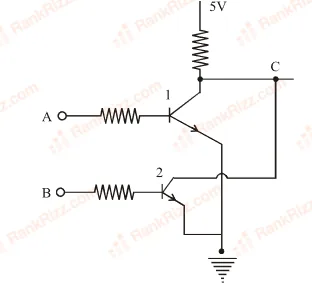
A NAND B
A OR B
A AND B
A NOR B
If a carrier wave is amplitude modulated by a modulator signal then the equation of modulated signal and its modulation index are respectively
and 2
and 1
and 1
and 2