Q1Dimensional analysis: deriving and checking relations
Let denote the dimensional formula of the permittivity of vacuum. If M = mass, L = length, T = time and A = electric current, then :
- A
- B
- C
- D
All 90 questions of JEE Main 07 Apr 2013, Online, in the order they were asked, one subject to a page. Pick an answer on any question to check it against the key. Free to read, nothing to download.
Questions
90
Physics · Chemistry · Maths
Answer key
90
questions with a checked key
Price
Free
no sign-up
Let denote the dimensional formula of the permittivity of vacuum. If M = mass, L = length, T = time and A = electric current, then :
A projectile is given an initial velocity of m s, where is along the ground and is along the vertical upward. If m s, the equation of its trajectory is :
A uniform cylinder of length L and mass M having cross-sectional area A is suspended, with its length vertical, from a fixed point by a massless spring, such that it is half submerged in a liquid of density at equilibrium position. The extension of the spring when it is in equilibrium is :
This question has Statement - I and Statement - II. Of the four choices given after the Statements, choose the one that best describes the two Statements.
Statement - I: A point particle of mass moving with speed collides with stationary point particle of mass . If the maximum energy loss possible is given as then .
Statement - II: Maximum energy loss occurs when the particles get stuck together as a result of the collision.
Statement-I is true, Statement-II is false.
Statement-I is false, Statement-II is true.
Statement-I is true, Statement-II is true, Statement-II is a correct explanation of Statement-I.
Statement-I is true, Statement-II is true, Statement-II is not a correct explanation of Statement-I.
A hoop of radius r and mass m rotating with an angular velocity is placed on a rough horizontal surface. The initial velocity of the centre of the hoop is zero. What will be the velocity of the centre of the hoop when it ceases to slip?
What is the minimum energy required to launch a satellite of mass m from the surface of a planet of mass M and radius R in a circular orbit at an altitude of 2R?
Assume that a drop of a liquid evaporates by a decrease in its surface energy so that its temperature remains unchanged. The minimum radius of the drop for this to be possible is. (The surface tension is T, the density of the liquid is and L is its latent heat of vaporisation.)
If a piece of metal is heated to temperature and then allowed to cool in a room which is at temperature , the graph between the temperature T of the metal and time t will be closest to :
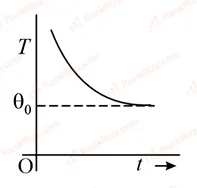
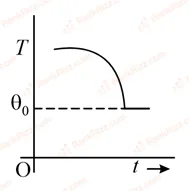
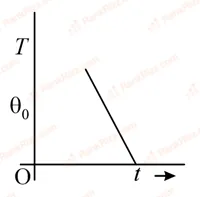
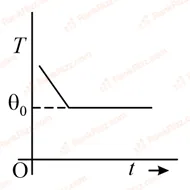
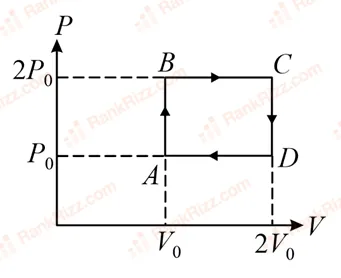
The below P-V diagram represents the thermodynamic cycle of an engine, operating with an ideal mono-atomic gas. The amount of heat, extracted from the source in a single cycle, is:
Two charges, each equal to q, are kept at and on the x-axis. A particle of mass m and charge is placed at the origin. If charge is given a small displacement () along the y-axis, the net force acting on the particle is proportional to :
An ideal gas enclosed in a vertical cylindrical container supports a freely moving piston of mass M. The piston and the cylinder have equal cross-sectional area A. When the piston is in equilibrium, the volume of the gas is and its pressure is . The piston is slightly displaced from the equilibrium position and released. Assuming that the system is completely isolated from its surrounding, the piston executes a simple harmonic motion with frequency
[Assume the system is in space.]
A sonometer wire of length 1.5 m is made of steel. The tension in it produces an elastic strain of 1%. What is the fundamental frequency of steel if density and elasticity of steel are kg m and N m respectively?
200.5 Hz
770 Hz
188.5 Hz
178.2 Hz
A charge Q is uniformly distributed over a long rod AB of length L as shown in the figure. The electric potential at the point O lying at a distance L from the end A is :

In an LCR circuit shown below, both the switches are open initially. Now switch is closed, kept open. (q is charge on the capacitor and = RC is capacitive time constant). Which of the following statement is correct?
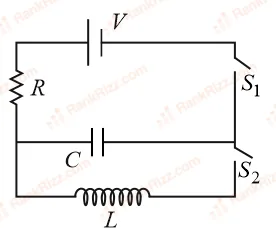
At ,
At ,
Work done by the battery is half of the energy dissipated in the resistor
At ,
Two capacitors and are charged to 120 V and 200 V respectively. It is found that by connecting them together the potential on each one can be made zero. Then:
The supply voltage to a room is 120 V. The resistance of the lead wires is 6 . A 60 W bulb is already switched on. What is the decrease of voltage across the bulb, when a 240 W heater is switched on in parallel to the bulb?
13.3 V
10.4 V
zero V
2.9 V
This question has Statement I and Statement II. Of the four choices given after the Statements, choose the one that best describes the two Statements.
Statement - I : Higher the range, greater is the resistance of ammeter.
Statement - II : To increase the range of ammeter, additional shunt needs to be used across it.
Statement-I is true, Statement-II is false.
Statement-I is false, Statement-II is true.
Statement-I is true, Statement-II is true, Statement-II is the correct explanation of Statement-I.
Statement-I is true, Statement-II is true, Statement-II is not the correct explanation of Statement-I.
Two short bar magnets of length 1 cm each have magnetic moments 1.20 A m and 1.00 A m respectively. They are placed on a horizontal table parallel to each other with their N poles pointing towards the south. They have a common magnetic equator and are separated by a distance of 20.0 cm. The value of the resultant horizontal magnetic induction at the mid-point O of the line joining their centres is close to
(Horizontal component of earth's magnetic induction is Wb m)
Wb m
Wb m
Wb m
Wb m
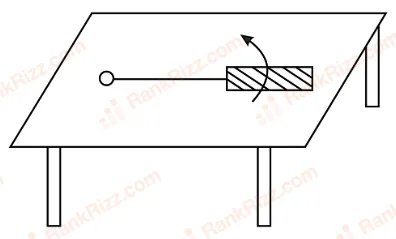
A metallic rod of length is tied to a string of length and made to rotate with angular speed on a horizontal table with one end of the string fixed. If there is a vertical magnetic field B in the region, the e.m.f. induced across the ends of the rod is:
A circular loop of radius 0.3 cm lies parallel to a much bigger circular loop of radius 20 cm. The centre of the small loop is on the axis of the bigger loop. The distance between their centres is 15 cm. If a current of 2.0 A flows through the smaller loop, then the flux linked with a bigger loop is:
weber
weber
weber
weber
The amplitude of a damped oscillator decreases to 0.9 times its original magnitude in 5s. In another 10s it will decrease to times its original magnitude, where equals :
0.729
0.6
0.7
0.81
The magnetic field in a travelling electromagnetic wave has a peak value of 20 nT. The peak value of electric field strength is :
9 V m
12 V m
3 V m
6 V m
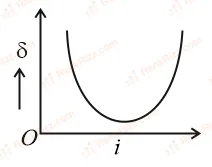
The graph between angle of deviation () and angle of incidence () for a triangular prism is represented by :
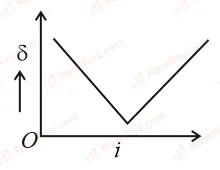
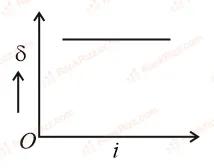
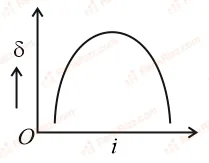
Diameter of a plano-convex lens is 6 cm and thickness at the centre is 3 mm. If the speed of light in the material of lens is m s, the focal length of the lens is:
30 cm
10 cm
15 cm
20 cm
A beam of unpolarised light of intensity is passed through a polaroid A and then through another polaroid B which is oriented so that its principle plane makes an angle of 45° relative to that of A. The intensity of the emergent light is:
Two coherent point sources and are separated by a small distance as shown in the figure. The fringes obtained on the screen will be
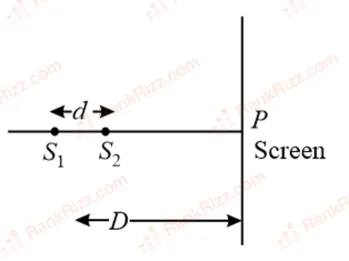
semi-circles
concentric circles
points
straight lines
The anode voltage of a photocell is kept fixed. The wavelength of the light falling on the cathode is gradually changed. The plate current I of the photocell varies as follows :
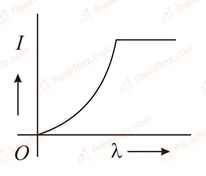
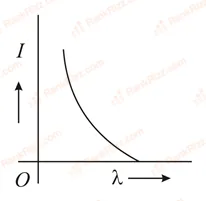
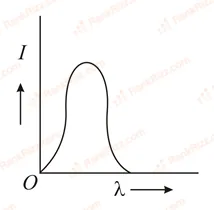
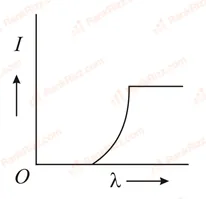
In a hydrogen like atom electron makes transition from an energy level with quantum number n to another with quantum number (n - 1). If n >> 1, the frequency of radiation emitted is proportional to :
A diode detector is used to detect an amplitude modulated wave of 60% modulation by using a condenser of capacity 250 pico farad in parallel with a load resistance of 100 kilo ohm. Find the maximum modulated frequency which could be detected by it.
5.31 MHz
5.31 kHz
10.62 MHz
10.62 kHz
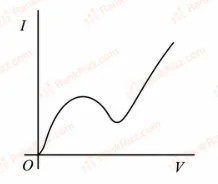
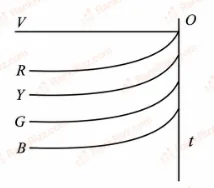
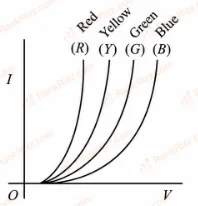
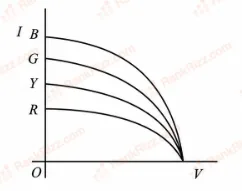
The I-V characteristics of an LED is: