Q1Dimensional analysis: deriving and checking relations
The dimensions of angular momentum, latent heat and capacitance are, respectively.
- A
, ,
- B
, ,
- C
, ,
- D
, ,
All 90 questions of JEE Main 22 Apr 2013, Online, in the order they were asked, one subject to a page. Pick an answer on any question to check it against the key. Free to read, nothing to download.
Questions
90
Physics · Chemistry · Maths
Answer key
89
questions with a checked key
Price
Free
no sign-up
The dimensions of angular momentum, latent heat and capacitance are, respectively.
, ,
, ,
, ,
, ,
A ball projected from ground at an angle of 45° just clears a wall in front. If point of projection is 4 m from the foot of wall and ball strikes the ground at a distance of 6 m on the other side of the wall, the height of the wall is :
4.4 m
2.4 m
3.6 m
1.6 m
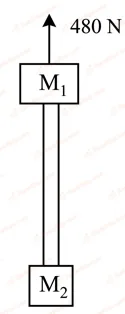
Two blocks of mass kg and kg are connected by a metal rod of mass 8 kg. The system is pulled vertically up by applying a force of 480 N as shown. The tension at the mid-point of the rod is:
144 N
96 N
240 N
192 N
A body starts from rest on a long inclined plane of slope 45°. The coefficient of friction between the body and the plane varies as , where x is distance travelled down the plane. The body will have maximum speed (for m/s) when =
9.8 m
27 m
12 m
3.33 m
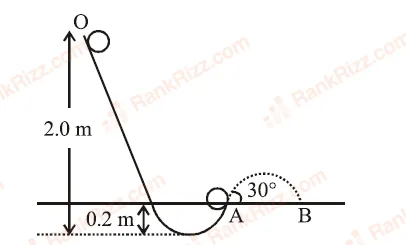
A tennis ball (treated as hollow spherical shell) starting from O rolls down a hill. At point A, the ball becomes air borne leaving at an angle of 30° with the horizontal. The ball strikes the ground at B. What is the value of the distance AB? (Moment of inertia of a spherical shell of mass m and radius R about its diameter = )
1.87 m
2.08 m
1.57 m
1.77 m
The change in the value of acceleration of earth towards sun, when the moon comes from the position of solar eclipse to the position on the other side of earth in line with sun is: (mass of the moon = kg, radius of the moon's orbit = m).
m/s
m/s
m/s
m/s
A uniform wire (Young's modulus Nm) is subjected to longitudinal tensile stress of Nm. If the overall volume change in the wire is 0.02%, the fractional decrease in the radius of the wire is close to:
Air of density 1.2 kg m is blowing across the horizontal wings of an aeroplane in such a way that its speeds above and below the wings are 150 ms and 100 ms, respectively. The pressure difference between the upper and lower sides of the wings, is :
60 Nm
180 Nm
7500 Nm
12500 Nm
Given that 1 g of water in liquid phase has volume 1 cm and in vapour phase 1671 cm at atmospheric pressure and the latent heat of vaporization of water is 2256 J/g; the change in the internal energy in joules for 1 g of water at 373 K when it changes from liquid phase to vapour phase at the same temperature is :
2256
167
2089
1
An ideal gas at atmospheric pressure is adiabatically compressed so that its density becomes 32 times of its initial value. If the final pressure of gas is 128 atmospheres, the value of '' of the gas is :
1.5
1.4
1.3
1.6
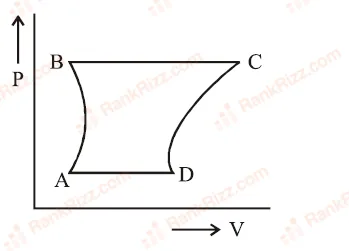
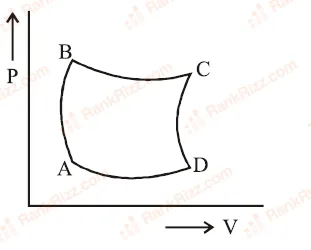
A certain amount of gas is taken through a cyclic process (A B C D A) that has two isobars, one isochore and one isothermal. The cycle can be represented on a P - V indicator diagram as :
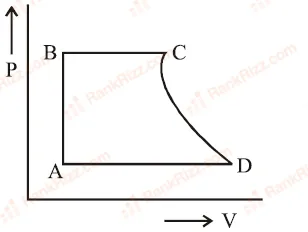
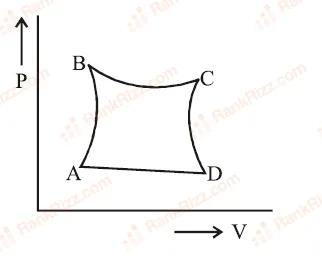
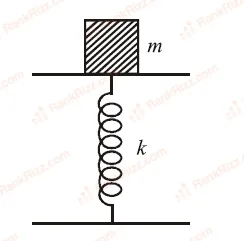
A mass kg is put on a flat pan attached to a vertical spring fixed on the ground. The mass of the spring and the pan is negligible. When pressed slightly and released, the mass executes simple harmonic motion. The spring constant is 500 N/m. What is the amplitude A of the motion, so that the mass m tends to get detached from the pan? (Take m/s). The spring is stiff enough so that it does not get distorted during the motion.
A 2.0 cm
A = 2.0 cm
A < 2.0 cm
A = 1.5 cm
A and B are two sources generating sound waves. A listener is situated at C. The frequency of the source at A is 500 Hz. A, now, moves towards C with a speed 4 m/s. The number of beats heard at C is 6. When A moves away from C with speed 4 m/s, the number of beats heard at C is 18. The speed of sound is 340 m/s. The frequency of the source at B is :

500 Hz
506 Hz
512 Hz
494 Hz
A point charge of magnitude is fixed at (0, 0, 0). An isolated uncharged spherical conductor, is fixed with its center at (4, 0, 0). The potential and the induced electric field at the centre of the sphere is :
V and V/m
0 V and 0 V/m
V and V/m
V and 0 V/m
Two small equal point charges of magnitude are suspended from a common point on the ceiling by insulating mass less strings of equal lengths. They come to equilibrium with each string making angle from the vertical. If the mass of each charge is , then the electrostatic potential at the centre of line joining them will be .
To establish an instantaneous current of 2 A through a 1F capacitor; the potential difference across the capacitor plates should be changed at the rate of:
V/s
V/s
V/s
V/s
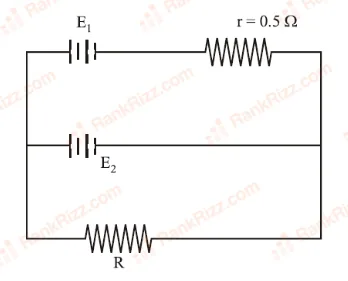
A dc source of emf V and internal resistance , a storage battery of emf V and an external resistance R are connected as shown in figure. For what value of R no current will pass through the battery?
5.5
3.5
4.5
2.5
To find the resistance of a galvanometer by the half deflection method, the following circuit is used with resistances , and . The deflection in the galvanometer is d. With , the deflection changed to . The galvanometer resistance is approximately:
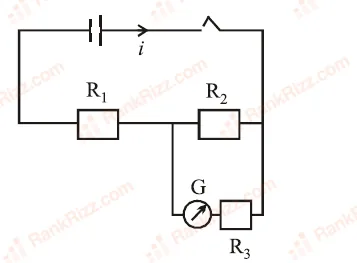
107
137
107/2
77
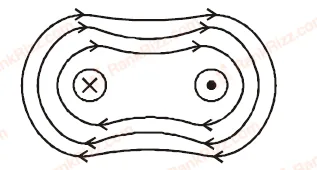
Choose the correct sketch of the magnetic field lines of a circular current loop shown by the dot and the cross .
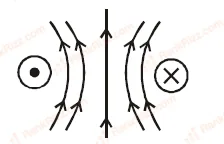
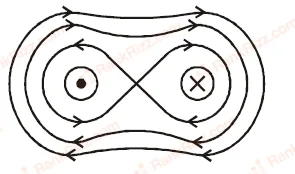
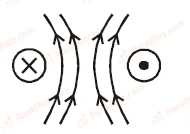
A current is flowing in a straight conductor of length . The magnetic induction at a point on its axis at a distance from its centre will be :
Zero
An LCR circuit as shown in the figure is connected to a voltage source whose frequency can be varied. The frequency, at which the voltage across the resistor is maximum, is :
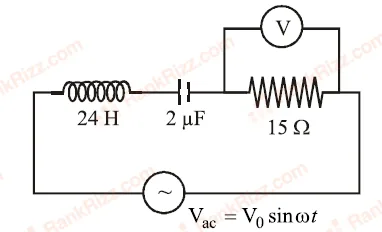
902 Hz
143 Hz
23 Hz
345 Hz
In a series L - C - R circuit, Farad, Henry and Ohm, when a constant D.C. voltage E is applied to the circuit, the capacitor acquires a charge C. The D.C. source is replaced by a sinusoidal voltage source in which the peak voltage is equal to the constant D.C. voltage E. At resonance the peak value of the charge acquired by the capacitor will be :
C
C
C
C
A plane electromagnetic wave in a non-magnetic dielectric medium is given by with distance being in meter and time in seconds. The dielectric constant of the medium is :
2.4
5.8
8.2
4.8
The focal length of the objective and the eyepiece of a telescope are 50 cm and 5 cm respectively. If the telescope is focussed for distinct vision on a scale distant 2 m from its objective, then its magnifying power will be :
-4
-8
+8
-2
The image of an illuminated square is obtained on a screen with the help of a converging lens. The distance of the square from the lens is 40 cm. The area of the image is 9 times that of the square. The focal length of the lens is :
36 cm
27 cm
60 cm
30 cm
This question has Statement-1 and Statement-2. Of the four choices given after the Statements, choose the one that best describes the two Statements.
Statement-1: Short wave transmission is achieved due to the total internal reflection of the e-m wave from an appropriate height in the ionosphere.
Statement-2: Refractive index of a plasma is independent of the frequency of e-m waves.
Statement-1 is true, Statement-2 is false.
Statement-1 is false, Statement-2 is true.
Statement-1 is true, Statement-2 is true but Statement-2 is not the correct explanation of statement-1.
Statement-1 is true, Statement-2 is true and Statement-2 is the correct explanation of Statement-1.
This question has Statement-1 and Statement-2. Of the four choices given after the Statements, choose the one that best describes the two Statements.
Statement-1: In Young's double slit experiment, the number of fringes observed in the field of view is small with longer wavelength of light and is large with shorter wavelength of light.
Statement-2: In the double slit experiment the fringe width depends directly on the wavelength of light.
Statement-1 is true, Statement-2 is true and the Statement-2 is correct explanation of the Statement-1.
Statement-1 is false and the Statement-2 is true.
Statement-1 is true Statement-2 is true and the Statement-2 is not correct explanation of the Statement-1.
Statement-1 is true and the Statement-2 is false.
Orbits of a particle moving in a circle are such that the perimeter of the orbit equals an integer number of de-Broglie wavelengths of the particle. For a charged particle moving in a plane perpendicular to a magnetic field, the radius of the orbital will therefore be proportional to :
The half-life of a radioactive element A is the same as the mean-life of another radioactive element B. Initially both substances have the same number of atoms, then :
A and B decay at the same rate always.
A and B decay at the same rate initially.
A will decay at a faster rate than B.
B will decay at a faster rate than A.
Figure shows a circuit in which three identical diodes are used. Each diode has forward resistance of 20 and infinite backward resistance. Resistors . Battery voltage is 6 V. The current through is :
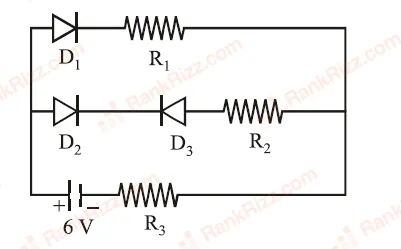
50 mA
100 mA
60 mA
25 mA