All 90 questions of JEE Main 23 Apr 2013, Online, in the order they were asked, one subject to a page. Pick an answer on any question to check it against the key. Free to read, nothing to download.
Questions
90
Physics · Chemistry · Maths
Answer key
88
questions with a checked key
Price
Free
no sign-up
Physics
Q1Dimensional analysis: deriving and checking relations
If the time period t of the oscillation of a drop of liquid of density d, radius r, vibrating under surface tension s is given by the formula t=r2bscda/2. It is observed that the time period is directly proportional to sd. The value of b should therefore be :
A 70 kg man leaps vertically into the air from a crouching position. To take the leap the man pushes the ground with a constant force F to raise himself. The center of gravity rises by 0.5 m before he leaps. After the leap the c.g. rises by another 1 m. The maximum power delivered by the muscles is : (Take g = 10 ms−2)
Q3Motion of centre of mass, momentum conservation and explosions
A boy of mass 20 kg is standing on a 80 kg free to move long cart. There is negligible friction between cart and ground. Initially, the boy is standing 25 m from a wall. If he walks 10 m on the cart towards the wall, then the final distance of the boy from the wall will be
Q4Motion of centre of mass, momentum conservation and explosions
A projectile of mass M is fired so that the horizontal range is 4 km. At the highest point the projectile explodes in two parts of masses M/4 and 3M/4 respectively and the heavier part starts falling down vertically with zero initial speed. The horizontal range (distance from point of firing) of the lighter part is :
A particle of mass 2 kg is moving such that at time t, its position, in meter, is given by r(t)=5i^−2t2j^. The angular momentum of the particle at t=2s about the origin in kgm−2 s−1 is :
Q6Dynamics of horizontal circular motion: conical pendulum, rotating drums
A body of mass 'm' is tied to one end of a spring and whirled round in a horizontal plane with a constant angular velocity. The elongation in the spring is 1 cm. If the angular velocity is doubled, the elongation in the spring is 5 cm. The original length of the spring is :
A copper wire of length 1.0 m and a steel wire of length 0.5 m having equal cross-sectional areas are joined end to end. The composite wire is stretched by a certain load which stretches the copper wire by 1 mm. If the Young's modulii of copper and steel are respectively 1.0×10¹¹ Nm−2 and 2.0×10¹¹ Nm−2, the total extension of the composite wire is :
Wax is coated on the inner wall of a capillary tube and the tube is then dipped in water. Then, compared to the unwaxed capillary, the angle of contact θ and the height h upto which water rises change. These changes are :
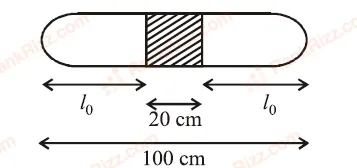
A thin tube sealed at both ends is 100 cm long. It lies horizontally, the middle 20 cm containing mercury and two equal ends containing air at standard atmospheric pressure. If the tube is now turned to a vertical position, by what amount will the mercury be displaced? (Given : cross-section of the tube can be assumed to be uniform)
The ratio of the coefficient of volume expansion of a glass container to that of a viscous liquid kept inside the container is 1 : 4. What fraction of the inner volume of the container should the liquid occupy so that the volume of the remaining vacant space will be same at all temperatures?
500 g of water and 100 g of ice at 0°C are in a calorimeter whose water equivalent is 40 g. 10 g of steam at 100°C is added to it. Then water in the calorimeter is : (Latent heat of ice = 80 cal/g, Latent heat of steam = 540 cal/g)
Q12Molar specific heats of gases, Mayer's relation and gas mixtures
This question has Statement-1 and Statement-2. Of the four choices given after the Statements, choose the one that best describes the two Statements. Statement 1: The internal energy of a perfect gas is entirely kinetic and depends only on absolute temperature of the gas and not on its pressure or volume. Statement 2: A perfect gas is heated keeping pressure constant and later at constant volume. For the same amount of heat the temperature of the gas at constant pressure is lower than that at constant volume.
A
Statement-1 is true, Statement-2 is true and Statement-2 is the correct explanation of Statement-1.
B
Statement-1 is true, Statement-2 is false.
C
Statement-1 is true, Statement-2 is true but Statement-2 is not the correct explanation of Statement-1.
Bob of a simple pendulum of length l is made of iron. The pendulum is oscillating over a horizontal coil carrying direct current. If the time period of the pendulum is T then :
A
T<2πgl and damping is smaller than in air alone.
B
T=2πgl and damping is larger than in air alone.
C
T>2πgl and damping is smaller than in air alone.
A sonometer wire of length 114 cm is fixed at both the ends. Where should the two bridges be placed so as to divide the wire into three segments whose fundamental frequencies are in the ratio 1 : 3 : 4?
Q16Electric field of continuous charge distributions
A liquid drop having 6 excess electrons is kept stationary under a uniform electric field of 25.5 kVm−1. The density of liquid is 1.26×10³ kg m−3. The radius of the drop is (neglect buoyancy).
A parallel plate capacitor of area 60 cm2 and separation 3 mm is charged initially to 90μC. If the medium between the plate gets slightly conducting and the plate loses the charge initially at the rate of 2.5×10⁻⁸ C/s, then what is the magnetic field between the plates?
Q19Magnetic dipole moment of current loops and torque on loops
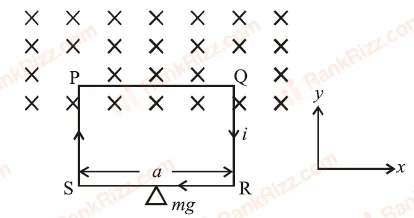
A rectangular loop of wire, supporting a mass m, hangs with one end in a uniform magnetic field B pointing out of the plane of the paper. A clockwise current is set up such that i>mg/Ba, where a is the width of the loop. Then :
A
The weight rises due to a vertical force caused by the magnetic field and work is done on the system.
B
The weight do not rise due to vertical for caused by the magnetic field and work is done on the system.
C
The weight rises due to a vertical force caused by the magnetic field but no work is done on the system.
D
The weight rises due to a vertical force caused by the magnetic field and work is extracted from the magnetic field.
Q20Motion of charged particles in a magnetic field
A particle of charge 16×10−16 C moving with velocity 10 ms−1 along x-axis enters a region where magnetic field of induction B is along the y-axis and an electric field of magnitude 104 Vm−1 is along the negative z-axis. If the charged particle continues moving along x-axis, the magnitude of B is :
Q23Optical instruments: microscopes and telescopes
This question has Statement-1 and Statement-2. Of the four choices given after the Statements, choose the one that best describes the two Statements. Statement 1: Very large size telescopes are reflecting telescopes instead of refracting telescopes. Statement 2: It is easier to provide mechanical support to large size mirrors than large size lenses.
A
Statement-1 is true and Statement-2 is false.
B
Statement-1 is false and Statement-2 is true.
C
Statements-1 and statement-2 are true and Statement-2 is correct explanation for statement-1.
D
Statements-1 and statement-2 are true and Statement-2 is not the correct explanation for statement-1.
Q24Refraction at plane surfaces, Snell's law and apparent depth
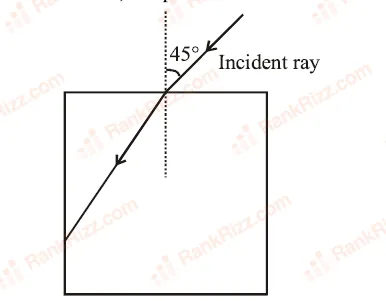
A light ray falls on a square glass slab as shown in the diagram. The index of refraction of the glass, if total internal reflection is to occur at the vertical face, is equal to :
Q25Young's double slit experiment: fringe width and intensity
n identical waves each of intensity I0 interfere with each other. The ratio of maximum intensities if the interference is (i) coherent and (ii) incoherent is :
Electrons are accelerated through a potential difference V and protons are accelerated through a potential difference 4 V. The de-Broglie wavelengths are λe and λp for electrons and protons respectively. The ratio of λpλe is given by: (given me is mass of electron and mp is mass of proton).
In the Bohr's model of hydrogen-like atom the force between the nucleus and the electron is modified as F=4πϵ0e2(r21+r3β), where β is a constant. For this atom, the radius of the nth orbit in terms of the Bohr radius (a0=mπe2ϵ0h2) is :