RankRizz

JEE Advanced 2024 Paper 2 Question Paper

All 51 questions of JEE Advanced 2024 Paper 2, in the order they were asked, one subject to a page. Pick an answer on any question to check it against the key. Free to read, nothing to download.

Questions

51

Physics · Chemistry · Maths

Answer key

45

questions with a checked key

Price

Free

no sign-up

Physics

Q1Motional emf in moving rods and loops

A region in the form of an equilateral triangle (in x−yx - y plane) of height LL has a uniform magnetic field B⃗\vec{B} pointing in the +z+z-direction. A conducting loop PQRPQR, in the form of an equilateral triangle of the same height LL, is placed in the x−yx - y plane with its vertex PP at x=0x = 0 in the orientation shown in the figure. At t=0t = 0, the loop starts entering the region of the magnetic field with a uniform velocity v⃗\vec{v} along the +x+x-direction. The plane of the loop and its orientation remain unchanged throughout its motion.
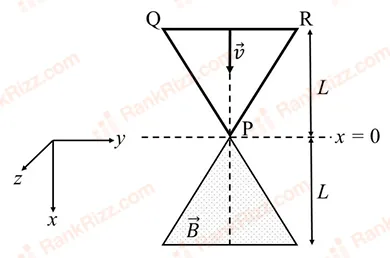
Figure for JEE Advanced 2024 Physics question on Motional emf in moving rods and loops

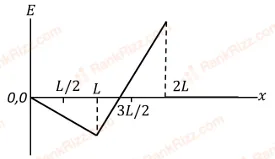
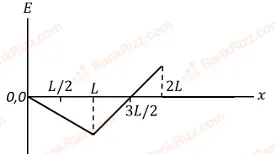
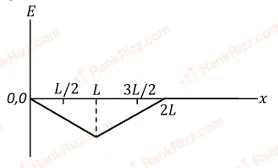
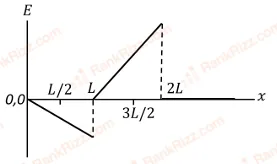
Which of the following graph best depicts the variation of the induced emf (EE) in the loop as a function of the distance (xx) starting from x=0x = 0?

  1. A
    Figure for JEE Advanced 2024 Physics question on Motional emf in moving rods and loops
  2. B
    Figure for JEE Advanced 2024 Physics question on Motional emf in moving rods and loops
  3. C
    Figure for JEE Advanced 2024 Physics question on Motional emf in moving rods and loops
  4. D
    Figure for JEE Advanced 2024 Physics question on Motional emf in moving rods and loops
Q2Escape speed

A particle of mass mm is under the influence of the gravitational field of a body of mass MM (≫m\gg m). The particle is moving in a circular orbit of radius r0r_0 with time period T0T_0 around the mass MM. Then, the particle is subjected to an additional central force, corresponding to the potential energy Vc(r)=mα/r3V_c(r) = m\alpha / r^3, where α\alpha is a positive constant of suitable dimensions and rr is the distance from the center of the orbit. If the particle moves in the same circular orbit of radius r0r_0 in the combined gravitational potential due to MM and Vc(r)V_c(r), but with a new time period T1T_1, then (T12−T02)/T12(T_1^2 - T_0^2)/T_1^2 is given by

[GG is the gravitational constant.]

  1. A

    3αGMr02\dfrac{3\alpha}{GMr_0^2}

  2. B

    α2GMr02\dfrac{\alpha}{2GMr_0^2}

  3. C

    αGMr02\dfrac{\alpha}{GMr_0^2}

  4. D

    2αGMr02\dfrac{2\alpha}{GMr_0^2}

Q3Photons: energy, momentum and radiation pressure

A metal target with atomic number Z=46Z = 46 is bombarded with a high energy electron beam. The emission of X-rays from the target is analyzed. The ratio rr of the wavelengths of the KαK_\alpha-line and the cut-off is found to be r=2r = 2. If the same electron beam bombards another metal target with Z=41Z = 41, the value of rr will be

  1. A

    2.53

  2. B

    1.27

  3. C

    2.24

  4. D

    1.58

Q4Magnetic dipole moment of current loops and torque on loops

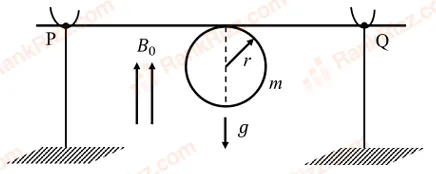
A thin stiff insulated metal wire is bent into a circular loop with its two ends extending tangentially from the same point of the loop. The wire loop has mass mm and radius rr and it is in a uniform vertical magnetic field B0B_0, as shown in the figure. Initially, it hangs vertically downwards, because of acceleration due to gravity gg, on two conducting supports at PP and QQ. When a current II is passed through the loop, the loop turns about the line PQPQ by an angle θ\theta given by: ( equilibrium position)

Figure for JEE Advanced 2024 Physics question on Magnetic dipole moment of current loops and torque on loops
  1. A

    tan⁡θ=πrIB0/(mg)\tan \theta = \pi r I B_0 / (mg)

  2. B

    tan⁡θ=2πrIB0/(mg)\tan \theta = 2\pi r I B_0 / (mg)

  3. C

    tan⁡θ=πrIB0/(2mg)\tan \theta = \pi r I B_0 / (2mg)

  4. D

    tan⁡θ=mg/(πrIB0)\tan \theta = mg / (\pi r I B_0)

Q5Electric dipole and dipole in external field

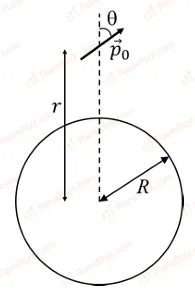
A small electric dipole p⃗0\vec{p}_0, having a moment of inertia II about its center, is kept at a distance rr from the center of a spherical shell of radius RR. The surface charge density σ\sigma is uniformly distributed on the spherical shell. The dipole is initially oriented at a small angle θ\theta as shown in the figure. While staying at a distance rr, the dipole is free to rotate about its center.

Figure for JEE Advanced 2024 Physics question on Electric dipole and dipole in external field

If released from rest, then which of the following statement(s) is (are) correct?

[ε0\varepsilon_0 is the permittivity of free space.]

  1. A

    The dipole will undergo small oscillations at any finite value of rr.

  2. B

    The dipole will undergo small oscillations at any finite value of r>Rr > R.

  3. C

    The dipole will undergo small oscillations with an angular frequency of 2σp0ε0I\sqrt{\dfrac{2\sigma p_0}{\varepsilon_0 I}} at r=2Rr = 2R

  4. D

    The dipole will undergo small oscillations with an angular frequency of σp0100ε0I\sqrt{\dfrac{\sigma p_0}{100 \varepsilon_0 I}} at r=10Rr = 10R

Q6Archimedes' principle and floatation

A table tennis ball has radius (3/2)×10−2(3/2) \times 10^{-2} m and mass (22/7)×10−3(22/7) \times 10^{-3} kg. It is slowly pushed down into a swimming pool to a depth of d=0.7d = 0.7 m below the water surface and then released from rest. It emerges from the water surface at speed vv, without getting wet, and rises up to a height HH. Which of the following option(s) is (are) correct?

[Given: π=22/7\pi = 22/7, g=10g = 10 ms−2^{-2}, density of water =1×103= 1 \times 10^3 kg m−3^{-3}, viscosity of water =1×10−3= 1 \times 10^{-3} Pa·s.]

  1. A

    The work done in pushing the ball to the depth dd is 0.077 J.

  2. B

    If we neglect the viscous force in water, then the speed v=7v = 7 m/s.

  3. C

    If we neglect the viscous force in water, then the height H=1.4H = 1.4 m.

  4. D

    The ratio of the magnitudes of the net force excluding the viscous force to the maximum viscous force in water is 500/9.

Q7Motion of charged particles in a magnetic field

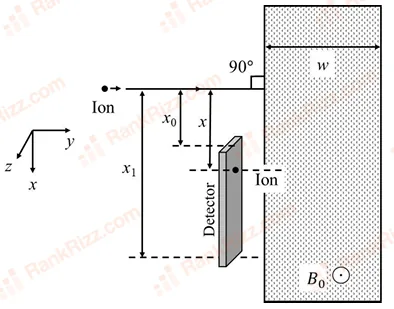
A positive, singly ionized atom of mass number AMA_M is accelerated from rest by the voltage 192 V. Thereafter, it enters a rectangular region of width ww with magnetic field B⃗0=0.1k^\vec{B}_0 = 0.1\hat{k} Tesla, as shown in the figure. The ion finally hits a detector at the distance xx below its starting trajectory.

[Given: Mass of neutron/proton =(5/3)×10−27= (5/3) \times 10^{-27} kg, charge of the electron =1.6×10−19= 1.6 \times 10^{-19} C.]

Figure for JEE Advanced 2024 Physics question on Motion of charged particles in a magnetic field

Which of the following option(s) is(are) correct?

  1. A

    The value of xx for H+H^+ ion is 4 cm.

  2. B

    The value of xx for an ion with AM=144A_M = 144 is 48 cm.

  3. C

    For detecting ions with 1≤AM≤1961 \leq A_M \leq 196, the minimum height (x1−x0)(x_1 - x_0) of the detector is 55 cm.

  4. D

    The minimum width ww of the region of the magnetic field for detecting ions with AM=196A_M = 196 is 56 cm.

Q8Errors in measurement and significant figures

The dimensions of a cone are measured using a scale with a least count of 2 mm. The diameter of the base and the height are both measured to be 20.0 cm. The maximum percentage error in the determination of the volume is ______.

Q9Projectile motion from level ground

A ball is thrown from the location (x0,y0)=(0,0)(x_0, y_0) = (0,0) of a horizontal playground with an initial speed v0v_0 at an angle θ0\theta_0 from the +x+x-direction. The ball is to be hit by a stone, which is thrown at the same time from the location (x1,y1)=(L,0)(x_1, y_1) = (L, 0). The stone is thrown at an angle (180∘−θ1)(180^\circ - \theta_1) from the +x+x-direction with a suitable initial speed. For a fixed v0v_0, when (θ0,θ1)=(45∘,45∘)(\theta_0, \theta_1) = (45^\circ, 45^\circ), the stone hits the ball after time T1T_1, and when (θ0,θ1)=(60∘,30∘)(\theta_0, \theta_1) = (60^\circ, 30^\circ), it hits the ball after time T2T_2. In such a case, (T1/T2)2(T_1/T_2)^2 is ________.

Q10Electric flux and Gauss's law

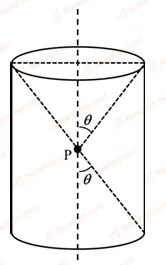
A charge is kept at the central point PP of a cylindrical region. The two edges subtend a half-angle θ\theta at PP, as shown in the figure. When θ=30∘\theta = 30^\circ, then the electric flux through the curved surface of the cylinder is Φ\Phi. If θ=60∘\theta = 60^\circ, then the electric flux through the curved surface becomes Φ/n\Phi / \sqrt{n}, where the value of nn is ________.

Figure for JEE Advanced 2024 Physics question on Electric flux and Gauss's law
Q11Refraction at plane surfaces, Snell's law and apparent depth

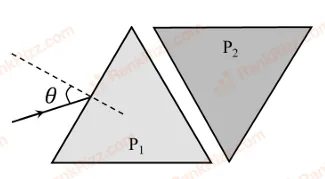
Two equilateral-triangular prisms P1P_1 and P2P_2 are kept with their sides parallel to each other, in vacuum, as shown in the figure. A light ray enters prism P1P_1 at an angle of incidence θ\theta such that the outgoing ray undergoes minimum deviation in prism P2P_2. If the respective refractive indices of P1P_1 and P2P_2 are 32\sqrt{\dfrac{3}{2}} and 3\sqrt{3}, θ=sin⁡−1[32sin⁡(πβ)]\theta = \sin^{-1}\left[\sqrt{\dfrac{3}{2}} \sin\left(\dfrac{\pi}{\beta}\right)\right], where the value of β\beta is ________.

Figure for JEE Advanced 2024 Physics question on Refraction at plane surfaces, Snell's law and apparent depth
Q12Relation between field and potential, equipotential surfaces

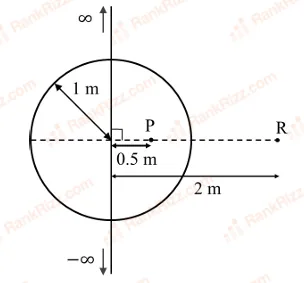
An infinitely long thin wire, having a uniform charge density per unit length of 5 nCm5\ \frac{nC}{m} , is passing through a spherical shell of radius 1 m1\ m, as shown in the figure. A 10 nC10\ nC charge is distributed uniformly over the spherical shell. If the configuration of the charges remains static, the magnitude of the potential difference between points PP and RR, in Volt, is ________.

[Given: In SI units 14πε0=9×10⁹\dfrac{1}{4\pi \varepsilon_0} = 9 \times 10^9, ln 2 = 0.7. Ignore the area pierced by the wire.]

Figure for JEE Advanced 2024 Physics question on Relation between field and potential, equipotential surfaces
Q13Multi-step processes and gas-piston-spring systems

A spherical soap bubble inside an air chamber at pressure P0=105P_0 = 10^5 Pa has a certain radius so that the excess pressure inside the bubble is ΔP=144\Delta P = 144 Pa. Now, the chamber pressure is reduced to 8P0/278P_0/27 so that the bubble radius and its excess pressure change. In this process, all the temperatures remain unchanged. Assume air to be an ideal gas and the excess pressure ΔP\Delta P in both the cases to be much smaller than the chamber pressure. The new excess pressure ΔP\Delta P in Pa is ________.

Q14Young's double slit experiment: fringe width and intensity

The 8th bright fringe above the point OO oscillates with time between two extreme positions. The separation between these two extreme positions, in micrometer (μ\mum), is ________.

Q15Young's double slit experiment: fringe width and intensity

The maximum speed in μ\mu m/s at which the 8th8^{th} bright fringe will move is ________.

Q16Spring-block oscillations

If the collision occurs at time t0=0t_0 = 0, the value of vcm/(aω)v_{cm}/(a\omega) will be ________.

Q17Spring-block oscillations

If the collision occurs at time t0=π/(2ω)t_0 = \pi/(2\omega), then the value of 4b2/a24b^2/a^2 will be ________.

NEXT IN THIS PAPER →Chemistry, Q18 onwards