RankRizz

JEE Advanced 2022 Paper 1 Question Paper

All 54 questions of JEE Advanced 2022 Paper 1, in the order they were asked, one subject to a page. Pick an answer on any question to check it against the key. Free to read, nothing to download.

Questions

54

Physics · Chemistry · Maths

Answer key

33

questions with a checked key

Price

Free

no sign-up

Physics

Q1Escape speed

Two spherical stars AA and BB have densities ρA\rho_A and ρB\rho_B, respectively. AA and BB have the same radius, and their masses MAM_A and MBM_B are related by MB=2MAM_B = 2M_A. Due to an interaction process, star AA loses some of its mass, so that its radius is halved, while its spherical shape is retained, and its density remains ρA\rho_A. The entire mass lost by AA is deposited as a thick spherical shell on BB with the density of the shell being ρA\rho_A. If vAv_A and vBv_B are the escape velocities from AA and BB after the interaction process, the ratio vBvA=10n151/3\frac{v_B}{v_A} = \sqrt{\frac{10n}{15^{1/3}}}. The value of nn is ______.

Q2Nuclear size, mass defect and binding energy

The minimum kinetic energy needed by an alpha particle to cause the nuclear reaction 716N+24He→11H+819O^{16}_7N + ^4_2He \to ^1_1H + ^{19}_8O in a laboratory frame is nn (in MeV). Assume that 716N^{16}_7N is at rest in the laboratory frame. The masses of 716N^{16}_7N, 24He^4_2He, 11H^1_1H and 819O^{19}_8O can be taken to be 16.006 uu, 4.003 uu, 1.008 uu and 19.003 uu, respectively, where 1 uu = 930 MeVc−2c^{-2}. The value of nn is ______.

Q3Capacitors in DC circuits (steady state)

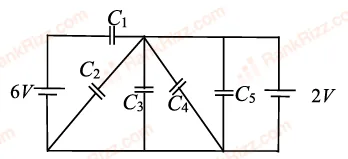
In the following circuit C1=12C_1 = 12 μF\mu F, C2=C3=4C_2 = C_3 = 4 μF\mu F and C4=C5=2C_4 = C_5 = 2 μF\mu F. The charge stored in C3C_3 is ______ μC\mu C.

Figure for JEE Advanced 2022 Physics question on Capacitors in DC circuits (steady state)
Q4Thin lenses: lens formula, lens maker's formula and power

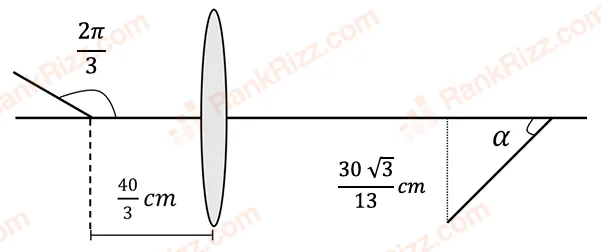
A rod of length 2 cm makes an angle 2π3\frac{2\pi}{3} rad with the principal axis of a thin convex lens. The lens has a focal length of 10 cm and is placed at a distance of 403\frac{40}{3} cm from the object as shown in the figure. The height of the image is 30313\frac{30\sqrt{3}}{13} cm and the angle made by it with respect to the principal axis is α\alpha rad. The value of α\alpha is πn\frac{\pi}{n} rad, where nn is ______.

Figure for JEE Advanced 2022 Physics question on Thin lenses: lens formula, lens maker's formula and power
Q5Rolling with friction, slipping and impulsive forces

At time t=0t = 0, a disk of radius 1 m starts to roll without slipping on a horizontal plane with an angular acceleration of α=23\alpha = \frac{2}{3} rad s−2^{-2}. A small stone is stuck to the disk. At t=0t = 0, it is at the contact point of the disk and the plane. Later, at time t=πt = \sqrt{\pi} s, the stone detaches itself and flies off tangentially from the disk. The maximum height (in m) reached by the stone measured from the plane is 12+x10\frac{1}{2} + \frac{x}{10}. The value of xx is ______. [Take g=10g = 10 m s−2^{-2}.]

Q6Rolling with friction, slipping and impulsive forces

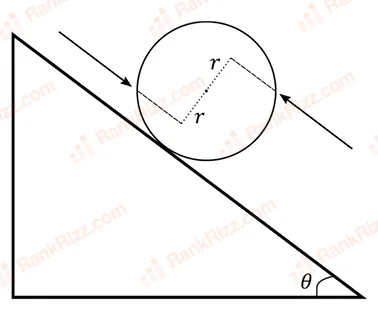
A solid sphere of mass 1 kg and radius 1 m rolls without slipping on a fixed inclined plane with an angle of inclination θ=30∘\theta = 30^\circ from the horizontal. Two forces of magnitude 1 N each, parallel to the incline, act on the sphere, both at distance r=0.5r = 0.5 m from the center of the sphere, as shown in the figure. The acceleration of the sphere down the plane is ______ ms−2^{-2}. (Take g=10g = 10 m s−2^{-2}.)

Figure for JEE Advanced 2022 Physics question on Rolling with friction, slipping and impulsive forces
Q7Self inductance and energy stored in inductors

Consider an LC circuit, with inductance L=0.1L = 0.1 H and capacitance C=10−3C = 10^{-3} F, kept on a plane. The area of the circuit is 1 m2^2. It is placed in a constant magnetic field of strength B0B_0 which is perpendicular to the plane of the circuit. At time t=0t = 0, the magnetic field strength starts increasing linearly as B=B0+βtB = B_0 + \beta t with β=0.04\beta = 0.04 Ts−1^{-1}. The maximum magnitude of the current in the circuit is ______ mA.

Q8Projectile motion from level ground

A projectile is fired from horizontal ground with speed vv and projection angle θ\theta. When the acceleration due to gravity is gg, the range of the projectile is dd. If at the highest point in its trajectory, the projectile enters a different region where the effective acceleration due to gravity is g′=g0.81g' = \frac{g}{0.81}, then the new range is d′=ndd' = nd. The value of nn is ______.

Q9Capacitors with dielectrics

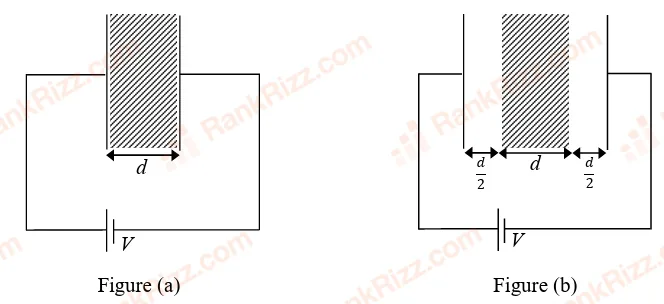
A medium having dielectric constant K>1K > 1 fills the space between the plates of a parallel plate capacitor. The plates have large area, and the distance between them is dd. The capacitor is connected to a battery of voltage VV, as shown in Figure (a). Now, both the plates are moved by a distance of d2\frac{d}{2} from their original positions, as shown in Figure (b).

Figure for JEE Advanced 2022 Physics question on Capacitors with dielectrics

In the process of going from the configuration depicted in Figure (a) to that in Figure (b), which of the following statement(s) is(are) correct?

  1. A

    The electric field inside the dielectric material is reduced by a factor of 2K2K.

  2. B

    The capacitance is decreased by a factor of 1K+1\frac{1}{K+1}.

  3. C

    The voltage between the capacitor plates is increased by a factor of (K+1)(K + 1).

  4. D

    The work done in the process DOES NOT depend on the presence of the dielectric material.

Q10Kirchhoff's laws and circuit analysis

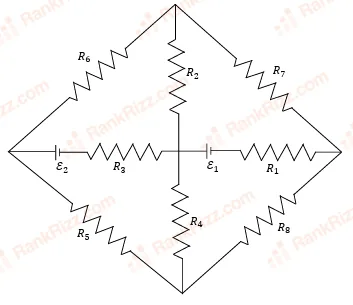
The figure shows a circuit having eight resistances of 1 Ω\Omega each, labelled R1R_1 to R8R_8, and two ideal batteries with voltages ε1=12\varepsilon_1 = 12 V and ε2=6\varepsilon_2 = 6 V.

Figure for JEE Advanced 2022 Physics question on Kirchhoff's laws and circuit analysis

Which of the following statement(s) is(are) correct?

  1. A

    The magnitude of current flowing through R1R_1 is 7.2 A.

  2. B

    The magnitude of current flowing through R2R_2 is 1.2 A.

  3. C

    The magnitude of current flowing through R3R_3 is 4.8 A.

  4. D

    The magnitude of current flowing through R5R_5 is 2.4 A.

Q11Equation of continuity and Bernoulli's theorem

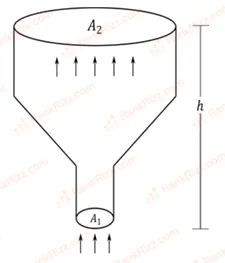
An ideal gas of density ρ=0.2\rho = 0.2 kg m−3^{-3} enters a chimney of height h at the rate of α=0.8\alpha = 0.8 kg s−1^{-1} from its lower end, and escapes through the upper end as shown in the figure. The cross-sectional area of the lower end is A1=0.1A_1 = 0.1 m2^2 and the upper end is A2=0.4A_2 = 0.4 m2^2. The pressure and the temperature of the gas at the lower end are 600 Pa and 300 K, respectively, while its temperature at the upper end is 150 K. The chimney is heat insulated so that the gas undergoes adiabatic expansion. Take g=10g = 10 ms−2^{-2} and the ratio of specific heats of the gas γ=2\gamma = 2. Ignore atmospheric pressure.

Figure for JEE Advanced 2022 Physics question on Equation of continuity and Bernoulli's theorem

Which of the following statement(s) is(are) correct?

  1. A

    The pressure of the gas at the upper end of the chimney is 300 Pa.

  2. B

    The velocity of the gas at the lower end of the chimney is 40 ms−1^{-1} and at the upper end is 20 ms−1^{-1}.

  3. C

    The height of the chimney is 590 m.

  4. D

    The density of the gas at the upper end is 0.05 kg m−3^{-3}.

Q12Spherical mirrors: mirror formula and magnification

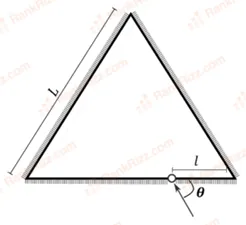
Three plane mirrors form an equilateral triangle with each side of length LL. There is a small hole at a distance l>0l > 0 from one of the corners as shown in the figure. A ray of light is passed through the hole at an angle θ\theta and can only come out through the same hole. The cross section of the mirror configuration and the ray of light lie on the same plane.

Figure for JEE Advanced 2022 Physics question on Spherical mirrors: mirror formula and magnification

Which of the following statement(s) is(are) correct?

  1. A

    The ray of light will come out for θ=30∘\theta = 30^\circ, for 0<l<L0 < l < L.

  2. B

    There is an angle for l=L2l = \frac{L}{2} at which the ray of light will come out after two reflections.

  3. C

    The ray of light will NEVER come out for θ=60∘\theta = 60^\circ, and l=L3l = \frac{L}{3}.

  4. D

    The ray of light will come out for θ=60∘\theta = 60^\circ, and 0<l<L20 < l < \frac{L}{2} after six reflections.

Q13Electric flux and Gauss's law

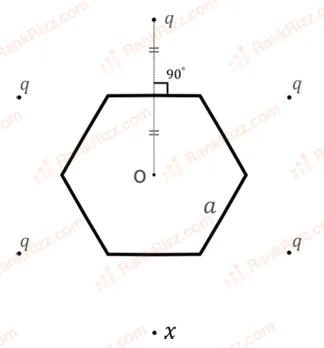
Six charges are placed around a regular hexagon of side length aa as shown in the figure. Five of them have charge qq, and the remaining one has charge xx. The perpendicular from each charge to the nearest hexagon side passes through the center O of the hexagon and is bisected by the side.

Figure for JEE Advanced 2022 Physics question on Electric flux and Gauss's law

Which of the following statement(s) is(are) correct in SI units?

  1. A

    When x=qx = q, the magnitude of the electric field at O is zero.

  2. B

    When x=−qx = -q, the magnitude of the electric field at O is q6πϵ0a2\frac{q}{6\pi \epsilon_0 a^2}.

  3. C

    When x=2qx = 2q, the potential at O is 7q43πϵ0a\frac{7q}{4\sqrt{3}\pi \epsilon_0 a}.

  4. D

    When x=−3qx = -3q, the potential at O is 3q43πϵ0a\frac{3q}{4\sqrt{3}\pi \epsilon_0 a}.

Q14Radioactivity: decay law, half-life and decay modes

The binding energy of nucleons in a nucleus can be affected by the pairwise Coulomb repulsion. Assume that all nucleons are uniformly distributed inside the nucleus. Let the binding energy of a proton be EbpE_b^p and the binding energy of a neutron be EbnE_b^n in the nucleus.

Which of the following statement(s) is(are) correct?

  1. A

    Ebp−EbnE_b^p - E_b^n is proportional to Z(Z−1)Z(Z-1) where ZZ is the atomic number of the nucleus.

  2. B

    Ebp−EbnE_b^p - E_b^n is proportional to A−1/3A^{-1/3} where AA is the mass number of the nucleus.

  3. C

    Ebp−EbnE_b^p - E_b^n is positive.

  4. D

    EbpE_b^p increases if the nucleus undergoes a beta decay emitting a positron.

Q15Force on current-carrying conductors and between parallel wires

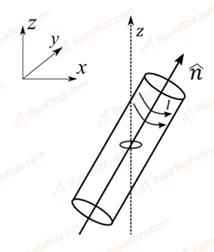
A small circular loop of area AA and resistance RR is fixed on a horizontal xyxy-plane with the center of the loop always on the axis n^\hat{n} of a long solenoid. The solenoid has mm turns per unit length and carries current II counterclockwise as shown in the figure. The magnetic field due to the solenoid is in n^\hat{n} direction. List-I gives time dependences of n^\hat{n} in terms of a constant angular frequency ω\omega.

List-II gives the torques experienced by the circular loop at time t=π6ωt = \frac{\pi}{6\omega}. Let α=A2μ02m2I2ω2R\alpha = \frac{A^2 \mu_0^2 m^2 I^2 \omega}{2R}.

Figure for JEE Advanced 2022 Physics question on Force on current-carrying conductors and between parallel wires
List-IList-II
(I) 12(sin⁡ωt j^+cos⁡ωt k^)\frac{1}{\sqrt{2}}(\sin \omega t \, \hat{j} + \cos \omega t \, \hat{k})(P) 0
(II) 12(sin⁡ωt i^+cos⁡ωt j^)\frac{1}{\sqrt{2}}(\sin \omega t \, \hat{i} + \cos \omega t \, \hat{j})(Q) −α4i^-\frac{\alpha}{4}\hat{i}
(III) 12(sin⁡ωt i^+cos⁡ωt k^)\frac{1}{\sqrt{2}}(\sin \omega t \, \hat{i} + \cos \omega t \, \hat{k})(R) 3α4i^\frac{3\alpha}{4}\hat{i}
(IV) 12(cos⁡ωt i^+sin⁡ωt k^)\frac{1}{\sqrt{2}}(\cos \omega t \, \hat{i} + \sin \omega t \, \hat{k})(S) α4j^\frac{\alpha}{4}\hat{j}
Which one of the following options is correct?(T) −3α4i^-\frac{3\alpha}{4}\hat{i}
  1. A

    I →\to Q, II →\to P, III →\to S, IV →\to T

  2. B

    I →\to S, II →\to T, III →\to Q, IV →\to P

  3. C

    I →\to Q, II →\to P, III →\to S, IV →\to R

  4. D

    I →\to T, II →\to Q, III →\to P, IV →\to R

Q16Kinematics in two dimensions using position vectors

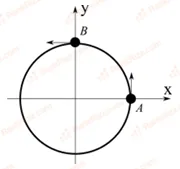
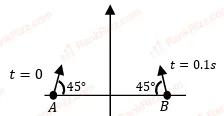
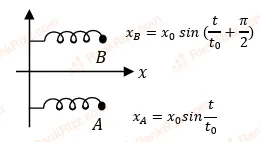
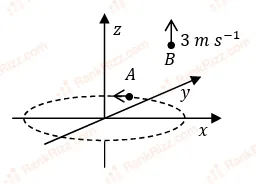
List I describes four systems, each with two particles AA and BB in relative motion as shown in figure. List II gives possible magnitudes of their relative velocities (in ms−1^{-1}) at time t=π3t = \frac{\pi}{3} s.

List-IList-II
(I) AA and BB are moving on a horizontal circle of radius 1 m with uniform angular speed ω=1\omega = 1 rad s−1^{-1}. The initial angular positions of AA and BB at time t=0t = 0 are θ=0\theta = 0 and θ=π2\theta = \frac{\pi}{2} respectively.
Figure for JEE Advanced 2022 Physics question on Kinematics in two dimensions using position vectors
(P) 3+12\frac{\sqrt{3}+1}{2}
(II) Projectiles AA and BB are fired (in the same vertical plane) at t=0t = 0 and t=0.1t = 0.1 s respectively, with the same speed v=5π2v = \frac{5\pi}{\sqrt{2}} m s−1^{-1} and at 45∘45^\circ from the horizontal plane. The initial separation between AA and BB is large enough so that they do not collide. (g=10g = 10 m s−2^{-2}).
Figure for JEE Advanced 2022 Physics question on Kinematics in two dimensions using position vectors
(Q) 3−12\frac{\sqrt{3}-1}{\sqrt{2}}
(III) Two harmonic oscillators AA and BB moving in the xx direction according to xA=x0sin⁡tt0x_A = x_0 \sin \frac{t}{t_0} and xB=x0sin⁡(tt0+π2)x_B = x_0 \sin\left(\frac{t}{t_0} + \frac{\pi}{2}\right) respectively, starting from t=0t = 0. Take x0=1x_0 = 1 m, t0=1t_0 = 1 s. Figure for JEE Advanced 2022 Physics question on Kinematics in two dimensions using position vectors(R) 10\sqrt{10}
(IV) Particle AA is rotating in a horizontal circular path of radius 1 m on the xyxy plane, with constant angular speed ω=1\omega = 1 rad s−1^{-1}. Particle BB is moving up at a constant speed 3 m s−1^{-1} in the vertical direction as shown in the figure. (Ignore gravity.) Figure for JEE Advanced 2022 Physics question on Kinematics in two dimensions using position vectors(S) 2\sqrt{2}
(T) 25π2+1\sqrt{25\pi^2 + 1}

Which one of the following options is correct?

  1. A

    I →\to R, II →\to T, III →\to P, IV →\to S

  2. B

    I →\to S, II →\to P, III →\to Q, IV →\to R

  3. C

    I →\to S, II →\to T, III →\to P, IV →\to R

  4. D

    I →\to T, II →\to P, III →\to R, IV →\to S

Q17Multi-step processes and gas-piston-spring systems

List I describes thermodynamic processes in four different systems. List II gives the magnitudes (either exactly or as a close approximation) of possible changes in the internal energy of the system due to the process.

List-IList-II
(I) 10−310^{-3} kg of water at 100°C is converted to steam at the same temperature, at a pressure of 10510^5 Pa. The volume of the system changes from 10−610^{-6} m3^3 to 10−310^{-3} m3^3 in the process. Latent heat of water = 2250 kJ/kg.(P) 2 kJ
(II) 0.2 moles of a rigid diatomic ideal gas with volume VV at temperature 500 K undergoes an isobaric expansion to volume 3V. Assume R=8.0R = 8.0 J mol−1^{-1} K−1^{-1}.(Q) 7 kJ
(III) One mole of a monatomic ideal gas is compressed adiabatically from volume V=13V = \frac{1}{3} m3^3 and pressure 2 kPa to volume V8\frac{V}{8}.(R) 4 kJ
(IV) Three moles of a diatomic ideal gas whose molecules can vibrate, is given 9 kJ of heat and undergoes isobaric expansion.(S) 5 kJ
(T) 3 kJ

Which one of the following options is correct?

  1. A

    I →\to T, II →\to R, III →\to S, IV →\to Q

  2. B

    I →\to S, II →\to P, III →\to T, IV →\to P

  3. C

    I →\to P, II →\to R, III →\to T, IV →\to Q

  4. D

    I →\to Q, II →\to R, III →\to S, IV →\to T

Q18Thin lenses: lens formula, lens maker's formula and power

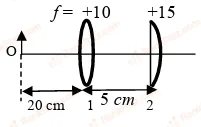
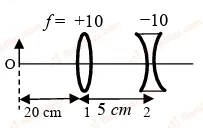
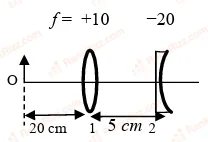
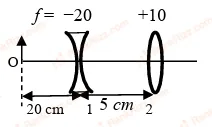
List I contains four combinations of two lenses (1 and 2) whose focal lengths (in cm) are indicated in the figures. In all cases, the object is placed 20 cm from the first lens on the left, and the distance between the two lenses is 5 cm. List II contains the positions of the final images.

List-IList-II
(I) Figure for JEE Advanced 2022 Physics question on Thin lenses: lens formula, lens maker's formula and power(P) Final image is formed at 7.5 cm on the right side of lens 2.
(II)Figure for JEE Advanced 2022 Physics question on Thin lenses: lens formula, lens maker's formula and power(Q) Final image is formed at 60.0 cm on the right side of lens 2.
(III) Figure for JEE Advanced 2022 Physics question on Thin lenses: lens formula, lens maker's formula and power(R) Final image is formed at 30.0 cm on the left side of lens 2.
(IV) Figure for JEE Advanced 2022 Physics question on Thin lenses: lens formula, lens maker's formula and power(S) Final image is formed at 6.0 cm on the right side of lens 2.
(T) Final image is formed at 30.0 cm on the right side of lens 2.

Which one of the following options is correct?

  1. A

    I →\to P, II →\to R, III →\to Q, IV →\to T

  2. B

    I →\to Q, II →\to P, III →\to T, IV →\to S

  3. C

    I →\to P, II →\to T, III →\to R, IV →\to Q

  4. D

    I →\to T, II →\to S, III →\to Q, IV →\to R

NEXT IN THIS PAPER →Chemistry, Q19 onwards