RankRizz

JEE Advanced 2022 Paper 2 Question Paper

All 54 questions of JEE Advanced 2022 Paper 2, in the order they were asked, one subject to a page. Pick an answer on any question to check it against the key. Free to read, nothing to download.

Questions

54

Physics · Chemistry · Maths

Answer key

53

questions with a checked key

Price

Free

no sign-up

Physics

Q1Superposition of SHMs

A particle of mass 1 kg is subjected to a force which depends on the position as F⃗=−k(xi^+yj^)\vec{F} = -k(x\hat{i} + y\hat{j}) kg m s−2^{-2} with k=1k = 1 kg s−2^{-2}. At time t=0t = 0, the particle's position r⃗=(12i^+2j^)\vec{r} = \left(\dfrac{1}{\sqrt{2}}\hat{i} + \sqrt{2}\hat{j}\right) m and its velocity v⃗=(−2i^+2j^+2πk^)\vec{v} = \left(-\sqrt{2}\hat{i} + \sqrt{2}\hat{j} + \dfrac{2}{\pi}\hat{k}\right) m s−1^{-1}. Let vxv_x and vyv_y denote the x and y components of the particle's velocity, respectively. Ignore gravity. When z=0.5z = 0.5 m, the value of (xvy−yvx)(x v_y - y v_x) is _______ m2^2 s−1^{-1}.

Q2Radioactivity: decay law, half-life and decay modes

In a radioactive decay chain reaction, 90230^{230}_{90}Th nucleus decays into 84214^{214}_{84}Po nucleus. The ratio of the number of α\alpha to number of β−\beta^- particles emitted in this process is _______.

Q3Potentiometer

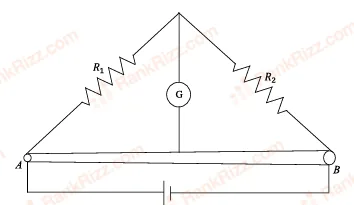
Two resistances R1=XR_1 = X Ω\Omega and R2=1R_2 = 1 Ω\Omega are connected to a wire AB of uniform resistivity, as shown in the figure. The radius of the wire varies linearly along its axis from 0.2 mm at A to 1 mm at B. A galvanometer (G) connected to the center of the wire, 50 cm from each end along its axis, shows zero deflection when A and B are connected to a battery. The value of X is _______.

Figure for JEE Advanced 2022 Physics question on Potentiometer
Q4Dimensional analysis: deriving and checking relations

In a particular system of units, a physical quantity can be expressed in terms of the electric charge ee, electron mass mem_e, Planck's constant hh, and Coulomb's constant k=14πϵ0k = \dfrac{1}{4\pi \epsilon_0}, where ϵ0\epsilon_0 is the permittivity of vacuum. In terms of these physical constants, the dimension of the magnetic field is [B] = [e]α^\alpha [me_e]β^\beta [h]γ^\gamma [k]δ^\delta. The value of α+β+γ+δ\alpha + \beta + \gamma + \delta is _______.

Q5Refraction at plane surfaces, Snell's law and apparent depth

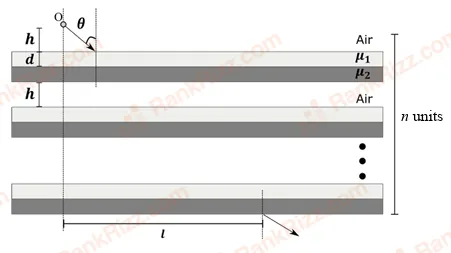
Consider a configuration of nn identical units, each consisting of three layers. The first layer is a column of air of height h=13h = \dfrac{1}{3} cm, and the second and third layers are of equal thickness d=3−12d = \dfrac{\sqrt{3}-1}{2} cm, and refractive indices μ1=32\mu_1 = \dfrac{\sqrt{3}}{2} and μ2=3\mu_2 = \sqrt{3}, respectively. A light source O is placed on the top of the first unit as shown in the figure. A Ray of light from OO is incident on the second layer of the first unit at an angle of θ=60∘\theta = 60^\circ to the normal. For a specific value of nn, the ray of light emerges from the bottom of the configuration at a distance l=83l = \dfrac{8}{\sqrt{3}} cm, as shown in the figure. The value of nn is _______.

Figure for JEE Advanced 2022 Physics question on Refraction at plane surfaces, Snell's law and apparent depth
Q6Electric flux and Gauss's law

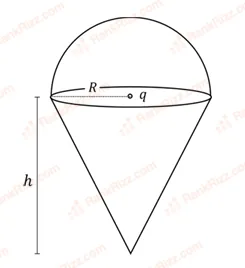
A charge qq is surrounded by a closed surface consisting of an inverted cone of height hh and base radius RR, and a hemisphere of radius RR as shown in the figure. The electric flux through the conical surface is nq6ϵ0\dfrac{nq}{6\epsilon_0} (in SI units). The value of nn is _______.

Figure for JEE Advanced 2022 Physics question on Electric flux and Gauss's law
Q7Spring-block oscillations

On a frictionless horizontal plane, a bob of mass m=0.1m = 0.1 kg is attached to a spring with natural length l0=0.1l_0 = 0.1 m. The spring constant is k1=0.009k_1 = 0.009 N m−1^{-1} when the length of the spring l>l0l > l_0 and is k2=0.016k_2 = 0.016 N m−1^{-1} when l<l0l < l_0. Initially the bob is released from l=0.15l = 0.15 m. Assume that Hooke's law remains valid throughout the motion. If the time period of the full oscillation is T = (nπ)(n\pi) s, then the integer closest to nn is _______.

Q8Spherical mirrors: mirror formula and magnification

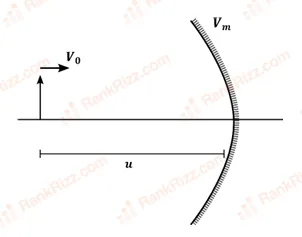
An object and a concave mirror of focal length f=10f = 10 cm both move along the principal axis of the mirror with constant speeds. The object moves with speed V0=15V_0 = 15 cm s−1^{-1} towards the mirror with respect to a laboratory frame. The distance between the object and the mirror at a given moment is denoted by uu. When u=30u = 30 cm, the speed of the mirror VmV_m is such that the image is instantaneously at rest with respect to the laboratory frame, and the object forms a real image. The magnitude of VmV_m is _______ cm s−1^{-1}.

Figure for JEE Advanced 2022 Physics question on Spherical mirrors: mirror formula and magnification
Q9Electric flux and Gauss's law

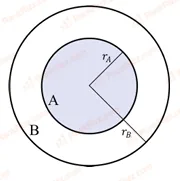
In the figure, the inner (shaded) region A represents a sphere of radius rA=1r_A = 1, within which the electrostatic charge density varies with the radial distance rr from the center as ρA=kr\rho_A = kr, where kk is positive. In the spherical shell B of outer radius rBr_B, the electrostatic charge density varies as ρB=2kr\rho_B = \dfrac{2k}{r}. Assume that dimensions are taken care of. All physical quantities are in their SI units.

Figure for JEE Advanced 2022 Physics question on Electric flux and Gauss's law

Which of the following statement(s) is(are) correct?

  1. A

    If rB=32r_B = \sqrt{\dfrac{3}{2}}, then the electric field is zero everywhere outside B.

  2. B

    If rB=32r_B = \dfrac{3}{2}, then the electric potential just outside B is kϵ0\dfrac{k}{\epsilon_0}.

  3. C

    If rB=2r_B = 2, then the total charge of the configuration is 15πk15\pi k.

  4. D

    If rB=52r_B = \dfrac{5}{2}, then the magnitude of the electric field just outside B is 13πkϵ0\dfrac{13\pi k}{\epsilon_0}.

Q10Electric power and heating effect of current

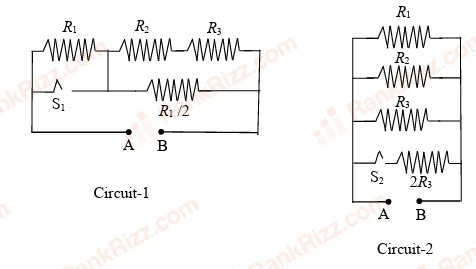
In Circuit-1 and Circuit-2 shown in the figures, R1=1R_1 = 1 Ω\Omega, R2=2R_2 = 2 Ω\Omega and R3=3R_3 = 3 Ω\Omega. P1P_1 and P2P_2 are the power dissipations in Circuit-1 and Circuit-2 when the switches S1S_1 and S2S_2 are in open conditions, respectively.

Q1Q_1 and Q2Q_2 are the power dissipations in Circuit-1 and Circuit-2 when the switches S1S_1 and S2S_2 are in closed conditions, respectively.

Figure for JEE Advanced 2022 Physics question on Electric power and heating effect of current

Which of the following statement(s) is(are) correct?

  1. A

    When a voltage source of 6 V is connected across A and B in both circuits, P1<P2P_1 < P_2.

  2. B

    When a constant current source of 2 Amp is connected across A and B in both circuits, P1>P2P_1 > P_2.

  3. C

    When a voltage source of 6 V is connected across A and B in Circuit-1, Q1>P1Q_1 > P_1.

  4. D

    When a constant current source of 2 Amp is connected across A and B in both circuits, Q2<Q1Q_2 < Q_1.

Q11Angle of contact and capillary rise

A bubble has surface tension SS. The ideal gas inside the bubble has ratio of specific heats γ=53\gamma = \dfrac{5}{3}. The bubble is exposed to the atmosphere and it always retains its spherical shape. When the atmospheric pressure is Pa1P_{a1}, the radius of the bubble is found to be r1r_1 and the temperature of the enclosed gas is T1T_1. When the atmospheric pressure is Pa2P_{a2}, the radius of the bubble and the temperature of the enclosed gas are r2r_2 and T2T_2, respectively.

Which of the following statement(s) is(are) correct?

  1. A

    If the surface of the bubble is a perfect heat insulator, then (r1r2)5=Pa2+2Sr2Pa1+2Sr1\left(\dfrac{r_1}{r_2}\right)^5 = \dfrac{P_{a2} + \dfrac{2S}{r_2}}{P_{a1} + \dfrac{2S}{r_1}}.

  2. B

    If the surface of the bubble is a perfect heat insulator, then the total internal energy of the bubble including its surface energy does not change with the external atmospheric pressure.

  3. C

    If the surface of the bubble is a perfect heat conductor and the change in atmospheric temperature is negligible, then (r1r2)3=Pa2+4Sr2Pa1+4Sr1\left(\dfrac{r_1}{r_2}\right)^3 = \dfrac{P_{a2} + \dfrac{4S}{r_2}}{P_{a1} + \dfrac{4S}{r_1}}.

  4. D

    If the surface of the bubble is a perfect heat insulator, then (T2T1)5/2=Pa2+4Sr2Pa1+4Sr1\left(\dfrac{T_2}{T_1}\right)^{5/2} = \dfrac{P_{a2} + \dfrac{4S}{r_2}}{P_{a1} + \dfrac{4S}{r_1}}.

Q12Relation between field and potential, equipotential surfaces

A disk of radius RR with uniform positive charge density σ\sigma is placed on the xyxy plane with its center at the origin. The Coulomb potential along the z-axis is

V(z)=σ2ϵ0(R2+z2−z)V(z) = \dfrac{\sigma}{2\epsilon_0}\left(\sqrt{R^2 + z^2} - z\right)

A particle of positive charge qq is placed initially at rest at a point on the z axis with z=z0z = z_0 and z0>0z_0 > 0. In addition to the Coulomb force, the particle experiences a vertical force F⃗=−ck^\vec{F} = -c\hat{k} with c>0c > 0. Let β=2cϵ0qσ\beta = \dfrac{2c\epsilon_0}{q\sigma}. Which of the following statement(s) is(are) correct?

  1. A

    For β=14\beta = \dfrac{1}{4} and z0=257Rz_0 = \dfrac{25}{7}R, the particle reaches the origin.

  2. B

    For β=14\beta = \dfrac{1}{4} and z0=37Rz_0 = \dfrac{3}{7}R, the particle reaches the origin.

  3. C

    For β=14\beta = \dfrac{1}{4} and z0=R3z_0 = \dfrac{R}{\sqrt{3}}, the particle returns back to z=z0z = z_0.

  4. D

    For β>1\beta > 1 and z0>0z_0 > 0, the particle always reaches the origin.

Q13Young's double slit experiment: fringe width and intensity

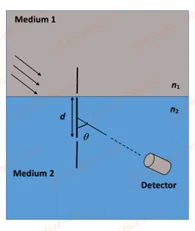
A double slit setup is shown in the figure. One of the slits is in medium 2 of refractive index n2n_2. The other slit is at the interface of this medium with another medium 1 of refractive index n1n_1 (≠n2\neq n_2). The line joining the slits is perpendicular to the interface and the distance between the slits is dd. The slit widths are much smaller than dd. A monochromatic parallel beam of light is incident on the slits from medium 1. A detector is placed in medium 2 at a large distance from the slits, and at an angle θ\theta from the line joining them, so that θ\theta equals the angle of refraction of the beam. Consider two approximately parallel rays from the slits received by the detector.

Figure for JEE Advanced 2022 Physics question on Young's double slit experiment: fringe width and intensity

Which of the following statement(s) is (are) correct?

  1. A

    The phase difference between the two rays is independent of dd.

  2. B

    The two rays interfere constructively at the detector.

  3. C

    The phase difference between the two rays depends on n1n_1 but is independent of n2n_2.

  4. D

    The phase difference between the two rays vanishes only for certain values of dd and the angle of incidence of the beam, with θ\theta being the corresponding angle of refraction.

Q14Multi-step processes and gas-piston-spring systems

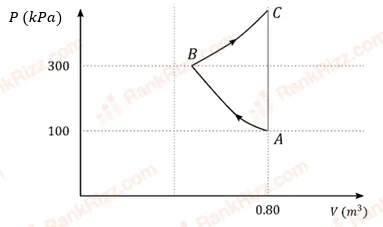
In the given P-V diagram, a monoatomic gas (γ=53)\left(\gamma = \dfrac{5}{3}\right) is first compressed adiabatically from state A to state B. Then it expands isothermally from state B to state C. [Given: (13)0.6=0.5\left(\dfrac{1}{3}\right)^{0.6} = 0.5, ln 2 ≃\simeq 0.7].

Figure for JEE Advanced 2022 Physics question on Multi-step processes and gas-piston-spring systems

Which of the following statement(s) is(are) incorrect?

  1. A

    The magnitude of the total work done in the process A →\to B →\to C is 144 kJ.

  2. B

    The magnitude of the work done in the process B →\to C is 84 kJ.

  3. C

    The magnitude of the work done in the process A →\to B is 60 kJ.

  4. D

    The magnitude of the work done in the process C →\to A is zero.

Q15Rolling with friction, slipping and impulsive forces

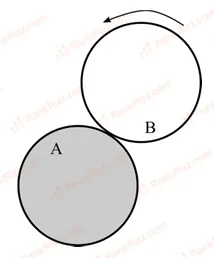
A flat surface of a thin uniform disk A of radius R is glued to a horizontal table. Another thin uniform disk B of mass M and with the same radius R rolls without slipping on the circumference of A, as shown in the figure. A flat surface of B also lies on the plane of the table. The center of mass of B has fixed angular speed ω\omega about the vertical axis passing through the center of A. The angular momentum of B is nMωR2nM\omega R^2 with respect to the center of A. Which of the following is the value of nn?

Figure for JEE Advanced 2022 Physics question on Rolling with friction, slipping and impulsive forces
  1. A

    2

  2. B

    5

  3. C

    72\dfrac{7}{2}

  4. D

    92\dfrac{9}{2}

Q16Photoelectric effect and Einstein's equation

When light of a given wavelength is incident on a metallic surface, the minimum potential needed to stop the emitted photoelectrons is 6.0 V. This potential drops to 0.6 V if another source with wavelength four times that of the first one and intensity half of the first one is used. What are the wavelength of the first source and the work function of the metal, respectively?

[Take hce=1.24×10⁻⁶\dfrac{hc}{e} = 1.24 \times 10^{-6} J m C−1^{-1}.]

  1. A

    1.72 ×\times 10−7^{-7} m, 1.20 eV

  2. B

    1.72 ×\times 10−7^{-7} m, 5.60 eV

  3. C

    3.78 ×\times 10−7^{-7} m, 5.60 eV

  4. D

    3.78 ×\times 10−7^{-7} m, 1.20 eV

Q17Screw gauge: pitch, least count and zero error

Area of the cross-section of a wire is measured using a screw gauge. The pitch of the main scale is 0.5 mm. The circular scale has 100 divisions and for one full rotation of the circular scale, the main scale shifts by two divisions. The measured readings are listed below.

Measurement conditionMain scale readingCircular scale reading
Two arms of gauge touching each other without wire0 division4 division
Attempt-1: With wire4 divisions20 divisions
Attempt-2: With wire4 divisions16 divisions

What are the diameter and cross-sectional area of the wire measured using the screw gauge?

  1. A

    2.22 ±\pm 0.02 mm, π\pi(1.23 ±\pm 0.02) mm2^2

  2. B

    2.22 ±\pm 0.01 mm, π\pi(1.23 ±\pm 0.01) mm2^2

  3. C

    2.14 ±\pm 0.02 mm, π\pi(1.14 ±\pm 0.02) mm2^2

  4. D

    2.14 ±\pm 0.01 mm, π\pi(1.14 ±\pm 0.01) mm2^2

Q18Biot-Savart law: straight wires and moving charges

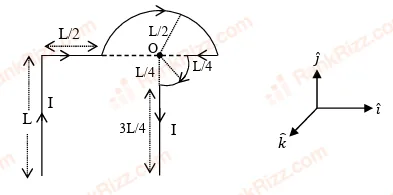
Which one of the following options represents the magnetic field B⃗\vec{B} at O due to the current flowing in the given wire segments lying on the xyxy plane?

Figure for JEE Advanced 2022 Physics question on Biot-Savart law: straight wires and moving charges
  1. A

    B⃗=−μ0IL(32+142π)k^\vec{B} = \dfrac{-\mu_0 I}{L}\left(\dfrac{3}{2} + \dfrac{1}{4\sqrt{2}\pi}\right)\hat{k}

  2. B

    B⃗=−μ0IL(32+122π)k^\vec{B} = -\dfrac{\mu_0 I}{L}\left(\dfrac{3}{2} + \dfrac{1}{2\sqrt{2}\pi}\right)\hat{k}

  3. C

    B⃗=−μ0IL(1+142π)k^\vec{B} = \dfrac{-\mu_0 I}{L}\left(1 + \dfrac{1}{4\sqrt{2}\pi}\right)\hat{k}

  4. D

    B⃗=−μ0IL(1+14π)k^\vec{B} = \dfrac{-\mu_0 I}{L}\left(1 + \dfrac{1}{4\pi}\right)\hat{k}

NEXT IN THIS PAPER →Chemistry, Q19 onwards