JEE Advanced 2022 Physics question — Kinematics in two dimensions using position vectors
List I describes four systems, each with two particles and in relative motion as shown in figure. List II gives possible magnitudes of their relative velocities (in ms) at time s.
| List-I | List-II |
|---|---|
(I) and are moving on a horizontal circle of radius 1 m with uniform angular speed rad s. The initial angular positions of and at time are and respectively.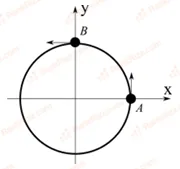 | (P) |
(II) Projectiles and are fired (in the same vertical plane) at and s respectively, with the same speed m s and at from the horizontal plane. The initial separation between and is large enough so that they do not collide. ( m s).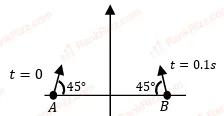 | (Q) |
(III) Two harmonic oscillators and moving in the direction according to and respectively, starting from . Take m, s.
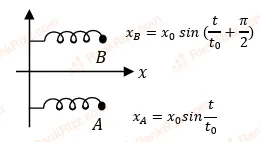 | (R) |
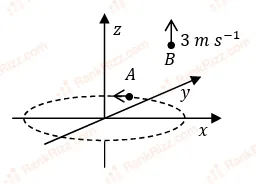
(IV) Particle is rotating in a horizontal circular path of radius 1 m on the plane, with constant angular speed rad s. Particle is moving up at a constant speed 3 m s in the vertical direction as shown in the figure. (Ignore gravity.)
 | (S) |
| (T) |
Which one of the following options is correct?
SOLUTION
Case I (List-I I)
The two particles move on the same horizontal circle of radius with the same angular speed .
At any instant their linear speeds are identical: .
Their angular positions differ by at all times, so the angle between the two velocity vectors is also .
For two vectors of equal magnitude with an angle between them, the magnitude of the relative velocity is
.
Putting and ,
.
Thus I S.
Case II (List-I II)
Projectile A is fired at , and projectile B at . Both have initial speed
at an angle to the horizontal, but they move in opposite horizontal directions (shown in the figure).
Horizontal component of each velocity (magnitude) is
,
so A moves with and B with along the -axis.
At the required instant :
Time of flight for A: .
Vertical velocity of A:
.
Time of flight for B: .
Vertical velocity of B:
$
Hence the components of the relative velocity are
Magnitude:
Thus II T.
Case III (List-I III)
The displacements are and (with ).
Velocities:
At :
Relative velocity:
Thus III P.
Case IV (List-I IV)
Particle A moves in the horizontal -plane on a circle of radius 1 m with angular speed , so
(purely horizontal, tangent to the circle).
Particle B moves vertically upward with constant speed along the -axis.
Since the two velocity vectors are mutually perpendicular, the magnitude of the relative velocity is
Thus IV R.
Collecting all four mappings:
I S, II T, III P, IV R.
The option that matches this set is
Option C: I S, II T, III P, IV R.
Topic: Kinematics in two dimensions using position vectors