RankRizz

JEE Advanced 2010 Paper 2: Maths

The 19 Maths questions of JEE Advanced 2010 Paper 2, numbered across the whole paper. Pick an answer on any question to check it against the key. Free to read, nothing to download.

Maths

Q39Products of coefficients and calculus-based sums

For r=0,1,....,10r = 0, 1, ...., 10, let Ar,BrA_r, B_r and CrC_r denote, respectively, the coefficient of xrx^r in the expansions of (1+x)10,(1+x)20(1 + x)^{10}, (1 + x)^{20} and (1+x)30(1 + x)^{30}. Then
∑r=110Ar(B10Br=C10Ar)\sum_{r=1}^{10}A_r(B_{10}B_r = C_{10}A_r) is equal to

  1. A

    B10−C10B_{10} - C_{10}

  2. B

    A10(B102−C10A10)A_{10}\left(B_{10}^{2} - C_{10}A_{10}\right)

  3. C

    0

  4. D

    C10−B10C_{10} - B_{10}

Q40One-one, onto functions and counting functions

Let S = {1, 2, 3, 4}. The total number of unordered pairs of disjoint subsets of S is equal to

  1. A

    25

  2. B

    34

  3. C

    42

  4. D

    41

Q41Leibniz rule for differentiating integrals

Let f be a real-valued function defined on the interval (-1, 1) such that e−xf(x)=2+∫0xt4+1dte^{-x}f(x) = 2 + \int_{0}^{x}\sqrt{t^4 + 1} dt, for all x∈(−1,1)x \in (-1, 1), and let f−1f^{-1} be the inverse function of f. Then (f−1)′(2)(f^{-1})'(2) is equal to

  1. A

    1

  2. B

    13\frac{1}{3}

  3. C

    12\frac{1}{2}

  4. D

    1e\frac{1}{e}

Q42Equation of a plane

If the distance of the point P(1, -2, 1) from the plane x+2y−2z=αx + 2y - 2z = \alpha, where α>0\alpha > 0, is 5, then the foot of the perpendicular from P to the plane is

  1. A

    (83,43,−73)\left(\frac{8}{3}, \frac{4}{3}, -\frac{7}{3}\right)

  2. B

    (43,−43,13)\left(\frac{4}{3}, -\frac{4}{3}, \frac{1}{3}\right)

  3. C

    (13,23,−103)\left(\frac{1}{3}, \frac{2}{3}, -\frac{10}{3}\right)

  4. D

    (23,−13,−52)\left(\frac{2}{3}, -\frac{1}{3}, -\frac{5}{2}\right)

Q43Scalar (dot) product

Two adjacent sides of a parallelogram ABCD are given by
AB→=2i^+10j^+11k^\overrightarrow{AB} = 2\hat{i} + 10\hat{j} + 11\hat{k} and AD→=−i^+2j^+2k^\overrightarrow{AD} = -\hat{i} + 2\hat{j} + 2\hat{k}
The side AD is rotated by an acute angle α\alpha in the plane of the parallelogram so that AD becomes AD'. If AD' makes a right angle with the side AB, then the cosine of the angle α\alpha is given by

  1. A

    89\frac{8}{9}

  2. B

    179\frac{\sqrt{17}}{9}

  3. C

    19\frac{1}{9}

  4. D

    459\frac{4\sqrt{5}}{9}

Q44Bayes' theorem

A signal which can be green or red with probability 45\frac{4}{5} and 15\frac{1}{5} respectively, is received by station A and then transmitted to station B. The probability of each station receiving the signal correctly is 34\frac{3}{4}. If the signal received at station B is green, then the probability that the original signal was green is

  1. A

    35\frac{3}{5}

  2. B

    67\frac{6}{7}

  3. C

    2023\frac{20}{23}

  4. D

    920\frac{9}{20}

Q45Multiple and sub-multiple angle formulas

Two parallel chords of a circle of radius 2 are at a distance 3+1\sqrt{3} + 1 apart. If the chords subtend at the center, angles of πk\frac{\pi}{k} and 2πk\frac{2 \pi}{k}, where k > 0, then the value of [k] is
[Note : [k] denotes the largest integer less then or equal to k]

Q46Half-angle formulas, area and Napier's analogy

Consider a triangle ABC and let a, b and c denote the lengths of the sides opposite to vertices A, B and C respectively. Suppose a = 6, b = 10 and the area of the triangle is 15315\sqrt{3}. If ∠ACB\angle ACB is obtuse andif r denotes the radius of the incircle of the triangle, then r2r^2 is equal to

Q47Optimization word and geometry problems

Let f be a function defined on R (the set of all real numbers) such that
f′(x)=2010(x−2009)(x−2010)2(x−2011)3(x−2012)4f'(x) = 2010(x-2009)(x-2010)^2(x-2011)^3(x-2012)^4, for all x∈Rx \in R.
If g is a function defined on R with values in the interval (0,∞)(0, \infty) such that f(x)=ln⁡(g(x))f(x) = \ln (g(x)), for all x∈Rx \in R,
then the number of points in R at which g has a local maximum is

Q48Sums of natural numbers, squares and cubes

Let a1,a2,a3,....,a11a_1, a_2, a_3, ...., a_{11} be real numbers satisfying
a1=15,27−2a2>0a_1 = 15, 27 - 2a_2 > 0 and ak=2ak−1−ak−2a_k = 2a_{k-1} - a_{k-2}, for k = 3, 4, ...., 11.
If a12+a22+.....+a11211=90\frac{a_{1}^{2} + a_{2}^{2} + ..... + a_{11}^{2}}{11} = 90, then the value of a1+a2+....+a1111\frac{a_1 + a_2 + .... + a_{11}}{11} is equal to

Q49Adjoint and inverse of a matrix

Let k be a positive real number and let
A=[2k−12k2k2k1−2k−2k2k−1]A = \begin{bmatrix}2k-1 & 2\sqrt{k} & 2\sqrt{k} \\2\sqrt{k} & 1 & -2k \\-2\sqrt{k} & 2k & -1 \end{bmatrix} and B=[02k−1k1−2k02k−k−2k0]B = \begin{bmatrix}0 & 2k-1 & \sqrt{k} \\1-2k & 0 & 2\sqrt{k} \\-\sqrt{k} & -2\sqrt{k} & 0 \end{bmatrix}.If det(adjA)+det(adjB)=106det(adj A) + det(adj B) = 10^6, then [k] is equal to
[Note : adj M denotes the adjoint of a square matrix M and [k] denotes the largest integer less than or equal to k].

Q50Monotonicity and intervals of increase/decrease

The real numbers lies in the interval

  1. A

    (−14,0)\left(-\frac{1}{4}, 0\right)

  2. B

    (−11,−34)\left(-11, -\frac{3}{4}\right)

  3. C

    (−34,−12)\left(-\frac{3}{4}, -\frac{1}{2}\right)

  4. D

    (0,14)\left(0, \frac{1}{4}\right)

Q51Area between curves

The area bounded bythe curve y= f(x) and the lines x = 0, y = O and x = t, lies in the interval

  1. A

    (−34,3)\left(-\frac{3}{4}, 3\right)

  2. B

    (2164,1116)\left(\frac{21}{64}, \frac{11}{16}\right)

  3. C

    (9, 10)

  4. D

    (0,2164)\left(0, \frac{21}{64}\right)

Q52Monotonicity and intervals of increase/decrease

The function f′(x)f'(x) is

  1. A

    increasing in (−t,−14)\left(-t, -\frac{1}{4}\right) and decreasing in (−14,t)\left(-\frac{1}{4}, t\right)

  2. B

    decreasing in (−t,−14)\left(-t, -\frac{1}{4}\right) and increasing in (−14,t)\left(-\frac{1}{4}, t\right)

  3. C

    increasing in (-t, t)

  4. D

    decreasing in (-t, t)

Q53Equation of a circle in various forms

The coordinates of A and B are

  1. A

    (3, 0) and (0, 2)

  2. B

    (−85,216115)\left(-\frac{8}{5}, \frac{2\sqrt{161}}{15}\right) and (−95,85)\left(-\frac{9}{5}, \frac{8}{5}\right)

  3. C

    (−85,216115)\left(-\frac{8}{5}, \frac{2\sqrt{161}}{15}\right) and (0, 2)

  4. D

    (3, 0) and (−95,85)\left(-\frac{9}{5}, \frac{8}{5}\right)

Q54Equation of a circle in various forms

The orthocenter of the triangle PAB is

  1. A

    (5,87)\left(5, \frac{8}{7}\right)

  2. B

    (75,258)\left(\frac{7}{5}, \frac{25}{8}\right)

  3. C

    (115,85)\left(\frac{11}{5}, \frac{8}{5}\right)

  4. D

    (825,75)\left(\frac{8}{25}, \frac{7}{5}\right)

Q55Chords, position of a point and locus on ellipse

The equation of the locus of the point whose distances from the point P and the line AB are equal, is

  1. A

    9x2+y2−6xy−54x−62y+241=09x^2 + y^2 - 6xy - 54x - 62y + 241 = 0

  2. B

    x2+9y2+6xy−54x+62y−241=0x^2 + 9y^2 + 6xy - 54x + 62y - 241 = 0

  3. C

    9x2+9y2−6xy−54x−62y−241=09x^2 + 9y^2 - 6xy - 54x - 62y - 241 = 0

  4. D

    x2+y2−2xy+27x+31y−120=0x^2 + y^2 - 2xy + 27x + 31y - 120 = 0

Q56Locus and regions in the Argand plane

Match the statements in Column-I with those in Column-II.
(Note: Here z takes values in the complex plane and Im z and Re z denote, respectively, the imaginary part and the real part of z.]
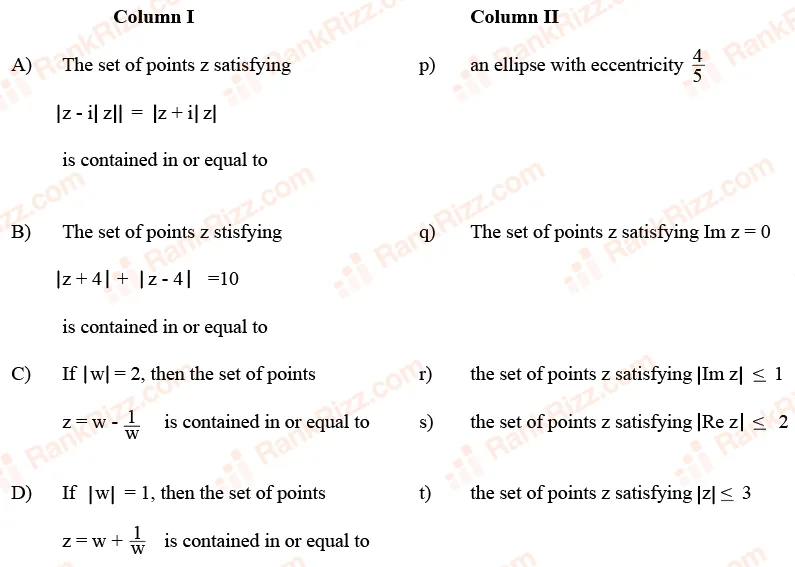
Figure for JEE Advanced 2010 Mathematics question on Locus and regions in the Argand plane
Q57Equation of a circle in various forms

Match the statements in Column-I with the values in Column-II.
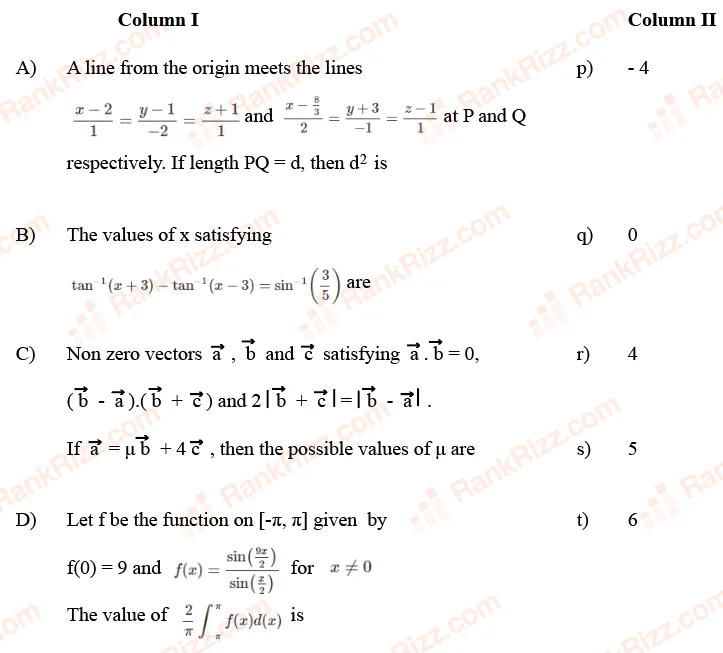
Figure for JEE Advanced 2010 Mathematics question on Equation of a circle in various forms