RankRizz

JEE Advanced 2010 Paper 2 Question Paper

All 57 questions of JEE Advanced 2010 Paper 2, in the order they were asked, one subject to a page. Pick an answer on any question to check it against the key. Free to read, nothing to download.

Questions

57

Physics · Chemistry · Maths

Answer key

57

questions with a checked key

Price

Free

no sign-up

Physics

Q1Vernier calipers: least count and zero error

A Vernier calipers has 1 mm marks on the main scale. It has 20 equal divisions on the Vernier scale which match with 16 main scale divisions. For this Vernier calipers, the least count is

  1. A

    0.02 mm

  2. B

    0.05 mm

  3. C

    0.1 mm

  4. D

    0.2 mm

Q2Superposition, interference and beats

A hollowpipe of length 0.8 mis closed at one end. At its open end a 0.5 mlong uniform string is vibrating in its second harmonic and it resonates with the fundamental frequencyof the pipe. If the tension in the wire is 50 N and the speed of sound is 320 ms−1^{-1}, the massof thestring is

  1. A

    5 grams

  2. B

    10 grams

  3. C

    20 grams

  4. D

    40 grams

Q3Combinations of lenses and mirrors

A biconvex lens of focal length 15 cmis in front of a plane mirror. The distance between the lens and the mirror is 10 cm. A small object is kept at a distance of 30 cm from the lens. The final image is

  1. A

    virtual and at a distance of 16 cm from the mirror

  2. B

    real and at a distance of 16 cm from the mirror

  3. C

    virtual and at a distance of 20 cm from the mirror

  4. D

    real and at a distance of 20 cm from the mirror

Q4Work done by constant and variable forces

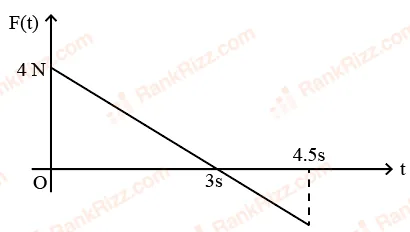
A block of mass 2 kg is free to move along the x-axis. It is at rest and from t = 0 onwards it is subjected to a time-dependent force Fit) in the x direction. The force F(t) varies with t as shown in the figure. The kinetic energy of the block after 4.5 seconds is

Figure for JEE Advanced 2010 Physics question on Work done by constant and variable forces
  1. A

    4.50 J

  2. B

    7.50 J

  3. C

    5.06 J

  4. D

    14.06 J

Q5Electric field of continuous charge distributions

A tiny spherical oil drop carrying a net charge q is balanced instill air with a vertical uniform electric field of strength 81π7×10⁵Vm−1\frac{81 \pi}{7} \times 10^5 Vm^{-1}. When the field switched off, the drop is observed to fall with terminal velocity 2×10⁻³ms−12 \times 10^{-3} m s^{-1}. Given g=9.8ms−2g = 9.8 m s^{-2}, viscosity of the air = 1.8×10⁻⁵Nsm−21.8 \times 10^{-5} Ns m^{-2} and the density of oil = 900kgm−3900 kg m^{-3}, the magnitude of q is

  1. A

    1.6×10⁻¹⁹C1.6 \times 10^{-19} C

  2. B

    3.2×10⁻¹⁹C3.2 \times 10^{-19} C

  3. C

    4.8×10⁻¹⁹C4.8 \times 10^{-19} C

  4. D

    8.0×10⁻¹⁹C8.0 \times 10^{-19} C

Q6Electric charge and Coulomb's law

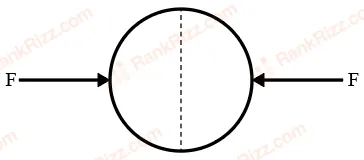
A uniformly charged thin spherical shell of radius R carries uniform surface charge density of σ\sigma per unit area. It is made of two hemispherical shells, held together by pressing them with force F (see figure). F is proportional to

Figure for JEE Advanced 2010 Physics question on Electric charge and Coulomb's law
  1. A

    1ε0σ2R2\frac{1}{ε_0}\sigma^2 R^2

  2. B

    1ε0σ2R\frac{1}{ε_0}\sigma^2 R

  3. C

    1ε0σ2R\frac{1}{ε_0}\frac{\sigma^2}{R}

  4. D

    1ε0σ2R2\frac{1}{ε_0}\frac{\sigma^2}{R^2}

Q7Multi-step processes and gas-piston-spring systems

A diatomic ideal gas is compressed adiabatically to 132\frac{1}{32} of its initial volume. In the initial temperature of the gas is TiT_i(in Kelvin) and the final temperature is aTiaT_i, the value of a is

Q8RC circuits: charging and discharging

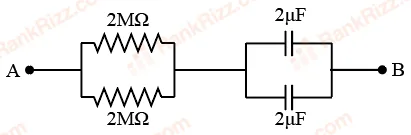
At time t = O, a battery of 10 V is connected across points A and B in the given circuit. If the capacitors have no charge initially, at what time (in seconds) does the voltage across them become 4 V ?
[Take : ln⁡5=1.6,ln⁡3=1.1\ln 5 = 1.6, \ln 3 = 1.1]

Figure for JEE Advanced 2010 Physics question on RC circuits: charging and discharging
Q9Reflection and plane mirrors

Image of an object approaching a convex mirror of radius of curvature 20 m along its optical axis is observed to move from 253m\frac{25}{3} m to 507m\frac{50}{7} m in 30 seconds. What is the speed of the object in km per hour ?

Q10Prism: deviation and dispersion

A large glass slab (μ=53)(\mu = \frac{5}{3}) of thickness 8 cm is placed over a point source of light on a plane surface. It is seen that light emerges out of the top surface of the slab from a circular area of radius R cm. What is the value of R?

Q11Radioactivity: decay law, half-life and decay modes

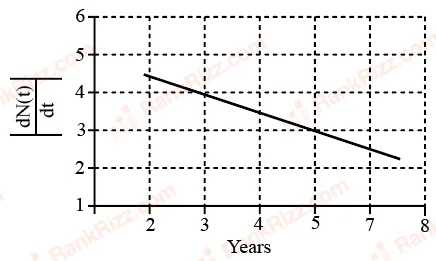
To determine the half life of a radioactive element, a student plots a graph of ln⁡∣dN(t)dt∣\ln \mid \frac{dN(t)}{dt} \mid versus t. Here dN(t)dt\frac{dN(t)}{dt} is the rate of radioactive decay at time t If the number of radioactive nuclei of this element decreases by a factor of p after 4.16 years, the value of p is

Figure for JEE Advanced 2010 Physics question on Radioactivity: decay law, half-life and decay modes
Q12Calculus, graphs and approximations used in physics

If the radius of the opening of the dropperis r, the vertical force due to the surface tension on the drop of radius R (assuming r≪Rr \ll R) is

  1. A

    2πrT2 \pi r T

  2. B

    2πRT2 \pi R T

  3. C

    2πr2TR\frac{2 \pi r^2 T}{R}

  4. D

    2πR2Tr\frac{2 \pi R^2 T}{r}

Q13Surface tension and surface energy

If r=5×10⁻⁴m,p=103kgm−3,g=10ms−2,T=0.11Nm−1r = 5 \times 10^{-4} m, p = 10^3 kgm^{-3}, g = 10 ms^{-2}, T = 0.11 Nm^{-1}, the radius of the drop when it detaches from the dropper is approximately

  1. A

    1.4×10−31.4 \times 10^{-3} m

  2. B

    3.3×10−33.3 \times 10^{-3} m

  3. C

    2.0×10−32.0 \times 10^{-3} m

  4. D

    4.1×10−34.1 \times 10^{-3} m

Q14Calculus, graphs and approximations used in physics

After the drop detaches, its surface energy is

  1. A

    1.4×10−61.4 \times 10^{-6} J

  2. B

    2.7×10−62.7 \times 10^{-6} J

  3. C

    5.4×10−65.4 \times 10^{-6} J

  4. D

    8.1×10−68.1 \times 10^{-6} J

Q15Hydrogen spectrum and spectral series

A diatomic molecule has momentof inertia I By Bohr's quantization condition its rotational energy in the nthn^{th} level (n = O is not allowed) is

  1. A

    1n2(h28π2I)\frac{1}{n^2}\left(\frac{h^2}{8 \pi^2 I}\right)

  2. B

    1n(h28π2I)\frac{1}{n}\left(\frac{h^2}{8 \pi^2 I}\right)

  3. C

    n(h28π2I)n \left(\frac{h^2}{8 \pi^2 I}\right)

  4. D

    n2(h28π2I)n^2 \left(\frac{h^2}{8 \pi^2 I}\right)

Q16Hydrogen spectrum and spectral series

It is found that the excitation frequency from ground to thefirst excited state of rotation for the CO molecule is close to 4π×1011\frac{4}{\pi} \times 10^{11} Hz. Then the moment of inertia of
CO molecule about its center of massis close to (Take h=2π×10−34h = 2 \pi \times 10^{-34} J s)

  1. A

    2.76×10−46kgm22.76 \times 10^{-46}kg m^2

  2. B

    1.87×10−46kgm21.87 \times 10^{-46}kg m^2

  3. C

    4.67×10−47kgm24.67 \times 10^{-47}kg m^2

  4. D

    1.17×10−47kgm21.17 \times 10^{-47}kg m^2

Q17Hydrogen spectrum and spectral series

In a CO molecule, the distance between C (mass = 12 a.m.u.) and O (mass = 16 a.m.u.), where 1 a.m.u. =53×10−27= \frac{5}{3} \times 10^{-27} kg, is close to

  1. A

    2.4×10−102.4 \times 10^{-10} m

  2. B

    1.9×10−101.9 \times 10^{-10} m

  3. C

    1.3×10−101.3 \times 10^{-10} m

  4. D

    4.4×10−114.4 \times 10^{-11} m

Q18Combinations of lenses and mirrors

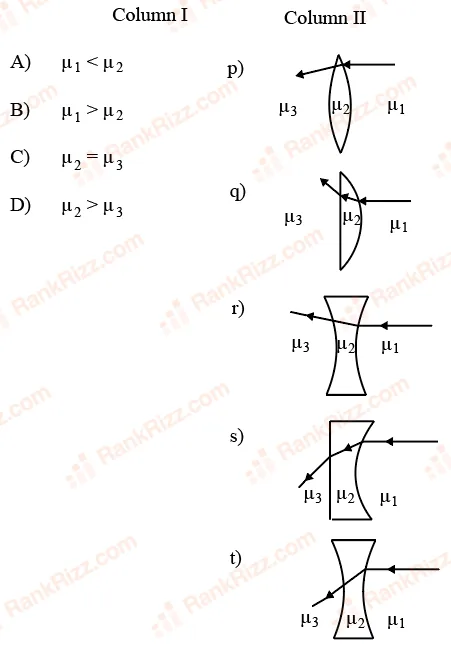
Two transparent media of refractive indices μ1\mu_1 and μ2\mu_2 have a solid lens shaped transper material of refractive index μ2\mu_2 between them as shown in figures in Column II A: traversing these media is also shown in the figures. In Column different relations between μ1,μ2\mu_1, \mu_2 and μ3\mu_3 are given. Match them to the ray diagrams shown in Column

Figure for JEE Advanced 2010 Physics question on Combinations of lenses and mirrors
Q19AC basics: rms and average values, phasors

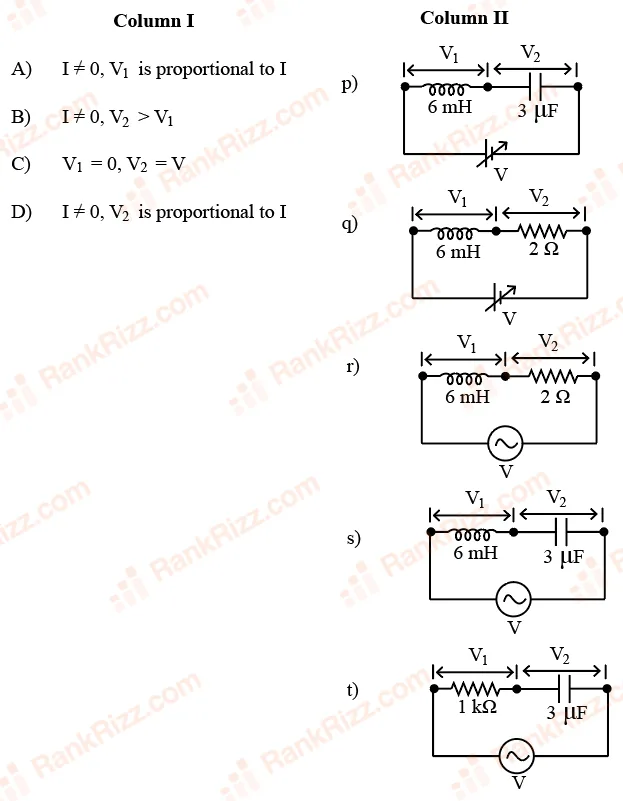
You are given many resistances, capacitors and inductors. These are connected to variable DC voltage source(the first two circuits) or an AC voltage source of 50 Hz frequency(the next three circuits) in different ways as shown in Column II. When a current (steady state for DC or rms for AC) flows through the circuit, the corresponding voltage V1V_1 and V2V_2. (indicated in circuits) are related as shown in column I. Match the two

Figure for JEE Advanced 2010 Physics question on AC basics: rms and average values, phasors
NEXT IN THIS PAPER →Chemistry, Q20 onwards