All 84 questions of JEE Advanced 2010 Paper 1, in the order they were asked, one subject to a page. Pick an answer on any question to check it against the key. Free to read, nothing to download.
Questions
84
Physics · Chemistry · Maths
Answer key
84
questions with a checked key
Price
Free
no sign-up
Physics
Q1Ohm's law, resistance, resistivity and colour code
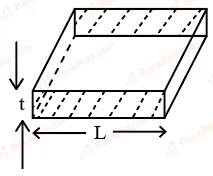
Consider a thin square sheet of side L and thickness t, made of a material of resistivity ρ. The resistance between two opposite faces, shown by the shaded areas in the figure is
Incandescent bulbs are designed by keeping in mind that the resistance of their filament increases with the increase in temperature. If at room temperature. 100 W, 60 Wand 40 Wbulbs have filament resistances R100,R60 and R40, respectively, the relation between these resistances is
Q4Ohm's law, resistance, resistivity and colour code
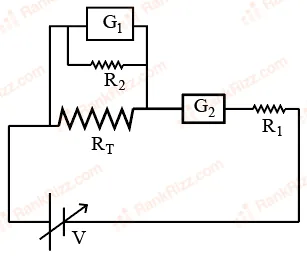
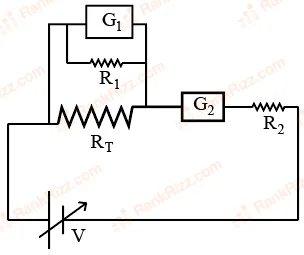
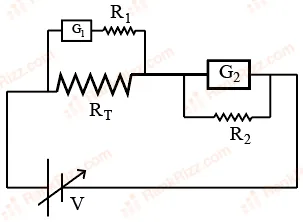
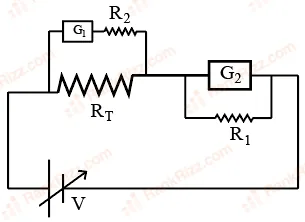
To verify Ohm's law, a student is provided with a test resistor RT, a high resistance R1, a small resistance R2, two identical galvanometers G1 and G2, and a variable voltage source V. The correct circuit to carry out the experiment is
An AC voltage source of variable angular frequency ω and fixed amplitude V0 is connected in series with a capacitance C and anelectric bulb of resistance R (inductance zero). When ω is increased
Q6Force on current-carrying conductors and between parallel wires
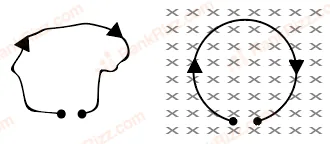
A thin flexible wire of length L is connected to two adjacent fixed points and carries a current I in the clockwise direction, as shown in the figure. When the system is put in a uniform magnetic field of strength B going into the plane of the paper, the wire takes the shape of a circle. The tension in the wire is
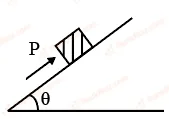
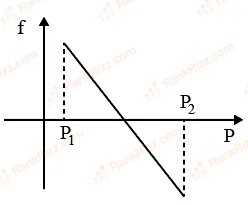
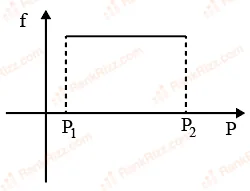
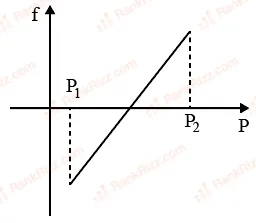
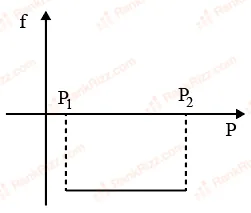
A block of mass m is on an inclined plane of angle θ. The coefficient of friction between the block and the plane is μ and tanθ>μ. The block is held stationary by applying a force P parallel to the plane. The direction of force pointing up the plane is taken to be positive. As P is varied from P1=mg(sinθ−μcosθ) to P2=mg(sinθ+μcosθ), the frictional force f versus P graph will look like
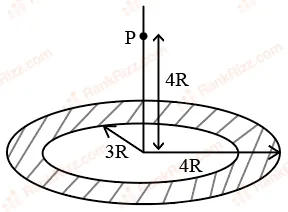
A thin uniform annular disc (see figure) of mass M has outer radius 4R and inner radius 3R. The work required to take a unit mass from point P on its axis to infinity is
Q9Electric field of continuous charge distributions
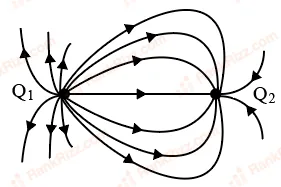
A few electric field lines for a system of two charges Q1 and Q2 fixed at two different points on the x-axis are shown in the figure. These lines suggest that
A
∣Q1∣>∣Q2∣
B
∣Q1∣<∣Q2∣
C
at a finite distance to the left of Q1 the electric field is zero
D
at a finite distance to the right of Q2 the electric field is zero
A student uses a simple pendulumof exactly 1m length to determine g, the acceleration due to gravity. He uses a stop watch with the least count of 1 sec for this and records 40 secondsfor 20 oscillations. For this observation, which of the following statement(s) is (are) true ?
A
Error △T in measuring T, the time period, is 0.05 seconds
B
Error △T in measuring T, the time period, is 1 second
C
Percentage error in the determination of g is 5%
D
Percentage error in the determination of g is 2.5%
Q11Motion of centre of mass, momentum conservation and explosions
A point mass of 1 kg collides elastically with a stationary point mass of 5 kg. After their collision, the 1 kg mass reverses its direction and moves with a speed of 2 ms−1. Which of the following statement(s) is (are) correct for the system of these two masses ?
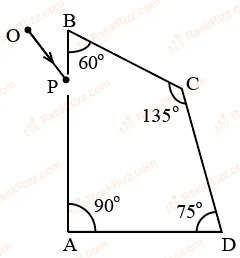
A ray OP of monochromatic light is incident on the face AB of prism ABCD near vertex B at an incident angle of 60∘ (see figure). If the refractive index of the material of the prism is 3, which of the following is (are) correct ?
A
The raygets totally internally reflected at face CD
B
The ray comes out through face AD
C
The angle between the incident ray and the emergent ray is 90∘
D
The angle between the incident ray and the emergent ray is 120∘
Q13Multi-step processes and gas-piston-spring systems
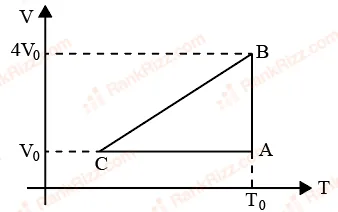
One mole of an ideal gas in initial state A undergoes a cyclic process ABCA, as shown in the figure. Its pressure at A is P0. Choose the correct option(s) from the following
Q17Dia-, para- and ferromagnetic materials and hysteresis
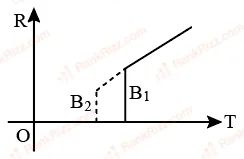
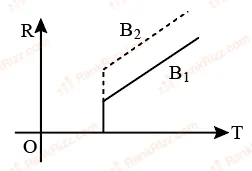
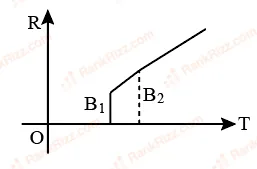
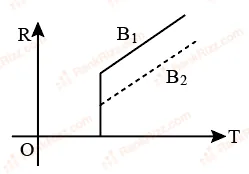
In the graphs below, the resistance R of a super conductor is shown as a function of its temperature T for two different magnetic fields B1 (solid line) and B2 (dashed line). If B2 is larger than B1, which of the following graphs shows the correct variation of R with T in these fields ?
Q18Dia-, para- and ferromagnetic materials and hysteresis
A superconductor has Tc(0)=100K. When a magnetic field of 7.5 Tesla is applied, its Tc decreases to 75 K. For this material one candefinitely say that when
The focal length of a thin biconvex lens is 20cm. When anobject is moved from a distance of 25cmin front of it to 50cm, the magnification of its image changes from m25 to m50. The ratio m50m25 is
An α-particle and a proton are accelerated from rest by a potential difference of 100V. After this, their de Broglie wavelengths are λα and λp respectively. The ratio \frac{\lambda_p}{\lambda_{\alpha}, to the nearest integer, is
When two identical batteries of internal resistance 1 Ω each are connected in series across a resistor R, the rate of heat produced in R is J1. When the samebatteries are connected in parallel across R, the rate is J2. If J1=2.25J2 then the value of R in Ω is
Q22Thermal radiation: Stefan's law, Wien's law and Kirchhoff's law
Two spherical bodies A (radius 6 cm) and B (radius 18 cm) are at temperatures T1 and T2, respectively. The maximum intensity in the emission spectrum of A is at 500 nm and in that of B is at 1500 nm. Considering themto be black bodies, what will be the ratio of the rate of total energy radiated by A to that of B ?
A 0.1 kg mass is suspended from a wire of negligible mass. The length of the wire is 1m and its cross-sectional area is 4.9×10⁻⁷m2. If the mass is pulled a little in the vertically downward direction and released, it performs simple harmonic motion of angular frequency 140 rad s−1. If the Young’s modulus of the material of the wire is n×109Nm−2, the value of n is
A binarystar consists of two stars A (mass 2.2 Ms) and B (mass 11 Ms). where Ms is the mass of the sun. They are separated by distance d and are rotating about their centre of mass, which is stationary. The ratio of the total angular momentum of the binarystar to the angular momentumof star B about the centre of mass is
Gravitational acceleration on the surface of a planet is 116g, where g is the gravitational acceleration on the surface of the earth. The average mass density of the planet is 32 times that of the earth. If the escape speed on the surface of the earth is taken to be 11 kms−1, the escape speed on the surface of the planet in kms−1 will be
A piece of ice (heat capacity = 2100 J kg−1∘C−1 andlatent heat = 3.36×10⁵Jkg−1) of mass m grams is at −5∘C at atmospheric pressure. It is given 420 J of heat so that the ice starts melting. Finally when the ice-water mixture is in equilibrium, it is found that 1 gmof ice has melted. Assuming there is no other heat exchange in the process, the value of m is
A stationary source is emitting sound ata fixed frequency f0, which is reflected by two cars approaching the source. The difference between the frequencies of sound reflected from the cars is 1.2% of f0. What is the difference in the speeds of the cars (in km per hour) to the nearest integer ? The cars are moving at constant speeds much smaller than the speed of sound which is 330 ms−1.