RankRizz

JEE Advanced 2009 Paper 2: Maths

The 19 Maths questions of JEE Advanced 2009 Paper 2, numbered across the whole paper. Pick an answer on any question to check it against the key. Free to read, nothing to download.

Maths

Q39Arithmetic progression

If the sum of first n terms of an A.P. is cn2cn^2, then the sum of squares of these n terms is

  1. A

    n(4n2−1)c26\frac{n(4n^2 - 1)c^2}{6}

  2. B

    n(4n2+1)c23\frac{n(4n^2 + 1)c^2}{3}

  3. C

    n(4n2−1)c23\frac{n(4n^2 - 1)c^2}{3}

  4. D

    n(4n2+1)c26\frac{n(4n^2 + 1)c^2}{6}

Q40Coordinates, direction cosines and direction ratios

A line with positive direction cosines passes through the point P(2,-1, 2) and makes equal angles with the coordinate axes. The line meets the plane 2x+y+z=92x + y + z = 9 at point Q. The length of the line segment PQ equals

  1. A

    1

  2. B

    2\sqrt{2}

  3. C

    3\sqrt{3}

  4. D

    2

Q41Normals to an ellipse

The normal at a point P on the ellipse x2+4y2=16x^2 + 4y^2 = 16 meets the x-axis at Q. If M is the mid point of the line segment PQ, then the locus of M intersects the latus rectums of the given ellipse at the points

  1. A

    (±352,±27)\left(\pm \frac{3\sqrt{5}}{2}, \pm \frac{2}{7}\right)

  2. B

    (±352,±194)\left(\pm \frac{3\sqrt{5}}{2}, \pm \frac{\sqrt{19}}{4}\right)

  3. C

    (±23,±17)\left(\pm 2\sqrt{3}, \pm \frac{1}{7}\right)

  4. D

    (±23,±437)\left(\pm 2\sqrt{3}, \pm \frac{4\sqrt{3}}{7}\right)

Q42Locus problems in coordinate geometry

The locus of the orthocentre of the triangle formed by the lines
(1 + p)x - py + p(1 + p) = 0,
(1 + q)x - qy + q(1 + q) = 0,
and y = 0, where p≠qp \neq q, is

  1. A

    a hyperbola

  2. B

    a parabola

  3. C

    a nellipse

  4. D

    a straight line

Q43Definite integrals: properties and King's rule

If In=∫−ππsin⁡nx(1+πx)sin⁡xdxI_n = \int_{-\pi}^{\pi}\frac{\sin nx}{(1 + \pi^x) \sin x}dx, n = 0, 1, 2, 3, ....,
then

  1. A

    In=In+2I_n = I_{n+2}

  2. B

    ∑m=110I2m+1=10π\sum_{m=1}^{10}I_{2m+1} = 10 \pi

  3. C

    ∑m=110I2m=0π\sum_{m=1}^{10}I_{2m} = 0 \pi

  4. D

    In=In+1I_n = I_{n+1}

Q44Common tangents involving an ellipse

An ellipse intersects the hyperbola 2x2−2y2=12x^2 - 2y^2 = 1 orthogonally. The eccentricity of the ellipse is reciprocal of that of the hyperbola. If the axes of the ellipse are along the
coordinate axes, then

  1. A

    Equation of ellipse is x2+2y2=2x^2 + 2y^2 = 2

  2. B

    The foci of ellipse are (±1,0)(\pm 1, 0)

  3. C

    Equation of ellipse is x2+2y2=4x^2 + 2y^2 = 4

  4. D

    The foci of ellipse are (±2,0)(\pm \sqrt{2}, 0)

Q45Monotonicity and intervals of increase/decrease

For the function
f(x)=xcos⁡1x,x≥1f(x) = x \cos \frac{1}{x}, x \geq 1,

  1. A

    for at least one x x in the interval [1,∞),f(x+2)−f(x)<2[1, \infty), f(x + 2) - f(x) < 2

  2. B

    lim⁡x→∞f′(x)=1\lim_{x \rightarrow \infty}f'(x) = 1

  3. C

    for all x in the interval [1,∞),f(x+2)−f(x)>2[1, \infty), f(x + 2) - f(x) > 2

  4. D

    f'(x) is strictly decreasing in the interval [1,∞)[1, \infty)

Q46Locus problems on parabola

The tangent PT and the normal PN to the parabola y2=4axy^2 = 4ax at a point P on it meet its axis at points T and N, respectively. The locus of the centroid of the triangle PTN is a parabola whose

  1. A

    vertex is (2a3,0)\left(\frac{2a}{3}, 0\right)

  2. B

    directrix is x = 0

  3. C

    latus rectum is 2a3\frac{2a}{3}

  4. D

    focus is (a, 0)

Q47Trigonometric series and products

For 0<θ<π20 < \theta < \frac{\pi}{2}, the solution(s) of
∑m=16cosec⁡(θ+(m−1)π4)cosec⁡(θ+mπ4)=42\sum_{m=1}^{6}\cosec\left(\theta + \frac{(m - 1)\pi}{4}\right)\cosec\left(\theta + \frac{m\pi}{4}\right) = 4\sqrt{2}
is(are)

  1. A

    π4\frac{\pi}{4}

  2. B

    π6\frac{\pi}{6}

  3. C

    π12\frac{\pi}{12}

  4. D

    5π12\frac{5 \pi}{12}

Q48Equation of a circle in various forms

Match the statements/expressions given in Column I with the values given in Column II.
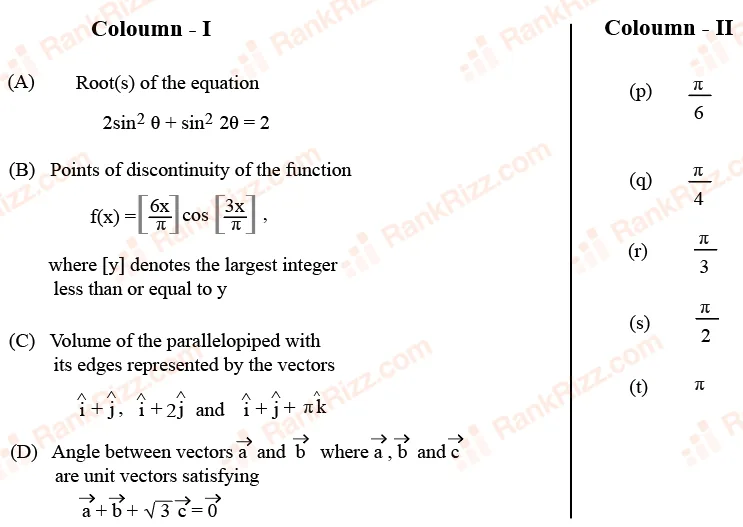
Figure for JEE Advanced 2009 Mathematics question on Equation of a circle in various forms
Q49Equation of a circle in various forms

Match the statements/expressions given in Column I with the values given in Column II.
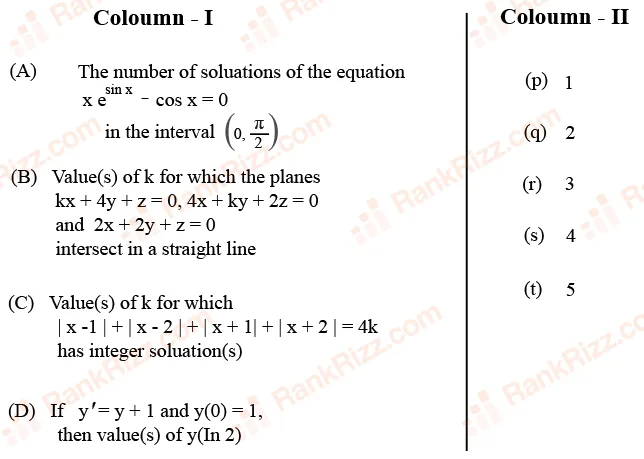
Figure for JEE Advanced 2009 Mathematics question on Equation of a circle in various forms
Q50Optimization word and geometry problems

The maximum value of the function f(x)=2x3−15x2+36x−48f(x) = 2x^3 - 15x^2 + 36x - 48 on the set A={x∣x2+20≤9x}A = \left\{x \mid x^2 + 20 \leq 9x \right\} is

Q51Systems of linear equations

Let (x, y, z) be points with integer coordinates satisfying the system of homogeneous equations:
3x−y−z=03x - y - z = 0
−3x+z=0-3x + z = 0
−3x+2y+z=0-3x + 2y + z = 0.
Then the number of such points for which x2+y2+z2≤100x^2 + y^2 + z^2 \leq 100 is

Q52Half-angle formulas, area and Napier's analogy

Let ABC and ABC' be two non-congruent triangles with sides AB=4,AC=AC′=22AB = 4, AC = AC' = 2\sqrt{2} and angle B=30∘B = 30^\circ. The absolute value ofthe difference between the areas of these triangles is

Q53Optimization word and geometry problems

Let p(x) be a polynomial of degree 4 having extremumat x = 1, 2 and
lim⁡x→0(1+p(x)x2)=2\lim_{x \rightarrow 0}\left(1 + \frac{p(x)}{x^2}\right) = 2.
Then the value of p(2) is

Q54Leibniz rule for differentiating integrals

Let f:R→Rf : R \rightarrow R be a continuous function which satisfies
f(x)=∫0xf(t)dtf(x) = \int_{0}^{x}f(t)dt.
Then the value of f(ln⁡5)f(\ln 5) is

Q55Position of two circles and common tangents

The centres of two circles C1C_1 and C2C_2 each of unit radius are at a distance of 6 units from each other. Let P be the mid point of the line segment joining the centres of C1C_1 and C2C_2 and C be a circle touching circles C1C_1 and C2C_2 externally. If a common tangent to C1C_1 and C passing through Pis also a common tangent to C2C_2 and C, then the radius ofthe circle C is

Q56Location of roots

The smallest value of k, for which both the roots of the equation
x2−8kx+16(k2−k+1)=0x^2 - 8kx + 16(k^2 - k + 1) = 0
are real, distinct and have values at least 4, is

Q57Inverse functions

If the function f(x)=x3+ex2f(x) = x^3 + e^{\frac{x}{2}} and g(x)=f−1(x)g(x) = f^{-1}(x), then the value of g′(1)g'(1) is