Q1Spring-block oscillations
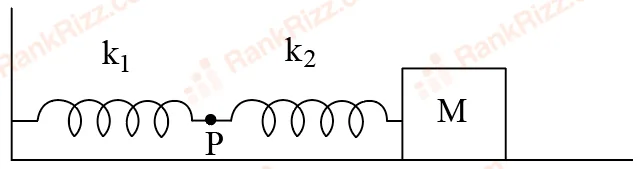
The mass M shown in the figure oscillates in simple harmonic motion with amplitude A. The amplitude of the point P is
- A
- B
- C
- D
All 57 questions of JEE Advanced 2009 Paper 2, in the order they were asked, one subject to a page. Pick an answer on any question to check it against the key. Free to read, nothing to download.
Questions
57
Physics · Chemistry · Maths
Answer key
26
questions with a checked key
Price
Free
no sign-up
The mass M shown in the figure oscillates in simple harmonic motion with amplitude A. The amplitude of the point P is
A piece of wire is bent in the shape of a parabola (y-axis vertical) with a bead of mass m onit. The bead canslide on the wire withoutfriction. It stays at the lowest point of the parabola when the wire is at rest. The wire is now accelerated parallel to the x-axis with a constant acceleration a. The distance of the new equilibrium position of the bead, where the bead can stay at rest with respect to the wire, from the y-axis is
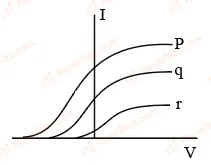
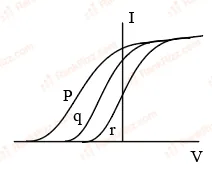
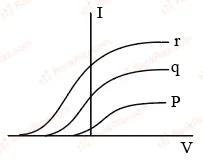
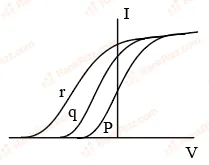
Photoelectric effect experiments are performed using three different metal plates p, q and r having work functions eV, eV and eV, respectively. A light beam containing wavelengths of 550 nm, 450 nm and 350 nm with equal intensities illuminates each of the plates. The correct I-V graph for the experiment is [Take hc = 1240 eV nm]
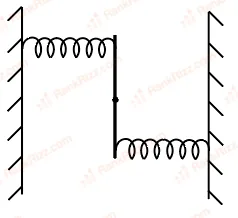
A uniform rod of length L and mass M is pivoted at the centre. Its two ends are attached to two springs of equal spring constants k. The springs are fixed to rigid supports as shown in the figure, and the rod is free to oscillate in the horizontal plane. The rod is gently pushed through a small angle in one direction and released. The frequency of oscillation is
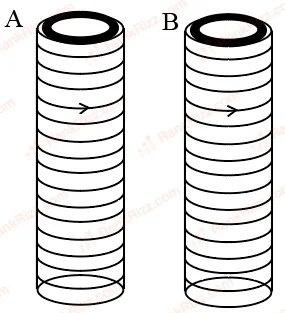
Two metallic rings A and B, identical in shape and size but having different resistivities and , are kept on top of two identical solenoids as shown in the figure. When current J is switched on in both the solenoids in identical manner, the rings A and B jump to heights and , respectively, with . The possible relation(s) between their resistivities and their masses and is(are)
and
and
and
and
A student performed the experiment to measure the speed of sound in air using resonance air-column method. Two resonances in the air-column were obtained by lowering the water level. The resonance with the shorter air-column is the first resonanceandthat with the longer air-column is the second resonance. Then,
the intensity of the sound heard at the first resonance was more than that at the second resonance
the prongs of the tuning fork were kept in a horizontal plane above the resonance tube
the amplitude of vibration of the ends of the prongsis typically around 1 cm
the length of the air-columnat the first resonance was somewhat shorter than of the wavelength of the sound in air
The figure shows the P-V plot of an ideal gas taken through a cycle ABCDA. The part ABC is a semi-circle and CDA is half of an ellipse. Then,
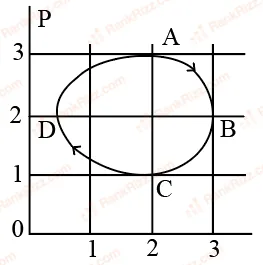
the process during the path is isothermal
heat flows out of the gas during the path
work done during the path is zero
positive work is done by the gas in the cycle ABCDA
Under the influence of the Coulomb field of charge +Q, a charge -q is moving around it in an elliptical orbit. Find out the correct statement(s).
The angular momentum of the charge —q is constant
The linear momentum of the charge —g is constant
The angular velocity of the charge —q is constant
Thelinear speed of the charge —q is constant
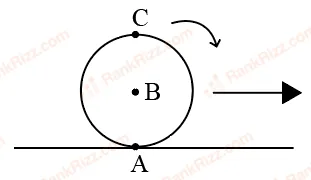
A sphere is rolling without slipping on a fixed horizontal plane surface. In the figure, A is the point of contact, B is the centre of the sphere and C is its topmost point. Then,
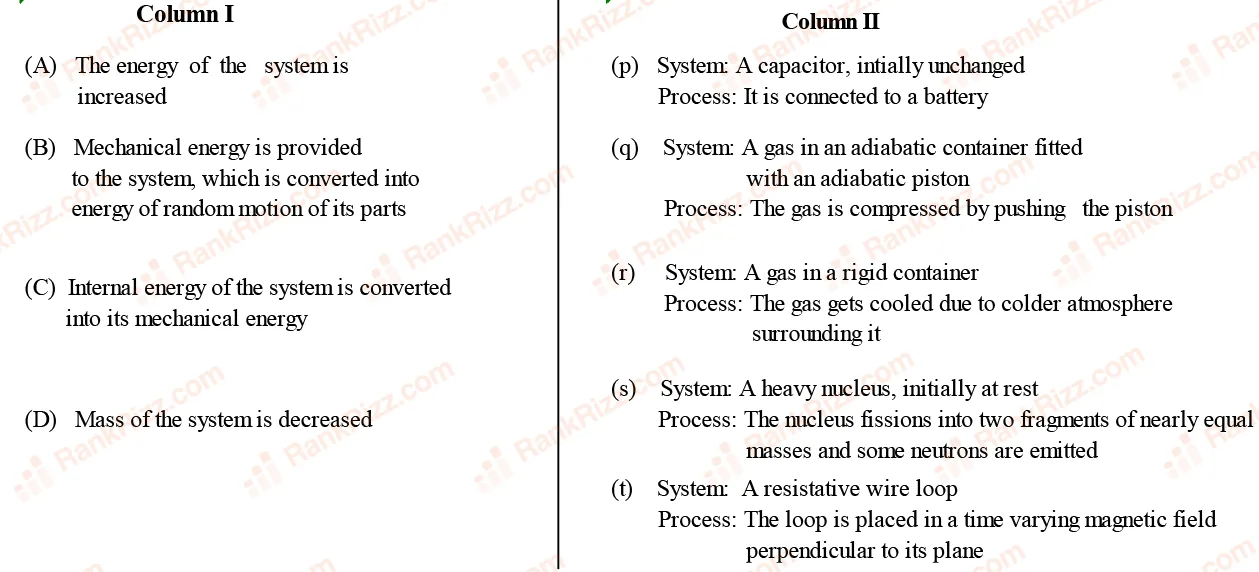
Column II gives certain systems undergoing a process. Column I suggests changes in some of the parameters related to the system. Match the statements in Column I to the appropriate process(es) from Column II.
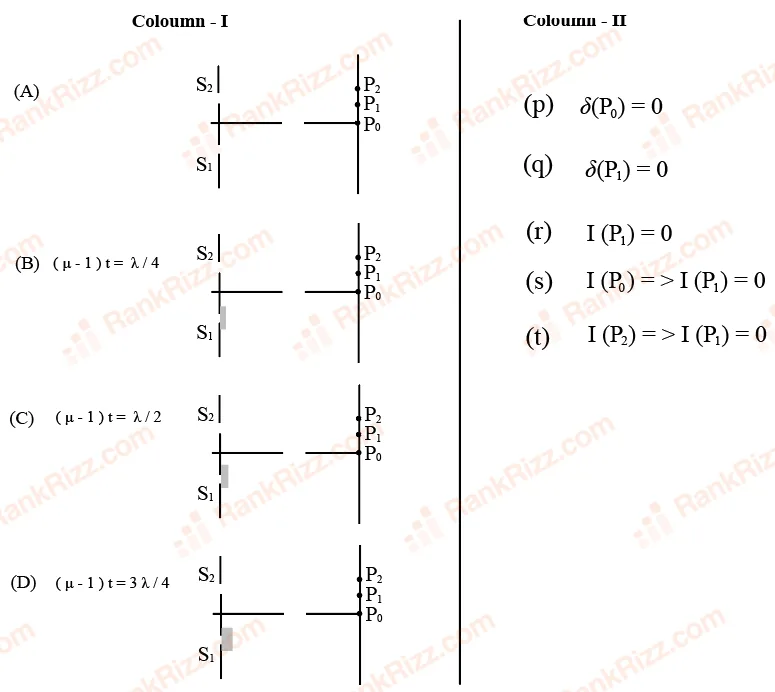
Column I shows four situations of standard Young’s double slit arrangement with the screen placed far away from the slits and . In each of these cases and , where is the wavelength of the light used. In the cases B, C and D, a transparent sheet of refractive index and thickness t is pasted on slit . The thicknesses of the sheets are different in different cases. The phase difference between thelight waves reaching a point P on the screen from the two slits is denoted by and the intensity by . Match each situation given in Column I with the statement(s) in Column II valid for that situation.
A metal rod AB of length 10x has its one end A in ice at and the other end B in water at . If a point P on the rod is maintained at , then it is found that equal amounts of water andice evaporate and melt per unit time. The latent heat of evaporation of water is 540 cal/g and latent heat of melting of ice is 80 cal/g. If the point P is at a distance of from the ice end A, find the value of . [Neglect any heat loss to the surrounding.]
A cylindrical vessel of height 500 mm has an orifice (small hole) at its bottom. The orifice is initially closed and wateris filled in it up to height H. Now the top is completely sealed with a cap and theorifice at the bottom is opened. Some water comes out from the orifice and the water level in the vessel becomes steady with height of water column being 200 mm. Find the fall in height (in mm) of water level due to opening ofthe orifice.
[Take atmospheric pressure , density of water and . Neglect any affect of surface tension.]
Two soap bubbles A and B are kept in a closed chamber where the air is maintained at pressure 8 N/m. The radii of bubbles A and B are 2 cm and 4 cm, respectively. Surface tension of the soap-water used to make bubbles is 0.04 N/m. Find the ratio . Where and are the number of moles of air in bubbles A and B, respectively. [Neglect the effect of gravity.]
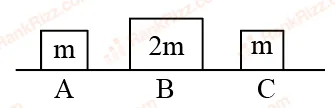
Three objects A. B and C are kept in a straight line on a frictionless horizontal surface. These have:masses m, 2m and m, respectively. The object A moves towards B with a speed 9 m/s and makes an elastic collision with it. Thereafter, B makes completely inelastic collision with C. All motions occur on the same straight line. Find the final speed (in m/s) of the object C.
A steady current I goes through a wire loop PQR having shape of a right angle triangle with PQ = 3x, PR = 4x and QR = 5x. If the magnitude of the magnetic field at P due to this loop is , find the value of k.
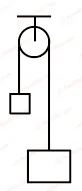
A light inextensible string that goes over a smooth fixed pulley as shown in the figure connects two blocks of masses 0.36 kg and 0.72 kg. Taking g = 10 m/s, find the work
done (in joules) by the string on the block of mass 0.36 kg during the first second after the system is released from rest.
A solid sphere of radius R has a charge Q distributed in its volume with a charge densityy , where k and a are constants and r is the distance from its center. If the electric field at is times that at r = R, find the value of a,
A 20 cm long string, having a mass of 1.0 g, is fixed at both the ends. The tension in tne string is 0.5 N. The string is set into vibrations using an external vibrator of
frequency 100 Hz. Find the separation (in em) between the successive nodes on the string.