RankRizz

JEE Advanced 2009 Paper 1 Question Paper

All 60 questions of JEE Advanced 2009 Paper 1, in the order they were asked, one subject to a page. Pick an answer on any question to check it against the key. Free to read, nothing to download.

Questions

60

Physics · Chemistry · Maths

Answer key

53

questions with a checked key

Price

Free

no sign-up

Physics

Q1Motion on inclined planes and wedges

A block of base 10 cm ×\times 10 cm and height 15 cm is kept on an inclined plane. The coefficient of friction between them is 3\sqrt{3}. The inclination θ\theta of this inclined plane from the horizontal plane is gradually increased from 0∘0^\circ. Then

  1. A

    at θ=30∘\theta = 30^\circ, the block will start sliding down the plane

  2. B

    the block will remain at rest on the plane up to certain θ\theta and then it will topple

  3. C

    at θ=60∘\theta = 60^\circ, the block will start sliding down the plane and continue to do so at higher angles

  4. D

    at θ=60∘\theta = 60^\circ, the block will start sliding down the plane and on further increasing θ\theta, it will topple at certain θ\theta

Q2Spring-block oscillations

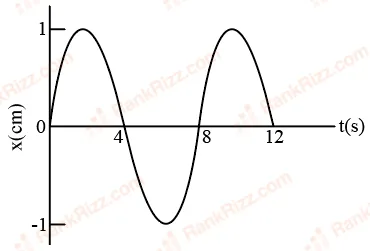
The x-t graph of a particle undergoing simple harmonic is shown below. The acceleration of the particle at t=43st = \frac{4}{3}s is-

Figure for JEE Advanced 2009 Physics question on Spring-block oscillations
  1. A

    332π2cm/s2\frac{\sqrt{3}}{32}\pi^2 cm/s^2

  2. B

    −π232cm/s2\frac{-\pi^2}{32} cm/s^2

  3. C

    π232π2cm/s2\frac{\pi^2}{32}\pi^2 cm/s^2

  4. D

    −332π2cm/s2-\frac{\sqrt{3}}{32}\pi^2 cm/s^2

Q3Electric flux and Gauss's law

Three concentric metallic spherical shells of radii R, 2R, 3R are given charges Q1,Q2,Q3Q_1, Q_2, Q_3 respectively. It is found that the surface charge densities on the outer surfaces of the shells are equal. Then, the ratio of the charges given to the shells, Q1:Q2:Q3Q_1 : Q_2 : Q_3 is-

  1. A

    1:2:31 : 2 : 3

  2. B

    1:3:51 : 3 : 5

  3. C

    1:4:91 : 4 : 9

  4. D

    1:8:181 : 8 : 18

Q4Electric flux and Gauss's law

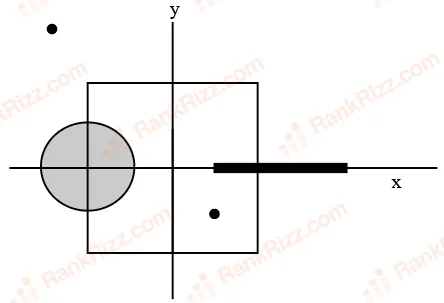
A disk of radius a4\frac{a}{4} having a uniformly distributed charge 6C is placed in the x-y plane with its centre at (−a2,0,0)\left(\frac{-a}{2}, 0, 0\right). A rod of length 'a' carrying a uniformly distributed charge 8C is placed on the x-axis from x=a4x = \frac{a}{4} to x=5a4x = \frac{5a}{4}. Two point charges -7C and 3C are placed at (a4,−a4,0)\left(\frac{a}{4}, \frac{-a}{4}, 0 \right) and (−3a4,3a4,0)\left(\frac{-3a}{4}, \frac{3a}{4}, 0 \right) respectively. Consider a cubical surface formed by six surfaces x=±a2,y=±a2,z=±a2x = \pm \frac{a}{2}, y = \pm \frac{a}{2}, z = \pm \frac{a}{2}. The electric flux this cubical surface is-

Figure for JEE Advanced 2009 Physics question on Electric flux and Gauss's law
  1. A

    −2Cε0\frac{-2C}{\varepsilon_0}

  2. B

    2Cε0\frac{2C}{\varepsilon_0}

  3. C

    10Cε0\frac{10C}{\varepsilon_0}

  4. D

    12Cε0\frac{12C}{\varepsilon_0}

Q5Centre of mass of continuous bodies and cavities

Look at the drawing given in the figure which has been drawn with ink of uniform linethickness. The mass of ink used to draw each of the two inner circles, and each of the two lines segments is m. The mass of the ink used to draw the outer circle is 6m. The coordinates of the centres of the different parts are : outer circle (0, 0), left inner circle (-a, a), right inner circle (a, a), vertical line (0, 0) and horizontal line (0, -a). The y-coordinate of the centre of mass of the ink in this drawing is-

Figure for JEE Advanced 2009 Physics question on Centre of mass of continuous bodies and cavities
  1. A

    a10\frac{a}{10}

  2. B

    a8\frac{a}{8}

  3. C

    a12\frac{a}{12}

  4. D

    a3\frac{a}{3}

Q6Magnetic flux, Faraday's law and Lenz's law

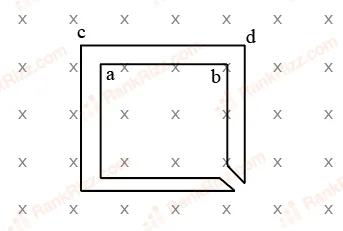
The figure shows certain wire segments joined together to form a coplanar loop. The loop is placed in a perpendicular magnetic field in the direction going into the plane of the figure. The magnitude of the field increases with time. I1 and I2 are the currents in the segments ab and cd. Then

Figure for JEE Advanced 2009 Physics question on Magnetic flux, Faraday's law and Lenz's law
  1. A

    I1>I2I_1 > I_2

  2. B

    I1<I2I_1 < I_2

  3. C

    I1I_1 is in the direction ba and I2I_2 is in the direction cd

  4. D

    I1I_1 is in the direction ab and I2I_2 is in the direction dc

Q7Prism: deviation and dispersion

A ball is dropped from a height of 20 m above the surface of water in a lake. The refractive index of water is 43\frac{4}{3}. A fish inside the lake, in the line of fall of the ball, is looking at the ball. At an instant, when the ball is 12.8 m above the water surface, the fish sees the speed of ball as-

  1. A

    9 m/s

  2. B

    12 m/s

  3. C

    16 m/s

  4. D

    21.33 m/s

Q8Motion of centre of mass, momentum conservation and explosions

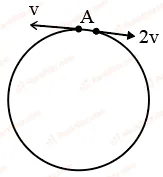
Two small particles of equal masses start moving in opposite directions from a point A in a horizontal circular orbit. Their tangential velocities are v and 2v, respectively, as shown in the figure. Between collisions, the particles move with constant speeds. After making how many collisions, other than that at A, these two particles will again reach the point A ?

Figure for JEE Advanced 2009 Physics question on Motion of centre of mass, momentum conservation and explosions
  1. A

    4

  2. B

    3

  3. C

    2

  4. D

    1

Q9Electric power and heating effect of current

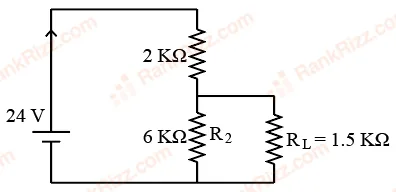
For the circuit shown in the figure

Figure for JEE Advanced 2009 Physics question on Electric power and heating effect of current
  1. A

    the current I through the battery is 7.5 mA

  2. B

    the potential difference across RLR_L is 18 V

  3. C

    ratio of powers dissipated in R1R_1 and R2R_2 is 3

  4. D

    if R1R_1 and R2R_2 are interchanged, magnitude of the power dissipated in R1R_1, will decrease by a factor of 9.

Q10Angular momentum of particles and rigid bodies

If the resultant of all the external forces acting on a system of particles is zero, then from an inertial frame, one can surely say that

  1. A

    linear momentum of the system does not change in time

  2. B

    kinetic energy of the system does not change in time

  3. C

    angular momentum of the system does not change in time

  4. D

    potential energy of the system does not change in time

Q11Reflection and plane mirrors

A student performed the experiment of determination of focal length of a concave mirror by u-v method using an optical bench of length 1.5 meter. The focal length of the mirror used is 24 cm. The maximum error in the location of the image can be 0.2 cm. The 5 sets of (u, v) values recorded by the student (in cm) are : (42, 56), (48, 48), (60, 40), (66, 33), (78, 39). The data set(s) that cannot come from experiment and is(are) incorrectly recorded, is (are)

  1. A

    (42, 56)

  2. B

    (48, 48)

  3. C

    (66, 33)

  4. D

    (78, 39)

Q12Degrees of freedom, equipartition of energy and internal energy

CvC_v and CpC_p denote the molar specific heat capacities of a gas at constant volume and constant pressure, respectively. Then

  1. A

    Cp−CvC_p - C_v is larger for a diatomic ideal gas than for a monoatomic ideal gas

  2. B

    Cp+CvC_p + C_v is larger for a diatomic ideal gas than for a monoatomic ideal gas

  3. C

    Cp/CvC_p / C_v is larger for a diatomic ideal gas than for a monoatomic ideal gas

  4. D

    Cp.CvC_p . C_v is larger for a diatomic ideal gas than for a monoatomic ideal gas

Q13Nuclear fission, fusion and Q-value

In the core of nuclear fusion reactor, the gas becomes plasma because of -

  1. A

    Strong nuclear force acting between the deuterons

  2. B

    Coulomb force acting between the deuterons

  3. C

    Coulomb force acting between deuteron-electron pairs

  4. D

    the high temperature maintained inside the reactor core

Q14Nuclear fission, fusion and Q-value

Assume that two deuteron nuclei in the core of fusion reactor at temperature T are moving towards each other, each with kinetic energy 1.5 kT, when the separation between them is large enough to neglect Coulomb potential energy. Also neglect any interaction from other particles in the core. The minimum temperature T required for them to reach a separation of 4×10−154 \times 10^{-15} m is in the range-

  1. A

    1.0×10⁹K<T<2.0×10⁹K1.0 \times 10^9 K < T < 2.0 \times 10^9 K

  2. B

    2.0×10⁹K<T<3.0×10⁹K2.0 \times 10^9 K < T < 3.0 \times 10^9 K

  3. C

    3.0×10⁹K<T<4.0×10⁹K3.0 \times 10^9 K < T < 4.0 \times 10^9 K

  4. D

    4.0×10⁹K<T<5.0×10⁹K4.0 \times 10^9 K < T < 5.0 \times 10^9 K

Q15Nuclear fission, fusion and Q-value

Results of calculations for four different designs of a fusion reactor using D-D reaction are given below. Which of these is most promising based on Lawson criterion ?

  1. A

    deuteron density = 2.0×1012cm−32.0 \times 10^{12} cm^{-3}, confinement time = 5.0×10−35.0 \times 10^{-3} s

  2. B

    deuteron density = 8.0×1014cm−38.0 \times 10^{14} cm^{-3}, confinement time = 9.0×10−19.0 \times 10^{-1} s

  3. C

    deuteron density = 4.0×1023cm−34.0 \times 10^{23} cm^{-3}, confinement time = 1.0×10−111.0 \times 10^{-11} s

  4. D

    deuteron density = 1.0×1024cm−31.0 \times 10^{24} cm^{-3}, confinement time = 4.0×10−124.0 \times 10^{-12} s

Q16de Broglie wavelength of matter waves

The allowed energy for the particle for a particular value of n is proportional to -

  1. A

    a−2a^{-2}

  2. B

    a−32a^{\frac{-3}{2}}

  3. C

    a−1a^{-1}

  4. D

    a2a^{2}

Q17de Broglie wavelength of matter waves

If the mass of the particle is m=1.0×10⁻³⁰m = 1.0 \times 10^{-30} kg and a = 6.6 nm, the energy of the particle in its ground state is closest to -

  1. A

    0.8 meV

  2. B

    8 meV

  3. C

    80 meV

  4. D

    800 meV

Q18de Broglie wavelength of matter waves

The speed of the particle, that can take discrete values, is proportional to -

  1. A

    n−32n^{\frac{-3}{2}}

  2. B

    n−1n^{-1}

  3. C

    n12n^{\frac{1}{2}}

  4. D

    n

Q19Electric field of continuous charge distributions

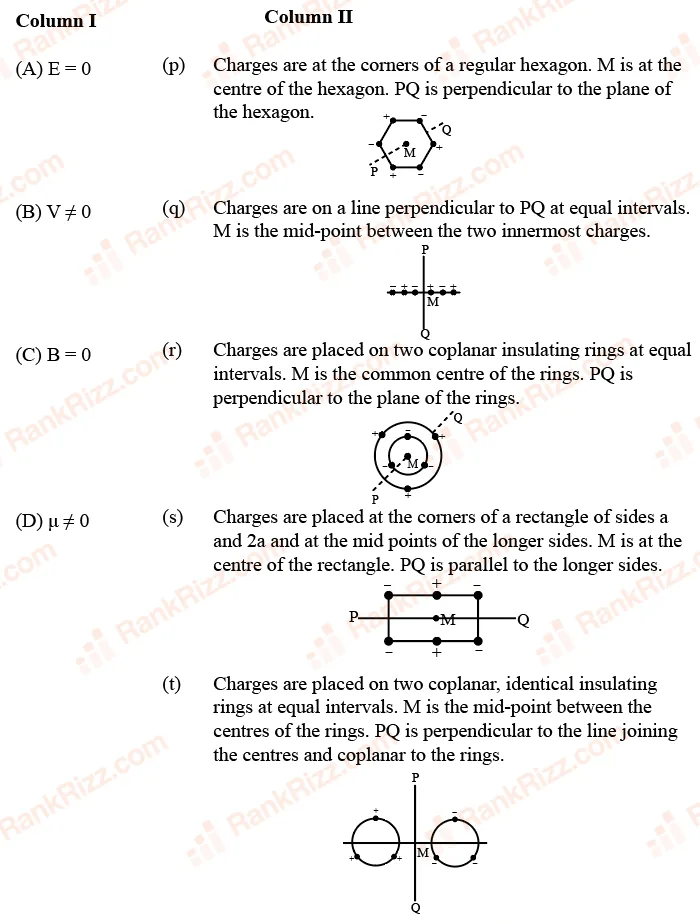
Six point charges, each of the same magnitude q, are arranged in different manners as shown in Column II. In each case, a point M and a line PQ passing through M are shown. Let E be the electric field and V be the electric potential at M (potential at infinity is zero) due to the given charge distribution when it is at rest. Now, the whole system is set into rotation with a constant angular velocity about the line PQ. Let B be the magnetic field at M and μ\mu be the magnetic moment of the system in this condition. Assume each rotating charge to be equivalent to a steady current.

Figure for JEE Advanced 2009 Physics question on Electric field of continuous charge distributions
Q20Calculus, graphs and approximations used in physics

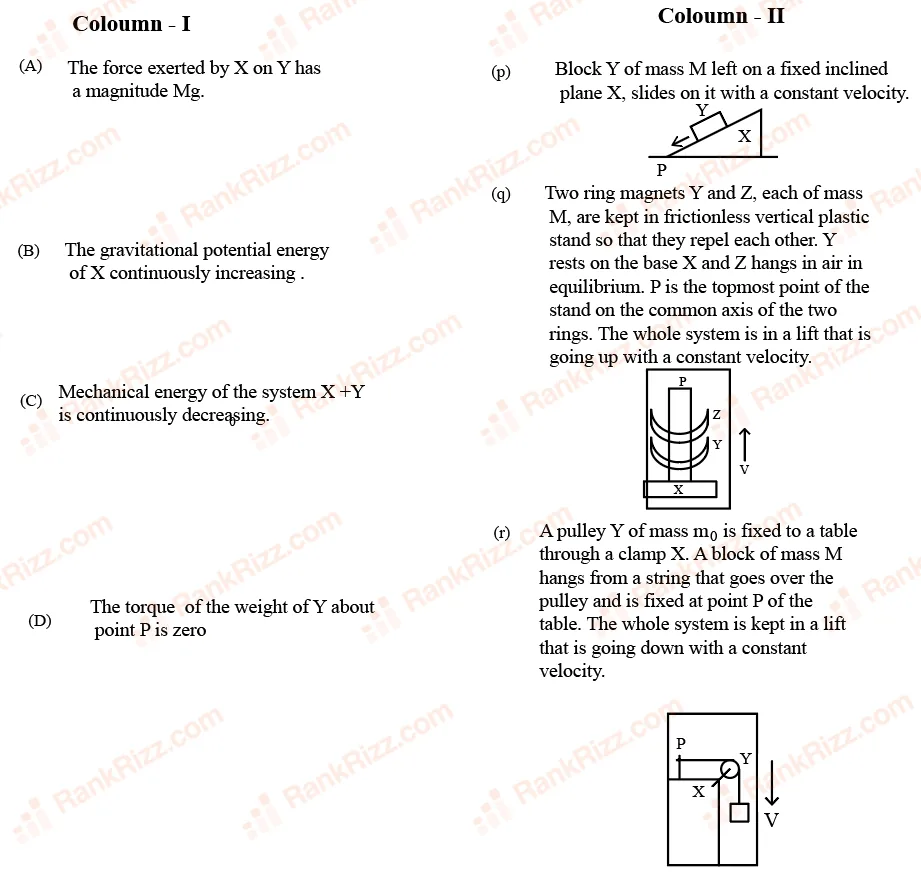
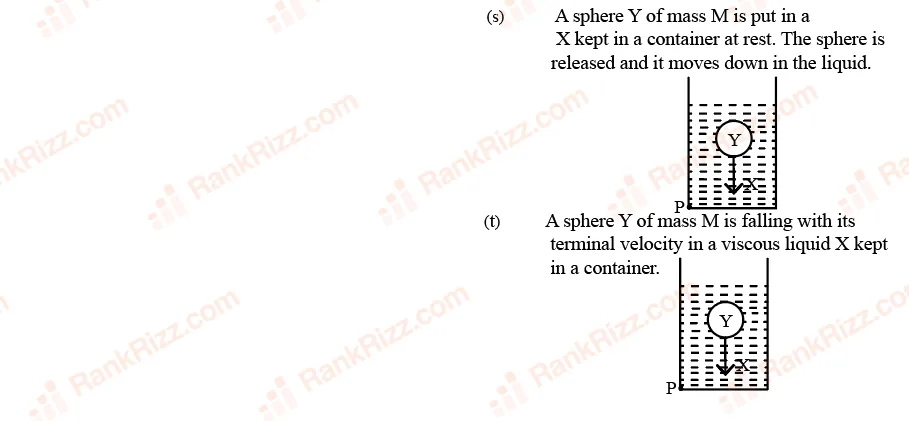
Column II shows five systems in which two object are labelled as X and Y. Also in each case a point P is shown. Column I gives some statements about X and/or Y. Match these statements to the appropriate system(s) from Column II.

Figure for JEE Advanced 2009 Physics question on Calculus, graphs and approximations used in physics Figure for JEE Advanced 2009 Physics question on Calculus, graphs and approximations used in physics
NEXT IN THIS PAPER →Chemistry, Q21 onwards