RankRizz

JEE Advanced 2007 Paper 2: Maths

The 22 Maths questions of JEE Advanced 2007 Paper 2, numbered across the whole paper. Pick an answer on any question to check it against the key. Free to read, nothing to download.

Maths

Q45Centroid, incentre, circumcentre and orthocentre

Let O(0, 0), P(3, 4), Q(6, 0) be the vertices of the triangle OPQ. The point R inside the triangle OPQ is such that the triangles OPR, PQR, OQR are of equal area. The coordinates of R are

  1. A

    (43,3)\left(\frac{4}{3}, 3\right)

  2. B

    (3,23)\left(3, \frac{2}{3}\right)

  3. C

    (3,43)\left(3, \frac{4}{3}\right)

  4. D

    (43,23)\left(\frac{4}{3}, \frac{2}{3}\right)

Q46Locus and regions in the Argand plane

If ∣z∣=1\mid z \mid = 1 and z≠±1z \neq \pm 1, then all the values of z1−z2\frac{z}{1 - z^2} lie on

  1. A

    a line not passing through the origin

  2. B

    ∣z∣=2\mid z \mid = \sqrt{2}

  3. C

    the x-axis

  4. D

    the y-axis

Q47Conditional probability and multiplication theorem

Let EcE^c denote the complement of an event E. Let E, F, G be pairwise independent events with P(G)>0P(G) > 0 and P(E∩F∩G)=0P(E \cap F \cap G) = 0. Then P(Ec∩Fc∣G)P(E^c \cap F^c \mid G) equals

  1. A

    P(Ec)+P(Fc)P(E^c) + P(F^c)

  2. B

    P(Ec)−P(Fc)P(E^c) - P(F^c)

  3. C

    P(Ec)−P(F)P(E^c) - P(F)

  4. D

    P(E)−P(Fc)P(E) - P(F^c)

Q48Higher order derivatives

d2xdy2\frac{d^2x}{dy^2} equals

  1. A

    (d2ydx2)−1\left(\frac{d^2y}{dx^2}\right)^{-1}

  2. B

    −(d2ydx2)−1(dydx)−3-\left(\frac{d^2y}{dx^2}\right)^{-1}\left(\frac{dy}{dx}\right)^{-3}

  3. C

    (d2ydx2)(dydx)−2\left(\frac{d^2y}{dx^2}\right)\left(\frac{dy}{dx}\right)^{-2}

  4. D

    −(d2ydx2)(dydx)−3-\left(\frac{d^2y}{dx^2}\right)\left(\frac{dy}{dx}\right)^{-3}

Q49Order, degree and formation of differential equations

The differential equation dydx=1−y2y\frac{dy}{dx} = \frac{\sqrt{1 - y^2}}{y} determines a family of circles with

  1. A

    variable radii and a fixed centre at (0, 1)

  2. B

    variable radii and a fixed centre at (0, -1)

  3. C

    fixed radius 1 and variable centres along the x-axis

  4. D

    fixed radius 1 and variable centres along the y-axis

Q50Vector (cross) product and area

Let a→,b→,c→\overrightarrow{a}, \overrightarrow{b}, \overrightarrow{c} be unit vectors such that a→+b→+c→=0→\overrightarrow{a} + \overrightarrow{b} + \overrightarrow{c} = \overrightarrow{0}. Which one of the following is correct?

  1. A

    a→×b→=b→×c→=c→×a→=0→\overrightarrow{a} \times \overrightarrow{b} = \overrightarrow{b} \times \overrightarrow{c} = \overrightarrow{c} \times \overrightarrow{a} = \overrightarrow{0}

  2. B

    a→×b→=b→×c→=c→×a→≠0→\overrightarrow{a} \times \overrightarrow{b} = \overrightarrow{b} \times \overrightarrow{c} = \overrightarrow{c} \times \overrightarrow{a} \neq \overrightarrow{0}

  3. C

    a→×b→=b→×c→=a→×c→≠0→\overrightarrow{a} \times \overrightarrow{b} = \overrightarrow{b} \times \overrightarrow{c} = \overrightarrow{a} \times \overrightarrow{c} \neq \overrightarrow{0}

  4. D

    a→×b→,b→×c→,c→×a→\overrightarrow{a} \times \overrightarrow{b}, \overrightarrow{b} \times \overrightarrow{c}, \overrightarrow{c} \times \overrightarrow{a} are mutually perpendicular

Q51Tangents and normals to a circle

Let ABCD be a quadrilateral with area 18, with side AB parallel to the side CD and AB =2CD. Let AD be perpendicular to AB and CD. If a circle is drawn inside the quadrilateral ABCD touchingall the sides, then its radius is

  1. A

    3

  2. B

    2

  3. C

    32\frac{3}{2}

  4. D

    1

Q52Integration by substitution

Lat f(x)=x(1+xn)1nf(x) = \frac{x}{\left(1 + x^n\right)^{\frac{1}{n}}} for n≥2n \geq 2 and g(x)=(f∘f∘...∘f)(x)⏟foccursntimesg(x) = \underbrace{(f\circ f \circ ... \circ f)(x)}_{f occurs n times}. Then ∫xn−2g(x)dx\int x^{n-2}g(x)dx equals

  1. A

    1n(n−1)(1+nxn)1−1n+K\frac{1}{n(n-1)}\left(1 + nx^n\right)^{1-\frac{1}{n}}+K

  2. B

    1n−1(1+nxn)1−1n+K\frac{1}{n-1}\left(1 + nx^n\right)^{1-\frac{1}{n}}+K

  3. C

    1n(n+1)(1+nxn)1+1n+K\frac{1}{n(n+1)}\left(1 + nx^n\right)^{1+\frac{1}{n}}+K

  4. D

    1n+1(1+nxn)1+1n+K\frac{1}{n+1}\left(1 + nx^n\right)^{1+\frac{1}{n}}+K

Q53Arrangements with restrictions

The letters of the word COCHIN are permuted and all the permutations are arranged in an alphabetical order as in an English dictionary. The number of words that appear before the word COCHIN is

  1. A

    360

  2. B

    192

  3. C

    96

  4. D

    48

Q54Line and plane: intersection, coplanarity and projection

Consider the planes 3x−6y−2z=153x - 6y - 2z = 15 and 2x+y−2z=52x + y - 2z = 5.
STATEMENT-1: The parametric equations of the line of intersection of the given planes are x=3+14t,y=1+2t,z=15t.<br/>because<br/>STATEMENT−2:Thevectorx = 3 + 14t, y = 1 + 2t, z = 15t.<br />because<br />STATEMENT-2: The vector14\hat{i} + 2 \hat{j} + 15 \hat{k}$$ is parallel to the line ofintersection of given planes.

  1. A

    Statement-1 is True, Statement-2 is True; Statement-2 is a correct explanation for Statement-1

  2. B

    Statement-1 is True, Statement-2 is True; Statement-2 is NOT a correct explanation for Statement-1

  3. C

    Statement-1 is True, Statement-2 is False

  4. D

    Statement-1 is False, Statement-2 is True

Q55Standard parabola and basic properties

STATEMENT-1: The curve y=−x22+x+1y = \frac{-x^2}{2} + x + 1 is symmetric with respect to the line x = 1.
because
STATEMENT-2: A parabola is symmetric aboutits axis.

  1. A

    Statement-1 is True, Statement-2 is True; Statement-2 is a correct explanation for Statement-1

  2. B

    Statement-1 is True, Statement-2 is True; Statement-2 is NOT a correct explanation for Statement-1

  3. C

    Statement-1 is True, Statement-2 is False

  4. D

    Statement-1 is False, Statement-2 is True

Q56Differentiability at a point

Let f(x)=2+cos⁡xf(x) = 2 + \cos x for all real x.
STATEMENT-1: For each real t, there exists a point c in [t,t+π][t, t + \pi] such that f′(c)=0.f'(c) = 0.
because
STATEMENT-2: f(t)=f(t+2π)f(t) = f(t + 2\pi) for each real t.

  1. A

    Statement-1 is True, Statement-2 is True; Statement-2 is a correct explanation for Statement-1

  2. B

    Statement-1 is True, Statement-2 is True; Statement-2 is NOT a correct explanation for Statement-1

  3. C

    Statement-1 is True, Statement-2 is False

  4. D

    Statement-1 is False, Statement-2 is True

Q57Angle bisectors

Lines L1:y−x=0L_1 : y - x = 0 and L2:2x+y=0L_2 : 2x + y = 0 intersect the line L3:y+2=0L_3 : y + 2 = 0 at P and Q, respectively. The bisector of the acute angle between L1L_1 and L2L_2 intersects L3L_3 at R.
STATEMENT-1: The ratio PR : RQ equals 22:5.2\sqrt{2} : \sqrt{5}.
because
STATEMENT-2: In any triangle, bisector of an angle divides the triangle into two similar triangles.

  1. A

    Statement-1 is True, Statement-2 is True; Statement-2 is a correct explanation for Statement-1

  2. B

    Statement-1 is True, Statement-2 is True; Statement-2 is NOT a correct explanation for Statement-1

  3. C

    Statement-1 is True, Statement-2 is False

  4. D

    Statement-1 is False, Statement-2 is True

Q58AM, GM, HM and the AM-GM inequality

Which one of the folowing statements is correct?

  1. A

    G1>G2>G3>....G_1 > G_2 > G_3 > ....

  2. B

    G1<G2<G3<....G_1 < G_2 < G_3 < ....

  3. C

    G1=G2=G3=....G_1 = G_2 = G_3 = ....

  4. D

    G1<G3<G5<....G_1 < G_3 < G_5 < .... and G2>G4>G6>....G_2 > G_4 > G_6 > ....

Q59AM, GM, HM and the AM-GM inequality

Which one of the following statements is correct?

  1. A

    A1>A2>A3>...A_1 > A_2 > A_3 > ...

  2. B

    A1<A2<A3<...A_1 < A_2 < A_3 < ...

  3. C

    A1>A3>A5>...A_1 > A_3 > A_5 > ... and A2<A4<A6<...A_2 < A_4 < A_6 < ...

  4. D

    A1<A3<A5<...A_1 < A_3 < A_5 < ... and A2>A4>A6>...A_2 > A_4 > A_6 > ...

Q60AM, GM, HM and the AM-GM inequality

Which one of the following statements is correct?

  1. A

    H1>H2>H3>...H_1 > H_2 > H_3 > ...

  2. B

    H1<H2<H3<...H_1 < H_2 < H_3 < ...

  3. C

    H1>H3>H5>...H_1 > H_3 > H_5 > ... and H2<H4<H6<...H_2 < H_4 < H_6 < ...

  4. D

    H1<H3<H5>...H_1 < H_3 < H_5 > ... and H2>H4>H6>...H_2 > H_4 > H_6 > ...

Q61Monotonicity for inequalities and number of roots

The line y = x meets y=kexy = ke^x for k≤0k \leq 0 at

  1. A

    no point

  2. B

    one point

  3. C

    two points

  4. D

    more than two points

Q62Monotonicity for inequalities and number of roots

The positive value of k for which kex−x=0ke^x - x = 0 has only one root is

  1. A

    1e\frac{1}{e}

  2. B

    1

  3. C

    e

  4. D

    log⁡e2\log_e{2}

Q63Monotonicity for inequalities and number of roots

For k>Ok > O, the set of all values of k for which kex−x=0ke^x - x = 0 has two distinct roots is

  1. A

    (0,1e)\left(0, \frac{1}{e}\right)

  2. B

    (1e,1)\left(\frac{1}{e}, 1\right)

  3. C

    (1e,∞)\left(\frac{1}{e}, \infty\right)

  4. D

    (0,1)\left(0, 1\right)

Q64Rational and polynomial inequalities

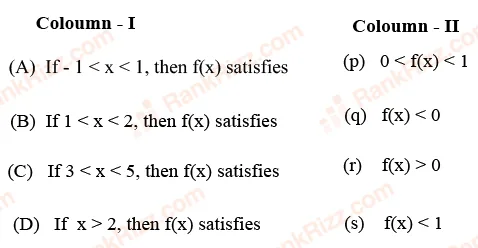
Let f(x)=x2−6x+5x2−5x+6f(x) = \frac{x^2 - 6x + 5}{x^2 - 5x + 6}.
Match the expressions/statements in Column I with expressions/statements in Column II and indicate your answer by darkening the appropriate bubbles in the 4×44 \times 4 matrix given in the ORS.

Figure for JEE Advanced 2007 Mathematics question on Rational and polynomial inequalities
Q65Properties and simplification of inverse trigonometric functions

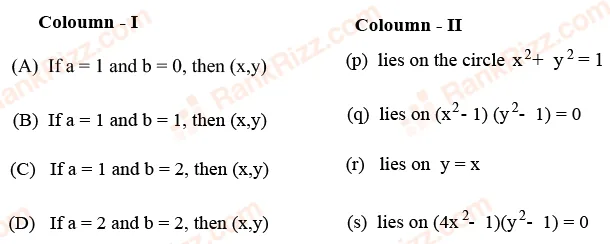
Let (x, y) be such that sin⁡−1(ax)+cos⁡−1(y)+cos⁡−1(bxy)=π2.\sin^{-1}(ax) + \cos^{-1}(y) + \cos^{-1}(bxy) = \frac{\pi}{2}.
Match the statements in Column I with statements in Column II and indicate your answer by darkening the appropriate bubbles in the 4×44 \times 4 matrix given in the ORS.

Figure for JEE Advanced 2007 Mathematics question on Properties and simplification of inverse trigonometric functions
Q66Equation of a circle in various forms

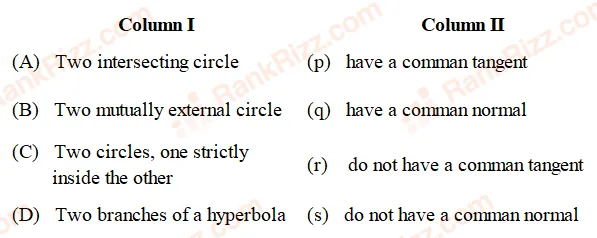
Match the statements in Column I with the properties in Column II and indicate your answer by darkening the appropriate bubbles in the 4×44 \times 4 matrix given in the ORS.

Figure for JEE Advanced 2007 Mathematics question on Equation of a circle in various forms