RankRizz

JEE Advanced 2007 Paper 2 Question Paper

All 66 questions of JEE Advanced 2007 Paper 2, in the order they were asked, one subject to a page. Pick an answer on any question to check it against the key. Free to read, nothing to download.

Questions

66

Physics · Chemistry · Maths

Answer key

66

questions with a checked key

Price

Free

no sign-up

Physics

Q1Progressive waves: wave equation, phase and intensity

In the experiment to determine the speed of sound using a resonance column,

  1. A

    prongs of the tuning fork are kept in a vertical plane

  2. B

    prongs of the tuning fork are kept in a horizontal plane

  3. C

    in one of the two resonances observed, the length of the resonating air columnis close to the wave length of sound in air

  4. D

    in one of the two resonances observed, the length of the resonating air column is close to half of the wave length of sound in air
Q2Errors in measurement and significant figures

A student performs an experiment to determine the Young’s modulus of a wire, exactly 2 m long, by Searle’s method. In a particular reading, the student measures the extension in the length of the wire to be 0.8 mm with an uncertainty of ±0.05\pm 0.05 mm at load of exactly 1.0 kg. The student also measures the diameter of the wire to be 0.4 mm with an uncertainty of ±0.01\pm 0.01 mm. Take g = 9.8 m/s2^2 (exact). The Young’s modulus obtained from the reading is

  1. A

    (2.0±0.3)×1011N/m2(2.0 \pm 0.3) \times 10^{11} N/m^2

  2. B

    (2.0±0.2)×1011N/m2(2.0 \pm 0.2) \times 10^{11} N/m^2

  3. C

    (2.0±0.1)×1011N/m2(2.0 \pm 0.1) \times 10^{11} N/m^2

  4. D

    (2.0±0.05)×1011N/m2(2.0 \pm 0.05) \times 10^{11} N/m^2

Q3Newton's laws, free-body diagrams and equilibrium of a particle

A particle moves in the X-Y plane underthe influence of a force such that its linear momentum is p→(t)=A[i^cos⁡(kt)−j^sin⁡(kt)]\overrightarrow{p}(t) = A\left[\hat{i} \cos (kt) - \hat{j} \sin (kt)\right], where A and k are constants. The angle between the force and the momentum is

  1. A

    0∘0^\circ

  2. B

    30∘30^\circ

  3. C

    45∘45^\circ

  4. D

    90∘90^\circ

Q4Rolling with friction, slipping and impulsive forces

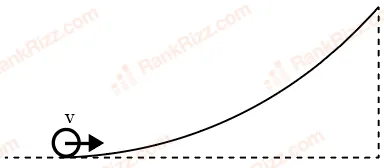
A small object of uniform density rolls up a curved surface with an initial velocity v. It reaches up to a maximum height of 3v24g\frac{3v^2}{4g} with respect to the initial position. The object is

Figure for JEE Advanced 2007 Physics question on Rolling with friction, slipping and impulsive forces
  1. A

    ring

  2. B

    solid sphere

  3. C

    hollow sphere

  4. D

    disc

Q5Surface tension and surface energy

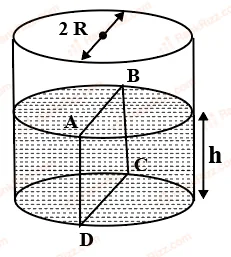
Water is filled up to a height h in a beaker of radius R as shown in the figure. The density of water is ρ\rho, the surface tension of water is T and the atmospheric pressure is P0P_0. Consider a vertical section ABCD of the water column through a diameter of the beaker. The force on water on one side of this section by water on the other side of this section has magnitude.

Figure for JEE Advanced 2007 Physics question on Surface tension and surface energy
  1. A

    ∣2P0Rh+πR2ρgh−2RT∣\mid 2P_0Rh + \pi R^2 \rho gh - 2RT \mid

  2. B

    ∣2P0Rh+Rρgh2−2RT∣\mid 2P_0Rh + R \rho gh^2 - 2RT \mid

  3. C

    ∣P0πR2+Rρgh2−2RT∣\mid P_0 \pi R^2 + R \rho gh^2 - 2RT \mid

  4. D

    ∣P0πR2+Rρgh2+2RT∣\mid P_0 \pi R^2 + R \rho gh^2 + 2RT \mid

Q6Electric flux and Gauss's law

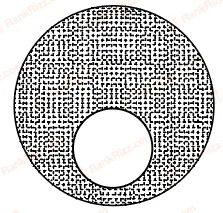
A spherical portion has been removed from a solid sphere having a charge distributed uniformly in its volume as showing the figure. The electric field inside the emptied space is

Figure for JEE Advanced 2007 Physics question on Electric flux and Gauss's law
  1. A

    zero everywhere

  2. B

    non-zero and uniform

  3. C

    non-uniform

  4. D

    zero only at its center

Q7Relation between field and potential, equipotential surfaces

Positive and negative point charges of equal magnitude are kept at (0,0,a2)\left(0, 0, \frac{a}{2}\right) and (0,0,−a2)\left(0, 0, \frac{-a}{2}\right), respectively. The work done by the electric field when another positive point charge is moved from (-a, 0, 0) to (0, a, 0) is

  1. A

    positive

  2. B

    negative

  3. C

    zero

  4. D

    depends on the path connecting the initial and final positions

Q8Calculus, graphs and approximations used in physics

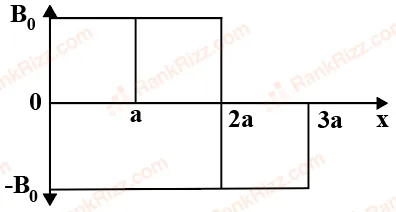
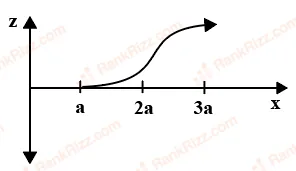
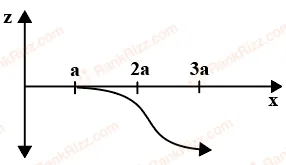
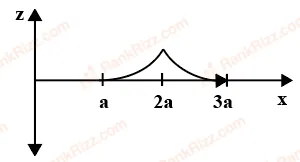
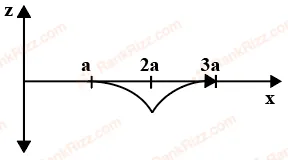
A magnetic field B→=B0j^\overrightarrow{B} = B_0\hat{j} exists in the region a < x < 2a and B→=−B0j^\overrightarrow{B} = -B_0 \hat{j}, in the region 2a < x < 3a, where B0B_0 is a positive constant. A positive point charge moving with a velocity v→=v0i^\overrightarrow{v} = v_0 \hat{i}, where v0v_0 is a positive constant, enters the magnetic field at x = a. The trajectory of the charge in this region can be like,

Figure for JEE Advanced 2007 Physics question on Calculus, graphs and approximations used in physics
  1. A
    Figure for JEE Advanced 2007 Physics question on Calculus, graphs and approximations used in physics
  2. B
    Figure for JEE Advanced 2007 Physics question on Calculus, graphs and approximations used in physics
  3. C
    Figure for JEE Advanced 2007 Physics question on Calculus, graphs and approximations used in physics
  4. D
    Figure for JEE Advanced 2007 Physics question on Calculus, graphs and approximations used in physics
Q9de Broglie wavelength of matter waves

Electrons with de-Broglie wave length λ\lambda fall on the target in an X-ray tube. The cut-off wavelength of the emitted X-rays is

  1. A

    λ0=2mcλ2h\lambda_0 = \frac{2mc \lambda^2}{h}

  2. B

    λ0=2hmc\lambda_0 = \frac{2h}{mc}

  3. C

    λ0=2m2c2λ3h2\lambda_0 = \frac{2 m^2 c^2 \lambda^3}{h^2}

  4. D

    λ0=λ\lambda_0 = \lambda

Q10Equilibrium of rigid bodies and toppling

STATEMENT-1
If there is no external torque on a body aboutits center of mass, then the velocity of the center of mass remains constant.
because
STATEMENT-2
The linear momentum of an isolated system remains constant.

  1. A

    Statement-1 is True, Statement-2 is True; Statement-2 is a correct explanation for Statement-1

  2. B

    Statement-1 is True, Statement-2 is True; Statement-2 is NOT a correct explanation for Statement-1

  3. C

    Statement-1 is True, Statement-2 is False

  4. D

    Statement-1 is False, Statement-2 is True

Q11Newton's laws, free-body diagrams and equilibrium of a particle

STATEMENT-1
A cloth covers a table. Some dishes are kept on it. The cloth can be pulled out without dislodging the dishes from thetable.
because
STATEMENT-2
For every action there is an equal and opposite reaction.

  1. A

    Statement-1 is True, Statement-2 is True; Statement-2 is a correct explanation for Statement-1

  2. B

    Statement-1 is True, Statement-2 is True; Statement-2 is NOT a correct explanation for Statement-1

  3. C

    Statement-1 is True, Statement-2 is False

  4. D

    Statement-1 is False, Statement-2 is True

Q12AC basics: rms and average values, phasors

STATEMENT-1
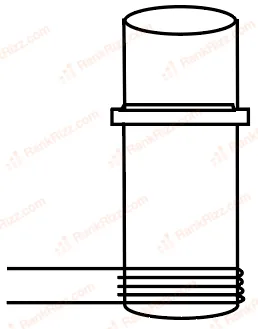
A vertical iron rod has a coil of wire wound over it at the bottom end. An alternating current flows in the coil. The rod goes through a conducting ring as showing the figure. The ring can float at a certain height above the coil.
because
STATEMENT-2
In the above situation, a current is induced in the ring which interacts with the horizontal component of the magnetic field to produce an average force in the upward direction.

Figure for JEE Advanced 2007 Physics question on AC basics: rms and average values, phasors
  1. A

    Statement-1 is True, Statement-2 is True; Statement-2 is a correct explanation for Statement-1

  2. B

    Statement-1 is True, Statement-2 is True; Statement-2 is NOT a correct explanation for Statement-1

  3. C

    Statement-1 is True, Statement-2 is False

  4. D

    Statement-1 is False, Statement-2 is True

Q13Ideal gas equation and gas laws

STATEMENT-1
The total translational kinetic energy of all the molecules of a given massof an ideal gas is 1.5 times the product of its pressure and its volume.
because
STATEMENT-2
The molecules of a gas collide with each other and the velocities of the molecules change dueto thecollision.

  1. A

    Statement-1 is True, Statement-2 is True; Statement-2 is a correct explanation for Statement-1

  2. B

    Statement-1 is True, Statement-2 is True; Statement-2 is NOT a correct explanation for Statement-1

  3. C

    Statement-1 is True, Statement-2 is False

  4. D

    Statement-1 is False, Statement-2 is True

Q14Doppler effect in sound

The speed of sound of the whistle is

  1. A

    340 m/s for passengers in A and 310 m/s for passengers in B

  2. B

    360 m/s for passengers in A and 310 m/s for passengers in B

  3. C

    310 m/s for passengers in A and 360 m/s for passengers in B

  4. D

    340 m/s for passengersin both the trains

Q15Doppler effect in sound

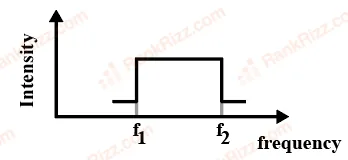
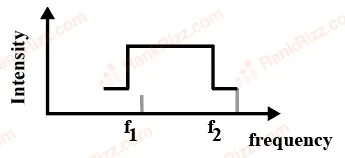
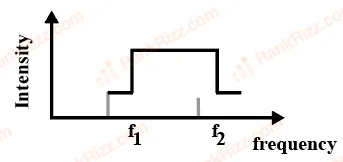
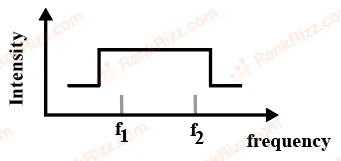
The distribution of the sound intensity of the whistle as observed by the passengers in train A is best represented by

  1. A
    Figure for JEE Advanced 2007 Physics question on Doppler effect in sound
  2. B
    Figure for JEE Advanced 2007 Physics question on Doppler effect in sound
  3. C
    Figure for JEE Advanced 2007 Physics question on Doppler effect in sound
  4. D
    Figure for JEE Advanced 2007 Physics question on Doppler effect in sound
Q16Doppler effect in sound

The spread of frequency as observed by the passengersin train B is

  1. A

    310 Hz

  2. B

    330 Hz

  3. C

    350 Hz

  4. D

    290 Hz

Q17Young's double slit experiment: fringe width and intensity

Light travels as a

  1. A

    parallel beam in each medium

  2. B

    convergent beam in each medium

  3. C

    divergent beam in each medium

  4. D

    divergent beam in one medium and convergent beam in the other medium

Q18Young's double slit experiment: fringe width and intensity

The phases of the light wave at c, d, e and f are ϕC,ϕd,ϕe\phi_C, \phi_d, \phi_e and ϕf\phi_f respectively. It is given that ϕc≠ϕf\phi_c \neq \phi_f.

  1. A

    ϕc\phi_c cannot be equal to ϕd\phi_d

  2. B

    ϕd\phi_d can be equal to ϕe\phi_e

  3. C

    (ϕd−ϕf)(\phi_d - \phi_f) is equal to (ϕc−ϕe)(\phi_c - \phi_e)

  4. D

    (ϕd−ϕc)(\phi_d - \phi_c) is not equal to (ϕf−ϕe)(\phi_f - \phi_e)

Q19Young's double slit experiment: fringe width and intensity

Speed of light is

  1. A

    the same in medium-1 and medium-2

  2. B

    larger in medium-1 than in medium-2

  3. C

    larger in medium-2 than in medium-1

  4. D

    different at b and d

Q20Calculus, graphs and approximations used in physics

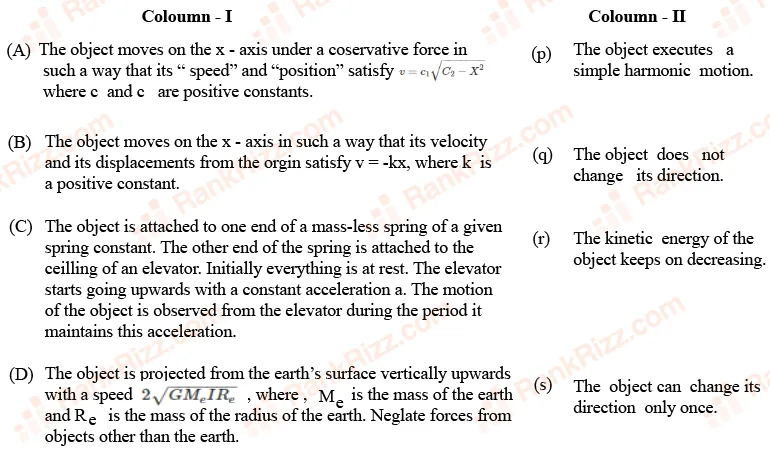
Column I describes some situations in which a small object moves. Column II describes some characteristics of these motions. Match the situations in Column I with the characteristics in Column II and indicate your answer by darkening appropriate bubbles in the 4×44 \times 4 matrix given in the ORS.

Figure for JEE Advanced 2007 Physics question on Calculus, graphs and approximations used in physics
Q21Magnetic field of circular loops, arcs and coils

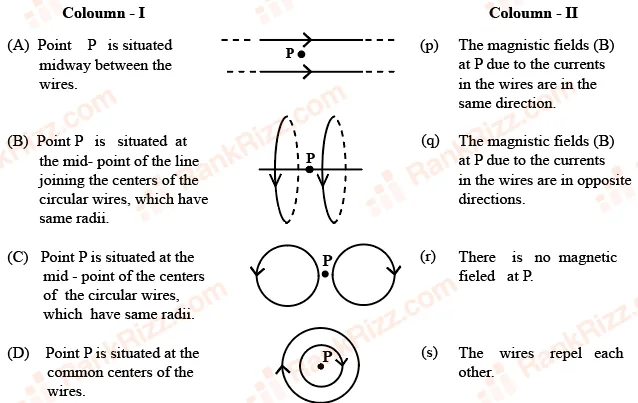
Two wires each carrying a steady current J are shown in four configurations in Column I. Some of the resulting effects are described in Column II. Match the statements in Column I with the statements in Column II and indicate your answer by darkening appropriate bubbles in the 4×44 \times 4 matrix given in the ORS.

Figure for JEE Advanced 2007 Physics question on Magnetic field of circular loops, arcs and coils
Q22Temperature scales and thermal expansion

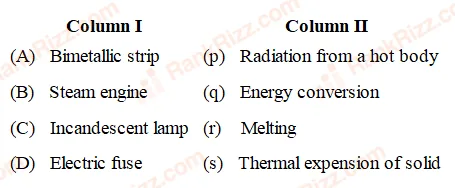
Column I gives some devices and Column II gives some processes on which the functioning of these devices depend. Match the devices in Column I with the processes in Column II and indicate your answer by darkening appropriate bubbles in the 4×44 \times 4 matrix given in the ORS.

Figure for JEE Advanced 2007 Physics question on Temperature scales and thermal expansion
NEXT IN THIS PAPER →Chemistry, Q23 onwards