RankRizz

JEE Advanced 2007 Paper 1 Question Paper

All 66 questions of JEE Advanced 2007 Paper 1, in the order they were asked, one subject to a page. Pick an answer on any question to check it against the key. Free to read, nothing to download.

Questions

66

Physics · Chemistry · Maths

Answer key

66

questions with a checked key

Price

Free

no sign-up

Physics

Q1Meter bridge

A resistance of 2 Ω is connected across one gap of a metre-bridge (the length of the wire is 100 cm) and an unknown resistance, greater than 2 Ω, is connected across the other gap. When these resistances are interchanged, the balance point shifts by 20 cm. Neglecting any corrections, the unknown resistance is

  1. A

    3 Ω

  2. B

    4 Ω

  3. C

    5 Ω

  4. D

    6 Ω

Q2Reflection and plane mirrors

In an experiment to determine the focal length (f) of a concave mirror by the u-v method, a student places the object pin A on the principal axis at a distance x from the pole P. The student looks at the pin and its inverted image from a distance keeping his/her eye in line with PA. When the student shifts his/her eye towards left, the image appears to the right of the object pin. Then,

  1. A

    x < f

  2. B

    f < x < 2f

  3. C

    x = 2f

  4. D

    x > 2f

Q3Connected bodies, pulleys and constraint relations

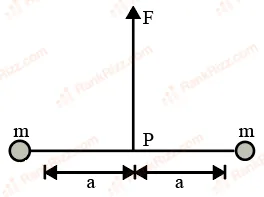
Two particles of mass m each are tied at the ends of a light string of length 2a. The whole system is kept on a frictionless horizontal surface with the string held tight so that each mass is at a distance ‘a’ from the center P (as shown in the figure). Now, the mid-point of the string is pulled vertically upwards with a small but constant force F. As a result, the particles move towards each other on the surface. The magnitude of acceleration, when the separation between them becomes 2x, is

Figure for JEE Advanced 2007 Physics question on Connected bodies, pulleys and constraint relations
  1. A

    F2maa2−x2\frac{F}{2m}\frac{a}{\sqrt{a^2 - x^2}}

  2. B

    F2mxa2−x2\frac{F}{2m}\frac{x}{\sqrt{a^2 - x^2}}

  3. C

    F2mxa\frac{F}{2m}\frac{x}{a}

  4. D

    F2ma2−x2x\frac{F}{2m}\frac{\sqrt{a^2 - x^2}}{x}

Q4Electric flux and Gauss's law

A long, hollow conducting cylinder is kept coaxially inside another long, hollow conducting cylinder of larger radius. Both the cylinders are initially electrically neutral.

  1. A

    A potential difference appears between the two cylinders when a charge density is given to the inner cylinder

  2. B

    A potential difference appears between the two cylinders when a charge density is given to the outer cylinder

  3. C

    No potential difference appears between the two cylinders when a uniform line charge is kept along the axis of the cylinders

  4. D

    No potential difference appears between the two cylinders when same charge density is given to both the cylinders

Q5Electric flux and Gauss's law

Consider a neutral conducting sphere. A positive point charge is placed outside the sphere. The net charge on the sphere is then,

  1. A

    negative and distributed uniformly over the surface of the sphere

  2. B

    negative and appears only at the pointon the sphere closest to the point charge

  3. C

    negative and distributed non-uniformly over the entire surface of the sphere

  4. D

    zero

Q6RC circuits: charging and discharging

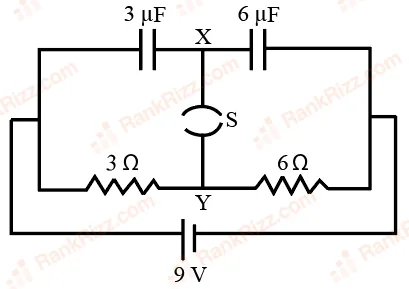
A circuit is connected as shown in the figure with the switch S open. When the switch is closed, the total amount of charge that flows from Y to X is 

Figure for JEE Advanced 2007 Physics question on RC circuits: charging and discharging
  1. A

    0

  2. B

    54 μ\mu C

  3. C

    27 μ\mu C

  4. D

    81 μ\mu C

Q7Prism: deviation and dispersion

A ray of light traveling in wateris incident on its surface open to air. The angle of incidence is θ\theta, which is less than the critical angle. Then there will be

  1. A

    only reflected ray and no refracted ray

  2. B

    only a refracted ray and no reflected ray

  3. C

    a reflected ray and a refracted ray and the angle between them would be less than 180∘−2θ180^\circ - 2\theta

  4. D

    a reflected ray and a refracted ray and the angle between them would be greater than 180∘−2θ180^\circ - 2\theta

Q8Nuclear fission, fusion and Q-value

In the options given below, let E denote the rest mass energy of a nucleus and n aneutron. The correct option is

  1. A

    E(92236U)>E(53137I)+E(3997Y)+2E(n)E\left(_{92}^{236}U\right) > E\left(_{53}^{137}I\right) + E\left(_{39}^{97}Y\right) + 2E(n)

  2. B

    E(92236U)<E(53137I)+E(3997Y)+2E(n)E\left(_{92}^{236}U\right) < E\left(_{53}^{137}I\right) + E\left(_{39}^{97}Y\right) + 2E(n)

  3. C

    E(92236U)<E(56140Ba)+E(3694Kr)+2E(n)E\left(_{92}^{236}U\right) < E\left(_{56}^{140}Ba\right) + E\left(_{36}^{94}Kr\right) + 2E(n)

  4. D

    E(92236U)=E(56140Ba)+E(3694Kr)+2E(n)E\left(_{92}^{236}U\right) = E\left(_{56}^{140}Ba\right) + E\left(_{36}^{94}Kr\right) + 2E(n)

Q9Hydrogen spectrum and spectral series

The largest wavelength in the ultraviolet region of the hydrogen spectrum is 122 nm. The smallest wavelength in the infrared region of the hydrogen spectrum (to the nearest integer) is

  1. A

    802 nm

  2. B

    823 nm

  3. C

    1882 nm

  4. D

    1648 nm

Q10Work done by constant and variable forces

STATEMENT-1
A block of mass m starts moving on a rough horizontal surface with a velocity v. It stops due to friction between the block and the surface after moving through a certain distance. The surface is now tilted to an angle of 30∘30^\circ with the horizontal and the same block is made to go up on the surface with the same initial velocity v. The decrease in the mechanical energy in the second situation is smaller than thatin thefirst situation.
because
STATEMENT-2
The coefficient of friction between the block and the surface decreases with the increase in the angle of inclination.

  1. A

    Statement-1 is True, Statement-2 is True; Statement-2 is a correct explanation for Statement-1

  2. B

    Statement-1 is True, Statement-2 is True; Statement-2 is NOT a correct explanation for Statement-1

  3. C

    Statement-1 is True, Statement-2 is False

  4. D

    Statement-1 is False, Statement-2 is True

Q11Motion of centre of mass, momentum conservation and explosions

STATEMENT-1
In an elastic collision between two bodies, the relative speed of the bodies after collision is equal to the relative speed before the collision.
because
STATEMENT-2
In anelastic collision, the linear momentum of the system is conserved.

  1. A

    Statement-1 is True, Statement-2 is True; Statement-2 is a correct explanation for Statement-1

  2. B

    Statement-1 is True, Statement-2 is True; Statement-2 is NOT a correct explanation for Statement-1

  3. C

    Statement-1 is True, Statement-2 is False

  4. D

    Statement-1 is False, Statement-2 is True

Q12Reflection and plane mirrors

STATEMENT-1
The formula connecting u, v and f for a spherical mirror is valid only for mirrors whosesizes are very small compared to their radii of curvature.
because
STATEMENT-2
Lawsof reflection are strictly valid for plane surfaces, but not for large spherical surfaces.

  1. A

    Statement-1 is True, Statement-2 is True; Statement-2 is a correct explanation for Statement-1

  2. B

    Statement-1 is True, Statement-2 is True; Statement-2 is NOT a correct explanation for Statement-1

  3. C

    Statement-1 is True, Statement-2 is False

  4. D

    Statement-1 is False, Statement-2 is True

Q13Photoelectric effect and Einstein's equation

STATEMENT-1
If the accelerating potential in an X-ray tube is increased, the wavelengths of the characteristic X-rays do not change.
because
STATEMENT-2
Whenanelectron beam strikes the target in an X-ray tube, part of the kinetic energy is converted into X-ray energy.

  1. A

    Statement-1 is True, Statement-2 is True; Statement-2 is a correct explanation for Statement-1

  2. B

    Statement-1 is True, Statement-2 is True; Statement-2 is NOT a correct explanation for Statement-1

  3. C

    Statement-1 is True, Statement-2 is False

  4. D

    Statement-1 is False, Statement-2 is True

Q14Rolling with friction, slipping and impulsive forces

The ratio x1x2\frac{x_1}{x_2} is

  1. A

    2

  2. B

    12\frac{1}{2}

  3. C

    2\sqrt{2}

  4. D

    12\frac{1}{\sqrt{2}}

Q15Angular momentum of particles and rigid bodies

When disc B is brought in contact with disc A, they acquire a common angular velocity in time t. The averagefrictional torque on one disc by the other during this period is

  1. A

    2Iω3t\frac{2 I \omega}{3t}

  2. B

    9Iω2t\frac{9 I \omega}{2t}

  3. C

    9Iω4t\frac{9 I \omega}{4t}

  4. D

    3Iω2t\frac{3 I \omega}{2t}

Q16Calculus, graphs and approximations used in physics

The loss of kinetic energy during the above process is

  1. A

    Iω22\frac{I \omega^2}{2}

  2. B

    Iω23\frac{I \omega^2}{3}

  3. C

    Iω24\frac{I \omega^2}{4}

  4. D

    Iω26\frac{I \omega^2}{6}

Q17Ideal gas equation and gas laws

The piston is now pulled out slowly and held at a distance 2L from the top. The pressure in the cylinder between its top and the piston will then be

  1. A

    P0P_0

  2. B

    P02\frac{P_0}{2}

  3. C

    P02+MgπR2\frac{P_0}{2} + \frac{Mg}{\pi R^2}

  4. D

    P02−MgπR2\frac{P_0}{2} - \frac{Mg}{\pi R^2}

Q18Ideal gas equation and gas laws

While the piston is at a distance 2L from the top, the hole at the top is sealed. The piston is then released, to a position where it can stay in equilibrium. In this condition, the distance of the piston from the top is

  1. A

    (2P0πR2πR2P0+Mg)(2L)\left(\frac{2P_0\pi R^2}{\pi R^2 P_0 + Mg}\right)(2L)

  2. B

    (P0πR2−MgπR2P0)(2L)\left(\frac{P_0\pi R^2 - Mg}{\pi R^2 P_0}\right)(2L)

  3. C

    (P0πR2+MgπR2P0)(2L)\left(\frac{P_0\pi R^2 + Mg}{\pi R^2 P_0}\right)(2L)

  4. D

    (P0πR2πR2P0−Mg)(2L)\left(\frac{P_0\pi R^2}{\pi R^2 P_0 - Mg}\right)(2L)

Q19Multi-step processes and gas-piston-spring systems

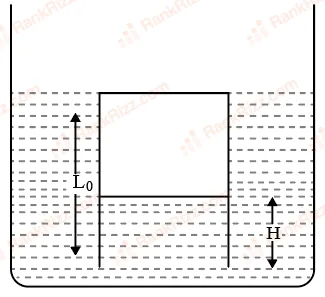
The piston is taken completely out of the cylinder. The hole at the top is sealed. A water tank is brought below the cylinder and put in a position so that the water surface in the tank is at the same level as the top of the cylinder as shown in the figure. The density of the water is ρ\rho. In equilibrium, the height H of the water column in the cylinder satisfies 

Figure for JEE Advanced 2007 Physics question on Multi-step processes and gas-piston-spring systems
  1. A

    ρg(L0−H)2+P0(L0−H)+L0P0=0\rho g(L_0 - H)^2 + P_0(L_0 - H) + L_0P_0 = 0

  2. B

    ρg(L0−H)2−P0(L0−H)−L0P0=0\rho g(L_0 - H)^2 - P_0(L_0 - H) - L_0P_0 = 0

  3. C

    ρg(L0−H)2+P0(L0−H)−L0P0=0\rho g(L_0 - H)^2 + P_0(L_0 - H) - L_0P_0 = 0

  4. D

    ρg(L0−H)2−P0(L0−H)+L0P0=0\rho g(L_0 - H)^2 - P_0(L_0 - H) + L_0P_0 = 0

Q20Kepler's laws and planetary motion

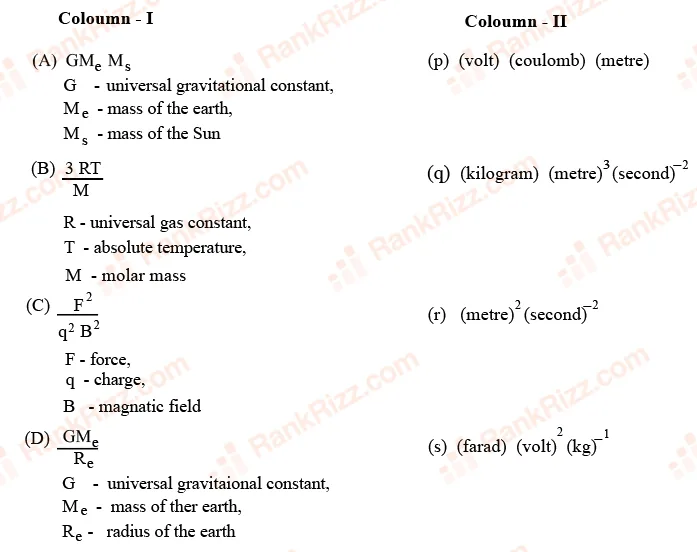
Some physical quantities are given in Column I and some possible SI units in which these quantities may be expressed are given in Column II. Match the physical quantities in Column I with the units in Column II and indicate your answer by darkening appropriate bubbles in the 4×44 \times 4 matrix given in the ORS.

Figure for JEE Advanced 2007 Physics question on Kepler's laws and planetary motion
Q21Electric power and heating effect of current

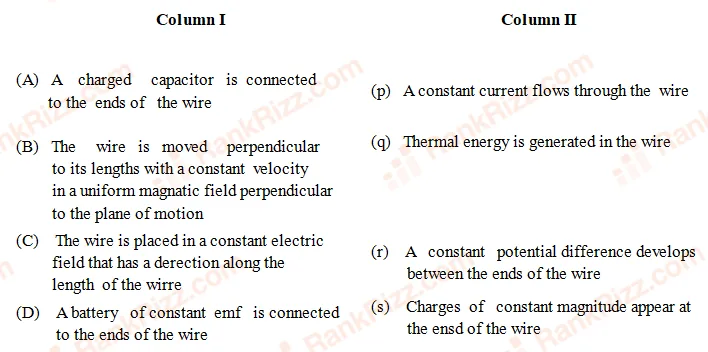
Column I gives certain situations in which a straight metallic wire of resistance R is used and Column II gives some resulting effects. Match the statements in Column I with the statements in Column II and indicate your answer by darkening appropriate bubbles in the 4×44 \times 4 matrix given in the ORS.

Figure for JEE Advanced 2007 Physics question on Electric power and heating effect of current
Q22Photoelectric effect and Einstein's equation

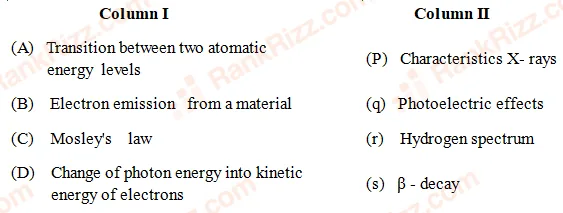
Some laws / processes are given in Column I. Match these with the physical phenomena given in Column II and indicate your answer by darkening appropriate bubbles in the 4×44 \times 4 matrix given in the ORS.

Figure for JEE Advanced 2007 Physics question on Photoelectric effect and Einstein's equation
NEXT IN THIS PAPER →Chemistry, Q23 onwards